Quick Take
- Narration: Luke Daniels brings his characteristic energy to a 54-minute runtime, making the comic-book-style lessons feel lively rather than rushed.
- Themes: Financial literacy for young listeners, assets versus liabilities, the Monopoly framework
- Mood: Encouraging and accessible, aimed squarely at young teenagers and pre-teens
- Verdict: A well-crafted introduction to Kiyosaki’s core ideas for young readers, though the brevity and illustrated format mean it functions more as a conversation starter than a complete financial education.
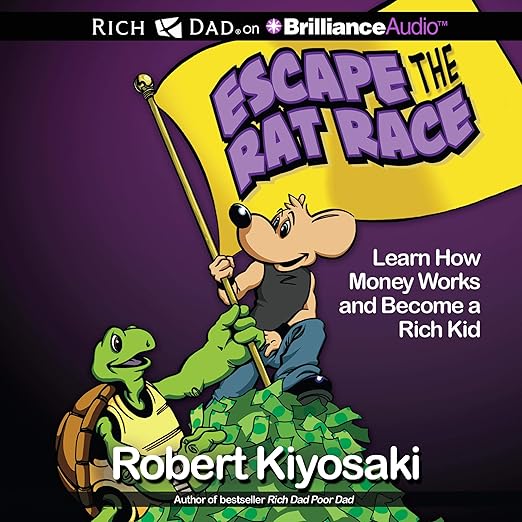
I want to be upfront about something before going further: at 54 minutes, Escape the Rat Race is not a book in the conventional sense that most audiobook listeners expect. It is the audio adaptation of a graphic novel designed for children and young teenagers, and the listening experience reflects that origin. If you are approaching this as an adult hoping to absorb Kiyosaki’s financial philosophy efficiently, you would be better served by the original Rich Dad Poor Dad. But if you are a parent looking for an accessible entry point for a child between eight and fourteen, this one does what it sets out to do with genuine skill.
I listened to this one on a short drive with a ten-year-old, which is probably close to the ideal context. Luke Daniels narrates with an energy calibrated to a young audience, brisk without being frenetic, clear without being condescending. The framework, derived from Monopoly as a teaching metaphor, clicked for my passenger in a way that abstract discussions of saving and investing typically do not. That is not nothing. When a child starts asking questions about where the rent money goes in a board game, you are having a different conversation than you were five minutes earlier.
The Monopoly Metaphor and Why Kiyosaki Uses It
Kiyosaki’s origin story in this short book is the same one he tells in the adult version of Rich Dad Poor Dad: learning about money through Monopoly at age nine, under the guidance of his friend’s wealthy father. The graphic novel format makes this founding anecdote more immediate and visual, and the Monopoly framework, buy four green houses, trade for a red hotel, collect rent rather than wage income, is genuinely pedagogically useful for young people who have played the game.
The core lessons, work to learn rather than to earn, understand the difference between assets and liabilities, make money work for you rather than working for money, are compressed versions of what Kiyosaki develops at much greater length in the adult books. The compression is appropriate for the audience, but it means that listeners who want depth will need to follow up with more substantial material. One reviewer who bought this for grandchildren noted that adults could use it too, and that the illustrations added a level of relevancy that could make the difference even for an older learner coming to financial concepts late.
What Luke Daniels Does in Under an Hour
Daniels is one of the busiest narrators in the business, known for his work on fantasy series and thrillers that require him to sustain dozens of distinct voices over many hours. Here he is working in a compressed format with a single narrative voice, and he adjusts accordingly. The energy level is calibrated higher than his thriller work, which suits the visual, kinetic quality of the source material.
Several reviewers’ children responded positively to the narration specifically, which is meaningful. Children are less forgiving of condescension in narration than adults are, and Daniels avoids the common trap of reading down to a young audience. He treats the material as genuinely interesting rather than simply appropriate, which is the right approach for a subject that adults often unintentionally make boring by treating it as instruction rather than discovery.
The Honest Assessment of Its Limitations
A reviewer whose children were ten and eleven found this slightly young for their ages, and who ultimately preferred the full Rich Dad Poor Dad audiobook for them, is pointing at something real. The comic-book format and the simplified Monopoly framework work best for children in the roughly eight to twelve range, and older children who have any prior exposure to financial concepts may find it thin.
Kiyosaki’s broader philosophy has attracted significant criticism over the years, from financial professionals who take issue with his specific investment advice and from journalists who have questioned the factual basis of his origin stories. None of this is present in Escape the Rat Race, which operates entirely at the level of financial principle rather than specific recommendation. The principles it teaches, the importance of financial education, the distinction between assets and liabilities, the value of understanding how money works, are broadly defensible starting points regardless of your position on Kiyosaki’s more contested adult advice.
Who This Works For and Who Should Look Elsewhere
Parents and grandparents looking for something to stimulate a first conversation about money with a child between eight and twelve will find this well-suited to that purpose. The Monopoly anchor gives the conversation a shared framework that makes follow-up discussion easier. Reviewers who used it alongside the Dave Ramsey children’s books found it a useful second step, introducing investment thinking after the Ramsey material had established basic financial discipline.
Adults who have not read Rich Dad Poor Dad and are curious about Kiyosaki’s ideas should start with the original. This short-form version is genuinely designed for children, and the adult listener will find it too abbreviated to be satisfying on its own terms. At 54 minutes it is a commitment so brief that the main question is whether you are using it for its intended purpose. The value of this format is not in the depth it achieves but in the conversations it opens. A child who finishes this one asking why working harder does not always mean earning more has already started thinking in ways that most adults take decades to arrive at.
Frequently Asked Questions
What age range is Rich Dad’s Escape the Rat Race actually designed for?
The book is designed as a graphic novel for children and young teenagers, with a target range that most reviewers placed between roughly eight and thirteen years old. Parents of ten and eleven year olds noted that some children found it slightly young, while others found it perfectly engaging. It is probably most effective for the eight to twelve range, before financial concepts become more abstract and complex.
Is this a summary of Rich Dad Poor Dad, or does it tell a different story?
It draws on the same foundational story and core principles as Rich Dad Poor Dad, specifically Kiyosaki’s account of learning about money through Monopoly as a child, but it is presented as an illustrated children’s narrative rather than a condensed version of the adult book. The principles are similar but the format, depth, and intended audience are quite different.
At only 54 minutes, is this worth purchasing as an audiobook?
Whether it is worth purchasing depends on your purpose. As a tool for sparking financial conversations with a child in the eight to twelve range, multiple reviewers found it genuinely useful. As a standalone financial education for an adult, it is too brief and simplified to stand on its own. The audiobook is available free with an Audible subscription, which removes the cost consideration entirely.
How does Luke Daniels’s narration compare to the audiobook version of Rich Dad Poor Dad?
Rich Dad Poor Dad uses a different narrator. Daniels brings his characteristic energy to the child-oriented material here, calibrating his delivery to a younger audience without condescending to them. Children who have heard him on fantasy series will recognize the voice, but his performance here is adjusted for a different register entirely.