Quick Take
- Narration: Dan Levy reads with a calm, reassuring tone that suits the subject matter well, avoiding both clinical detachment and patronizing cheerfulness.
- Themes: teen anxiety management, cognitive reframing, trauma identification
- Mood: Accessible and encouraging without being saccharine
- Verdict: A practical, jargon-free resource for teens and the adults in their lives who want concrete tools for managing anxiety rather than abstract reassurance.
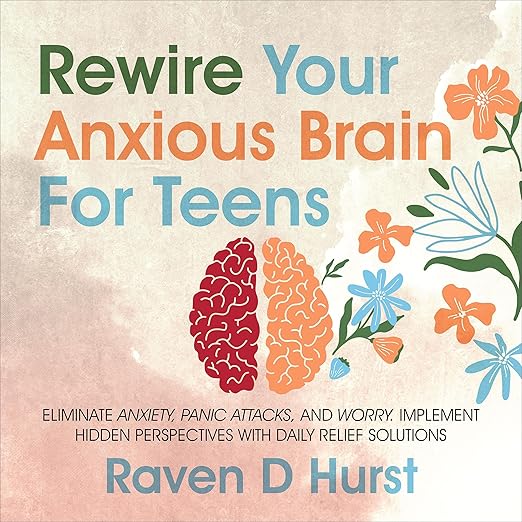
A friend texted me last spring asking if I knew any audiobooks about teen anxiety that her fifteen-year-old daughter might actually listen to willingly. Not textbooks, not clinical guides aimed at therapists or parents, but something that would speak directly to a teenager going through a hard stretch. I did not have an answer then. After spending time with Raven D. Hurst’s Rewire Your Anxious Brain for Teens, narrated by Dan Levy, I do now.
This is a short audiobook at just over three hours, and that brevity is a feature rather than a limitation. Hurst, a licensed therapist, has made clear structural choices: write in accessible language, use metaphors teenagers can actually hold onto, and do not bury the practical advice under layers of theoretical framing. The result is a book that feels less like a clinical intervention and more like a thoughtful conversation.
Our Take on Rewire Your Anxious Brain for Teens
The central metaphor Hurst employs, that of the mental prison, comes up across multiple reviewer responses as the thing that made the material click. One reviewer describes it as helping readers clearly understand the impact of anxiety in a way that defines what sometimes cannot be put into words, especially by a teenager. That is the precise gap this book is trying to close: the space between experiencing anxiety and being able to name and locate it well enough to do something about it.
Hurst covers the basics efficiently: what anxiety is, why it manifests as panic attacks or persistent worry, how to identify the difference between situational stress and something more structural. There is a section on identifying trauma that several reviewers flag as particularly useful. The language throughout avoids psychological jargon, which is a deliberate and important choice for a teen audience that will disengage the moment a book starts to feel like homework.
Why Listen to Rewire Your Anxious Brain for Teens
Dan Levy’s narration is a significant part of what makes this work in audio format. He reads at a measured pace that does not condescend, and his tone carries a kind of steady groundedness that models the very calmness the book is trying to teach. For an anxious listener, the quality of a narrator’s voice is not a trivial concern. Levy sounds like someone who has thought about these things carefully, not like someone performing concern.
Multiple reviewers note that despite the title, the techniques here apply to adults as well. One reviewer describes it as a great book of anxiety solutions for people of all ages. That is accurate, and parents who pick this up intending to give it to a teenager may find themselves underlining passages meant ostensibly for someone thirty years younger. The basics of observing your own mental state, identifying the sources of anxiety, and building daily practices to interrupt the worry loop are not age-specific.
What to Watch For in Hurst’s Framework
The book’s framing of anxiety as a part of life that can be managed rather than a condition to be eliminated is worth noting. This is a philosophically significant choice. Hurst is not promising to remove anxiety; she is promising to change the listener’s relationship to it. For teens who have been sold the idea that the goal is to feel nothing difficult, this reframe can itself be the most useful thing in the book.
The section on trauma identification is handled carefully. Hurst does not diagnose or prescribe, but she creates a framework for recognizing patterns that might have roots in past experience rather than present circumstances. One reviewer whose teenager had been paralyzed by anxiety for months describes the book as giving her concrete techniques and exercises to do as she recovers. That language, recovers rather than cures, captures the book’s tone exactly.
Who Should Listen to Rewire Your Anxious Brain for Teens
Teens aged thirteen to eighteen who are experiencing anxiety, panic, or persistent worry and want a resource they can engage with independently will find this genuinely useful. Parents and caregivers looking for a shared listening experience or a way to open conversations about mental health with a teenager will also find it valuable. This is not a substitute for professional support in cases of severe anxiety or clinical-level panic disorder, and Hurst does not claim otherwise. But for the broad middle ground of teens navigating a genuinely stressful period, it is a practical and compassionate starting point.
Frequently Asked Questions
Is this book appropriate for a teen to listen to alone, or is it designed for parents and teens together?
Hurst wrote it to speak directly to teenagers, and the language and tone are pitched accordingly. It works well as a solo listen for a motivated teen. Parents can also listen alongside, but the book does not require adult mediation to be useful.
Does Dan Levy’s narration feel age-appropriate for a teenage listener?
Yes. Levy avoids both clinical detachment and exaggerated enthusiasm. His tone is calm and measured in a way that suits the subject, and he does not talk down to the listener. Teenage listeners are unlikely to find it embarrassing or condescending.
Does the book cover panic attacks specifically, or only general anxiety?
Both. The synopsis specifically names panic attacks alongside general anxiety and worry, and the practical sections include techniques for interrupting acute anxiety episodes as well as building longer-term resilience against worry patterns.
Is this a good resource for parents trying to understand what their anxious teenager is experiencing?
Very much so. Multiple reviewers note that the accessible language and concrete examples help adults understand what their teens are going through. Reading it alongside your teenager, or listening first to understand the framework, are both approaches that reviewers describe as worthwhile.