Quick Take
- Narration: Mark Deakins delivers a competent performance for the YA fantasy material, handling the mythological and action-heavy passages with appropriate energy.
- Themes: Egyptian mythology and divine destiny, identity transformation and sacrifice, romantic love tested by supernatural stakes
- Mood: Propulsive and mythologically dense, with the emotional weight of a series conclusion pulling against the action
- Verdict: A satisfying close for readers who have been invested in Lily’s journey across the Reawakened series, though the pacing compresses in the final act.
I have a soft spot for YA mythology series that take their source material seriously, and Colleen Houck’s Reawakened series has earned a degree of attention in that space. The Tiger’s Curse brought Hindu mythology into the YA conversation in a way that few Western authors had done at the time of its publication, and the Reawakened series does something similar with Egyptian mythology: it immerses rather than merely references, building a world where Osiris, Isis, Seth, and Wasret are not decorative but structural.
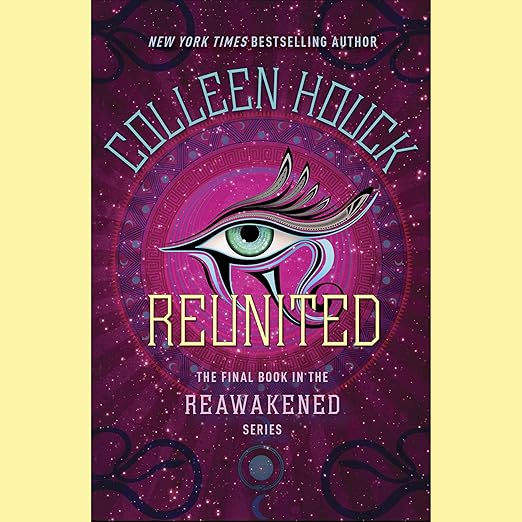
Reunited is the third and final book in that series, and it carries the specific weight of a trilogy conclusion: it has to pay off everything the earlier books built, close the character arcs that have been running since Reawakened, and deliver on the romance that has been the emotional engine of the series from the start. By most reader accounts, it does this. Not without some roughness in the third act, but the landing is genuine.
Our Take on Reunited
The setup is ambitious even by YA mythology standards. Lily wakes on her nana’s farm having forgotten everything, her body now part human, part lion, part fairy, and she must harness the power of three to become Wasret, a goddess destined to defeat the evil god Seth. The amnesia opening could feel like a reset in lesser hands, but Houck uses it to externalize the character’s transformation: Lily is literally not the same person she was in book one, and the story requires her to reconstruct herself as something new rather than simply remembering who she was.
The mythological density here is one of the series’ genuine strengths. Reviewers consistently mention loving the Egyptian mythology framework and appreciating that Houck does the research rather than borrowing cosmetic elements. One reader noted that this series “got me into Egyptian mythology just as the Tiger series got me into Hindu mythology,” which is a high compliment. The function of mythology here is educational as well as fictional, and that double value is what the best myth-based YA achieves.
Why Listen to Reunited
Mark Deakins has a long career in audiobook narration and brings professional confidence to the material. At sixteen hours and twenty-two minutes, this is a substantial series finale, and Deakins handles the tonal range, action sequences, romantic scenes, and mythological exposition, without noticeable weakness. YA mythology series at this length require a narrator who can hold energy across an extended arc, and he manages it.
The romance element, the sun prince Amon and Lily’s relationship across three books, is handled here with the directness that the series has established. Readers who have been invested in that relationship will find the conclusion satisfying in the ways they were hoping for. The supernatural stakes and the romantic resolution are woven together rather than being separate threads, which is consistent with how Houck has structured the series throughout.
What to Watch For in Reunited
One reviewer noted that the ending “came quick and fast” after a section that had been slower to develop. That telescoping in the final act is a common issue with ambitious trilogy conclusions, where the resolution requires more real estate than the final pages can give it without feeling rushed. It is honest criticism, and readers should know that the payoff they are building toward in this series arrives somewhat rapidly once the final conflict begins.
This is emphatically not a series entry point. Arriving at book three without the context of Reawakened and Recreated would strip away everything that makes the emotional payoffs here work. The amnesia opening that launches Reunited is meaningful precisely because the reader knows what Lily has forgotten. Starting here denies you that experience.
Who Should Listen to Reunited
Readers who have completed Reawakened and Recreated should absolutely close the loop here. YA mythology fans interested in Egyptian mythology specifically, rather than the Greek mythology that dominates the genre, will find this series and its conclusion rewarding. Rick Riordan readers who are looking for similar mythological depth with a more romance-forward narrative structure will find a compatible recommendation. Anyone starting the Reawakened series fresh: begin with book one.
Frequently Asked Questions
Is Reunited a satisfying ending to the Reawakened trilogy, or does it feel rushed?
Mostly satisfying, with one honest caveat: multiple reviewers note that the pacing compresses in the final act and the conclusion arrives quickly after a slower middle section. The emotional landing is genuine, but the execution gets tight toward the end.
How accurate is Houck’s use of Egyptian mythology in this series?
More accurate and more immersive than most YA mythology. Reviewers note it prompted them to actively explore Egyptian mythology further, which suggests the source material is deployed substantively rather than decoratively. The pantheon, the cosmology, and the divine roles are treated with care.
Can Reunited be read as a standalone, or does the amnesia opening require prior series knowledge?
The amnesia opening is deliberately designed for series readers, not new readers. Lily’s forgetting her journey is emotionally meaningful only if the reader knows what she has forgotten. This is not a standalone entry.
How does Mark Deakins handle the romantic and mythological elements together across sixteen hours of narration?
Competently and without the tonal lurches that can occur when a narrator has to switch between action fantasy and emotional romance. Deakins has the experience to hold both modes consistently across a long runtime.