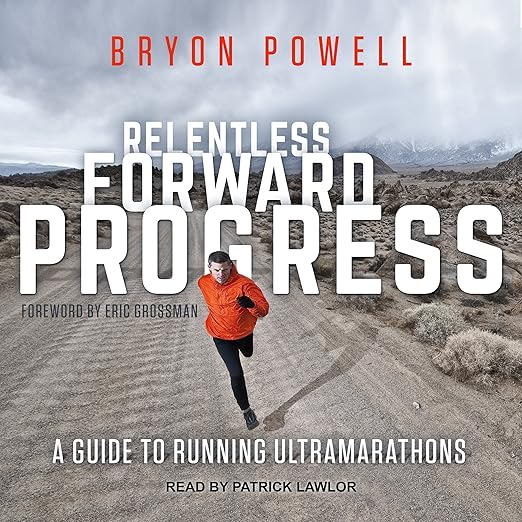
Quick Take
- Narration: Patrick Lawlor delivers the encyclopedic content with steady professional competence; this is reference material rather than narrative, and his measured delivery reflects that accurately.
- Themes: Ultramarathon training methodology, nutrition and recovery for extreme distances, the mental demands of going beyond 50 miles
- Mood: Thorough and workmanlike, aspirational without being evangelical
- Verdict: The foundational practical guide for anyone seriously considering their first ultramarathon, with enough depth to serve experienced runners transitioning from road to trail.
I ran my first marathon relatively late, in my mid-thirties, and spent the six months after it convinced that was sufficient. Then a friend described finishing a 50-mile trail race in the mountains of Colorado as the most alive she had felt in years, and something shifted in how I thought about what running could be. I started researching ultramarathoning with the same methodical attention I applied to anything I cared about professionally, and Relentless Forward Progress kept surfacing as the reference that serious practitioners recommended before everything else. I listened to it during a week of training runs, treating it as coursework rather than entertainment.
That framing is exactly what Bryon Powell intends. He is transparent about this from the beginning: Relentless Forward Progress is a how-to manual, not a narrative. It was the first practical guide to ultramarathoning when it was published, filling a gap that books like Dean Karnazes’s Ultramarathon Man and Chris McDougall’s Born to Run had created without filling. Those books inspired tens of thousands of people to consider ultra distances. Powell’s book tells them how.
The Encyclopedic Ambition and What It Costs
The structure of Relentless Forward Progress is genuinely encyclopedic. Powell organizes the book into short, digestible sections covering every conceivable aspect of training for and racing ultra distances. Guest contributors, themselves established ultrarunners, appear throughout to add perspectives on specific topics. One reviewer describes it as set up like a textbook that you can look up information by topic, which is both accurate and, in the audiobook format, a limitation worth acknowledging: the navigational benefits of a reference book are mostly unavailable when you are listening rather than reading.
A reviewer who describes taking a month to finish the book because they were not using it as it was intended, just looking for something to hold them over between better reads, captures both the book’s value and its limitations. Relentless Forward Progress does not function as a story. It does not have a narrative arc. It accumulates expertise. Listeners who come expecting the kind of driving momentum they found in Born to Run will be disappointed. Listeners who come because they have signed up for their first 50K and need to know how to train for it will find the book indispensable.
What the Training Guidance Actually Covers
The coverage is comprehensive in a way that justifies the encyclopedic label. Powell addresses training plans at multiple distances and experience levels, nutrition strategies for extended efforts, gear selection for different terrains, race-day management, crew and pacer coordination, and the psychological demands of covering distances where the last 30 miles are further than most people have ever run in a single effort. Multiple reviewers with different entry points into the ultra world describe finding specific sections newly useful at different stages of their training.
One of the book’s particular strengths is its willingness to present multiple approaches to contested questions rather than pretending there is one right answer to everything. Nutrition for ultramarathons is a domain where practitioners disagree substantially, and Powell acknowledges this rather than picking a side and ignoring the alternatives. That intellectual honesty makes the book more practically useful for runners who will need to figure out what works for their own bodies rather than following a single prescribed method.
Patrick Lawlor and the Reference Format Challenge
Narrating a reference book is a different skill set from narrating a narrative. Lawlor maintains consistent pacing and clarity across nearly seven hours of material that does not reward the kind of dramatic variation that keeps listeners engaged in fiction or even in memoir-style nonfiction. He does not try to make the nutrition tables exciting, which is the correct decision. He reads them accurately and moves on, which is what the material requires.
The real limitation is structural rather than performance-based. The sections of the book that include training charts, tables, and visual comparison data are referenced in the narration but not fully reproducible in audio. Listeners who want to build a training plan from the book’s frameworks will likely need the print or digital edition for the visual elements. The conceptual content, the what and why of ultramarathon training, translates fully to audio. The specific numerical scaffolding is harder to retain without a written reference.
Who This Book Is For and Who Should Look Elsewhere
Relentless Forward Progress is the right book for runners who have completed at least a marathon and are considering their first ultra, coaches working with athletes transitioning from road to trail, and experienced runners who want a systematic reference rather than inspiration. It is not the book for someone who needs to be persuaded that ultramarathons are worth attempting. It assumes that decision has already been made. And it delivers on its promise of comprehensive practical guidance with unusual thoroughness.
Frequently Asked Questions
What running experience do you need before Relentless Forward Progress is useful?
Powell positions the book as a guide for aspiring ultrarunners, which in practice means people who have at least run a marathon or longer and are considering their first ultra distance. The training plans and many of the protocols assume a baseline of running competence. Absolute beginners would be better served starting with a basic marathon training guide before coming to this one.
Does the audiobook format work for a book that functions as a reference manual?
Partially. The conceptual content, training principles, nutrition philosophy, mental preparation, and race-day strategy all transfer well to audio. The specific training plans, charts, and numerical tables are harder to retain without a written reference. Most serious listeners will find it useful to have the print or digital edition alongside for the structural materials.
How does Relentless Forward Progress compare to narrative ultrarunning books like Born to Run?
They serve entirely different purposes. Born to Run and Ultramarathon Man are narratives designed to inspire interest in ultra distances. Relentless Forward Progress is explicitly a how-to manual designed for people who already have that interest and need practical guidance on training for and completing their first race. Powell is transparent about this from the start.
Does the book favor a specific training philosophy or does it present multiple approaches?
Powell presents multiple approaches on contested topics, particularly nutrition and training load, acknowledging that ultrarunning practitioners disagree and that what works varies by individual. This intellectual honesty is one of the book’s strengths for practical use, as it allows runners to evaluate options for their own bodies rather than following one prescribed methodology.