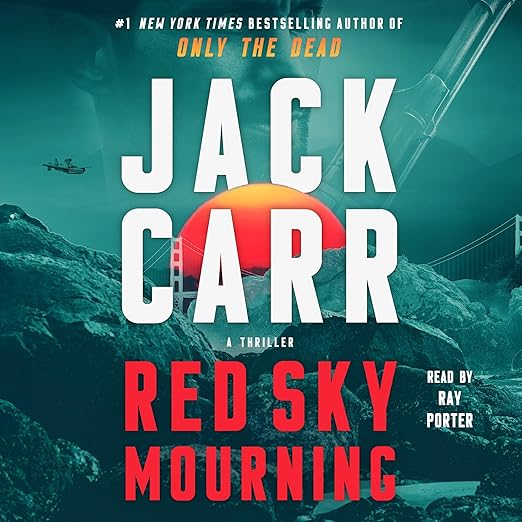
Quick Take
- Narration: Ray Porter has narrated the entire Terminal List series and sounds completely at home with James Reece, delivering the geopolitical tension and Reece’s internal weight with equal conviction.
- Themes: AI and national security, political compromise, the cost of returning to violence
- Mood: High-stakes and kinetic, with surprising stretches of culinary and weapons detail
- Verdict: A satisfying close to the Terminal List arc for fans already invested in Reece, though not the place to start with Carr.
I listened to Red Sky Mourning over the course of two long drives, which is exactly the environment a book like this was built for. Jack Carr writes thrillers that travel at speed, and the seventh installment of the Terminal List series sustains that velocity while adding a layer of technological unease that feels ripped from current headlines in the best possible sense of that phrase. By the second drive, I was genuinely unsure how the Alice thread would resolve, which is something I cannot say about every thriller I listen to.
James Reece has tried to put the violence behind him. The world does not cooperate. A rogue Chinese submarine is navigating toward the continental US with nuclear missiles within range of the West Coast. A Silicon Valley tech mogul of unclear allegiances is accelerating quantum computing and AI development. A politician controlled by foreign interests is a single step from the Oval Office. These three threads are on a collision course, and the only piece that can hold them together or accelerate the disaster is an AI named Alice who has been learning in isolation and whose loyalties remain genuinely uncertain.
Our Take on Red Sky Mourning
Carr has built something rare with this series: a long-running thriller franchise that has maintained quality and reader investment across seven books. The reviewers who praise Red Sky Mourning most specifically call out the series’ sustainability, the way each installment develops Reece further while delivering a fresh threat. The Alice plotline is the most ambitious element here. Carr is writing about a quantum AI at the center of a geopolitical crisis, and the book handles that premise with enough technical texture to feel credible without becoming a lecture. The tension between Alice as savior and Alice as existential threat is genuinely interesting and not fully resolved in the ways readers might predict.
Why Listen to Red Sky Mourning
Ray Porter is one of the best narrators working in military thriller, and his work on the Terminal List series is a large part of why the audiobooks have developed such a loyal following. He narrates Reece with a controlled intensity that never tips into parody, and he handles the ensemble of antagonists and supporting characters without losing the thread. At 15 hours and 43 minutes, this is a substantial commitment, but Porter makes the runtime feel purposeful rather than bloated. The torture scene that one reviewer flagged as unsettling lands as hard in audio as you would expect, and Porter does not flinch from it.
What to Watch For in Red Sky Mourning
Carr’s signature tendency to linger on culinary and wine detail, and on the technical specifications of weapons, is more pronounced in this installment than in earlier books. One reviewer described feeling like they were occasionally reading “a wine review or a culinary column,” and that observation is fair. These stretches are not tedious for readers who have come to expect them as part of Carr’s texture, but newcomers may find them surprising mid-thriller diversions. The ending is also more telegraphed than the series’ best entries, with the resolution becoming readable roughly three chapters before it arrives.
Who Should Listen to Red Sky Mourning
This is a book for established Terminal List readers. It assumes familiarity with Reece’s history, his losses, and his moral development across six prior novels. Listeners arriving here without that context will be able to follow the plot but will miss most of the emotional weight that makes the series compelling. For those current with the series, this is a strong and satisfying installment. Fans of military thriller who want AI and geopolitical conspiracy layered into their tradecraft will also find this a worthy entry point to Carr’s work, with the understanding that the earlier books are worth going back for. Listeners who enjoy the tradecraft detail and weapons specificity that Carr brings to every installment will find this entry in particular unusually rich, since the Alice storyline adds a new layer of technological texture to what has always been a tactically grounded series.
Frequently Asked Questions
Can I listen to Red Sky Mourning without having read the previous Terminal List books?
Technically yes, but practically no. The emotional stakes depend heavily on six books of character development. Carr does provide enough context to follow the plot, but the payoff of this installment is specifically designed for readers who have traveled with Reece from the beginning.
How does Ray Porter handle the AI character Alice, and does it work in audio?
Porter navigates Alice’s sections with a careful neutrality that suits the character’s ambiguity. He does not render her as robotic or obviously sinister, which preserves the genuine uncertainty about her allegiances that is central to the book’s tension.
Is the geopolitics in Red Sky Mourning realistic or broadly speculative?
Carr grounds his threats in real-world anxieties about Chinese naval capabilities, AI development in Silicon Valley, and political compromise. Reviewers consistently note that his fiction feels close enough to plausible to be unsettling, even when specific elements are clearly amplified for drama.
Does the book wrap up the Terminal List series definitively?
Reviewers describe Red Sky Mourning as a strong conclusion to this arc of the series. Whether Carr returns to Reece in future installments remains open, but this book provides a sense of closure that feels earned given the seven-book journey.