Quick Take
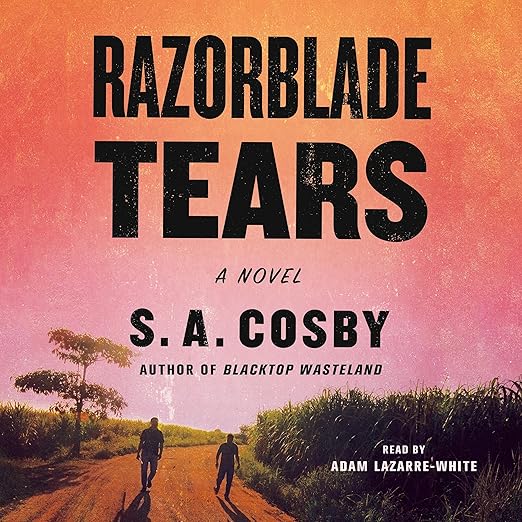
- Narration: Adam Lazarre-White delivers what AudioFile Magazine called a commanding, riveting performance. He handles both Ike and Buddy Lee with tonal distinction and keeps the propulsive pace taut throughout all twelve hours.
- Themes: Grief, parental guilt and redemption, violence as reckoning
- Mood: Brutal and emotionally raw, with unexpected tenderness
- Verdict: S. A. Cosby’s second major novel is a fast, gut-punch read about two deeply flawed men trying to do right by sons they failed while those sons were alive.
I started Razorblade Tears on a Friday night thinking I’d listen for an hour and then cook dinner. I finished it at two in the morning, standing at the kitchen counter in the dark, not quite ready to let the two men at its center go. That is the kind of novel this is: the kind that pulls you past your own intentions.
S. A. Cosby had already established himself with Blacktop Wasteland, a tight crime novel that drew favorable comparisons to the best of Donald Ray Pollock and Elmore Leonard. Razorblade Tears is broader in scope and more emotionally ambitious, and it earns the praise it received from Michael Connelly, who called it superb and said it cuts right to the heart of the most important questions of our times. That’s a big claim from a writer who knows his crime fiction. Cosby backs it up.
Our Take on Razorblade Tears
The premise is deceptively simple. Ike Randolph, a Black former convict who runs a landscaping business, and Buddy Lee Jenkins, a white ex-con who still has underworld contacts, have nothing in common except that their sons were married to each other and are now dead. Neither man fully accepted his son’s sexuality while he was alive. Both are consumed by guilt they can barely name. Their alliance to find the killers is uneasy, combustible, and frequently violent, but it is also the vehicle for the kind of emotional reckoning that crime fiction at its best has always been able to carry.
Cosby doesn’t let either man off easy. Ike’s nickname was Riot in his criminal past, and the man who has spent fifteen years building a legitimate life is never entirely free of what that name once meant. Buddy Lee is rougher around the edges, more openly prejudiced, less inclined to introspection, but Cosby gives him a bruised dignity that makes him sympathetic even when he’s being reckless. Their friction is the engine of the book.
Why Listen to Razorblade Tears
Adam Lazarre-White is the right narrator for this material, and AudioFile Magazine’s description of his performance as irresistible is not hyperbole. He differentiates Ike and Buddy Lee through rhythm and register, giving Ike a compressed intensity and Buddy Lee a looser, more volatile energy. The action sequences move quickly without becoming incomprehensible, and the emotional beats land because Lazarre-White doesn’t overplay them. When Ike finally allows himself to grieve openly, the restraint in the narration makes the moment more affecting, not less.
At twelve hours, this is a weekend listen or a week of commutes, and the pacing earns every one of those hours. Cosby structures the plot with enough forward momentum that you rarely feel the length. The violence is significant and frequent, which is worth knowing going in, but it is purposeful rather than gratuitous. It serves the larger argument about what these men are capable of and what they owe the people they failed.
What to Watch For in Razorblade Tears
Some readers have noted that the juxtaposition at the heart of the novel, two men who rejected their sons’ sexuality choosing to avenge them in death, could tip into irony or even exploitation. Cosby walks that line carefully. The fathers’ prejudices are not resolved through a neat conversion narrative. They are complicated, questioned, and only partially overcome, which feels more honest. One reviewer described it as a roller coaster with too much revolving at once; I’d say the density is mostly a feature rather than a flaw, though a few of the secondary villains are thinner than the central characters.
Multiple reviewers reported finishing in tears, and I can confirm the ending earns that response. The book doesn’t close on triumph exactly, but on something more durable, a kind of bruised understanding that these two men will carry forward.
Who Should Listen to Razorblade Tears
Crime and thriller readers who want substance underneath the plot mechanics will find it here. Fans of Attica Locke, S. J. Rozan, or the darker end of Dennis Lehane’s catalog will recognize what Cosby is doing. Skip it if graphic violence is not something you can engage with, or if you’re looking for a procedural with institutional resolution. This is not a police novel. It is a novel about fathers, guilt, and what happens when private grief turns outward.
Frequently Asked Questions
How graphic is the violence in Razorblade Tears?
Significant. Cosby doesn’t shy away from brutal scenes, and the revenge narrative involves several extended confrontations that are depicted in detail. It fits the register of hardboiled crime fiction rather than cozy or procedural, so listeners with low tolerance for violence should be aware.
Do you need to have read Blacktop Wasteland first?
No. Razorblade Tears is a standalone novel with completely different characters. Blacktop Wasteland gives you a sense of Cosby’s range and voice, but it shares no plot or characters with this book.
Does Adam Lazarre-White differentiate between the two main characters in his narration?
Yes, and this is one of the production’s strengths. Ike and Buddy Lee have distinct rhythms and registers in Lazarre-White’s reading. Given that the novel alternates between their perspectives, this differentiation matters a lot and he handles it well.
Is the handling of LGBTQ themes respectful, given that the fathers were not accepting of their sons?
Cosby is deliberate and careful here. The story does not use the sons’ sexuality as shock value or as a device purely to motivate the fathers. Isiah and Derek are present as people throughout, and the fathers’ failures are examined critically rather than excused. It’s not a perfect treatment of every dimension, but it’s thoughtful.