Quick Take
- Narration: Susan Ericksen is the definitive voice of Eve Dallas, authoritative, dry, and utterly consistent across the In Death series.
- Themes: virtual reality as weapon, corporate technology ethics, loyalty and partnership in crisis
- Mood: Slick and propulsive, with the series’ characteristic mix of dark procedural and domestic warmth
- Verdict: One of the stronger early entries in the In Death series, the VR premise holds up and the Roarke dynamic deepens in ways that reward readers following the series in order.
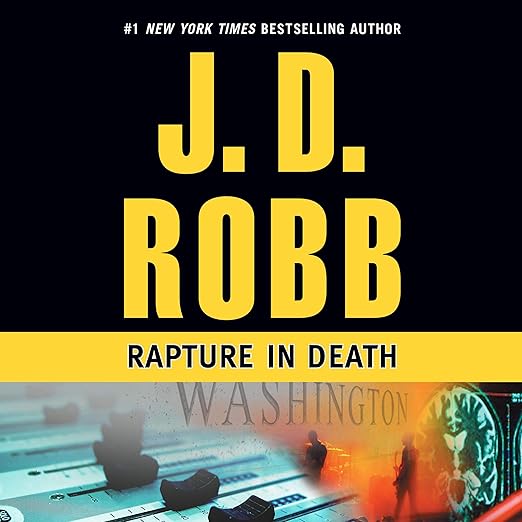
I came to the In Death series late, too late, really, given how many entries J.D. Robb has published since 1995. I started at book one and made my way to Rapture in Death, the fourth installment, expecting the series to be settling into comfortable formula by now. What I found instead was a book that uses its science fiction premise more ambitiously than the previous entries, and that deepens the emotional architecture of the series in ways that surprised me.
The setup is characteristically clever: three apparent suicides, a brilliant engineer, an infamous lawyer, and a controversial politician, each dying with a smile on their face and a small burn found on their brains at autopsy. Lieutenant Eve Dallas suspects murder before she can explain why. It is the right instinct.
Our Take on Rapture in Death
The virtual reality conceit at the center of this book is remarkably well-aged for a novel written in the mid-nineties and set in 2058. Robb imagines that the same neurostimulation technology used to create immersive pleasure experiences in VR can, with modification, prompt the brain to destroy itself from within. The mechanism is convincing enough that it does not strain credulity, and the implications, for privacy, for corporate accountability, for the weaponization of entertainment, feel considerably more resonant now than they probably did at publication. Robb was ahead of the conversation in ways that reward rereading.
The investigation moves at the pace the series has established: Dallas works hard, Roarke contributes resources and expertise that occasionally bend ethical lines, and the supporting cast of Peabody, Feeney, and Whitney keeps the precinct grounded. Reviewer J.C. Prins noted returning to this book after years away and finding it holds up entirely, which is a reliable signal for a genre title this old.
Why Listen to In Death Book Four Specifically
For listeners following the In Death series in sequence, Rapture in Death is where the Dallas-Roarke dynamic takes another meaningful step. The honeymoon period that opened the previous book is over, and the relationship is tested by circumstances that force both characters to examine their own limits. Robb is careful not to resolve these tensions too quickly, the growth feels earned. Reviewer D. Blankenship, who was still working through the full series, observed that people either love or hate these books, and that the polarity of response is appropriate given how distinctive the series voice is. That is accurate: the mix of futuristic procedural, relationship drama, and dark violence is unusual, and it is either exactly what you want or exactly what you don’t.
What to Watch For in Susan Ericksen’s Long-Running Performance
Ericksen has narrated the majority of the In Death series, and by book four she has settled so completely into Eve Dallas that it is genuinely difficult to imagine the character in another voice. She handles Dallas’s hard-edged professionalism, her particular brand of dark humor, and her unguarded moments with Roarke with equal fluency. What long-running series narrators develop that single-book narrators cannot is the lived-in quality, the sense that you are hearing a person who has been with these characters for years. Ericksen has that quality here, and it makes the emotional beats of the investigation land with more weight than they would under a different narration.
Who Should Listen to Rapture in Death
This is not the entry point for the In Death series, that remains the first book, Naked in Death. But for listeners who are working through the series in order, Rapture in Death is where the long-term investment starts paying dividends. The VR-as-murder-weapon premise is one of the more original in the early entries, and the relationship development here sets up storylines that matter for books well beyond number four. If you have not started the series and are considering it, know that it rewards commitment and sequence, jumping in mid-series is possible but costs you the accumulating weight of the character history.
Frequently Asked Questions
Can I listen to Rapture in Death without reading the first three In Death books?
Technically possible, but not recommended. The series has an ongoing relationship arc between Dallas and Roarke that develops continuously, and by book four their dynamic assumes knowledge of events in the previous installments. Newcomers will follow the murder plot fine but miss the emotional context that makes the character work land.
How does the 2058 near-future setting affect the story, is the worldbuilding heavy?
The worldbuilding is light and serves the plot rather than dominating it. Robb sketches the future with broad strokes, vehicle technology, legal frameworks, entertainment systems, and the VR premise is central to this book’s mystery specifically. You do not need to track elaborate future history to follow the story.
Is Susan Ericksen’s narration consistent with her performance in earlier In Death books?
Yes, Ericksen has been with the series from its audio beginnings and her characterizations are fully consistent across entries. She is the voice most series fans associate with Eve Dallas, and by book four she has completely inhabited the role. Listeners starting here will have no adjustment period.
Does Rapture in Death function as a satisfying standalone thriller despite being series entry four?
The murder investigation resolves completely within this book, there is no cliffhanger and the central mystery has a clear, satisfying conclusion. What carries across the series are the character and relationship threads. As a standalone crime narrative it works; as part of the series it is also where several longer arcs deepen.