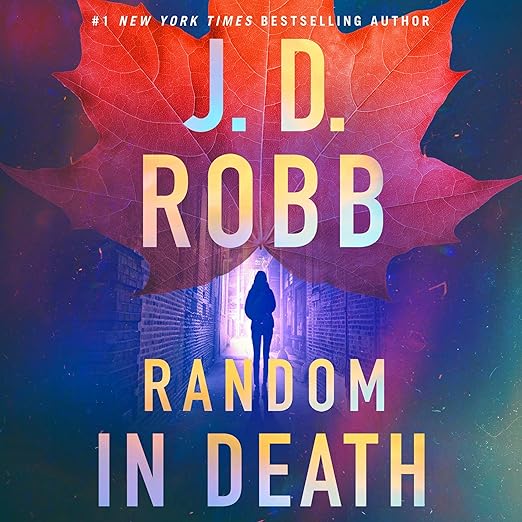
The scene at the club where Jenna dies is the kind of opening that the In Death series does better than almost any other long-running crime franchise. Random in Death audiobook plants you in a moment of pure, ordinary joy before turning it irrevocably dark, and J.D. Robb uses that contrast with surgical precision. Jenna's parents had finally given in. She was at the club with her best friends, watching the legendary band Avenue A, carrying her demo in hopes of slipping it to the guitarist. Jake Kincade catches her eye from the stage and smiles. And then, minutes later, she's stumbling into an alley, sick and deathly pale, and the best night of her life is the last night of her life. That's the engine. Susan Ericksen's narration, which vibrates with the kinetic energy that AudioFile singled out in her Earphones Award-winning performance on Desperation in Death, kicks in from the first paragraph and doesn't let up.
This is the fifty-eighth entry in the In Death series, and returning listeners know that Robb operates with a confidence built from decades of writing Eve Dallas. Random in Death demonstrates that confidence in the specificity of the case: the lab results reveal a toxic cocktail of substances in Jenna's body, and for an extra touch of viciousness, the needle used to administer them was loaded with infectious agents. Dallas searching for motive and finding none, no harassment, no risky behavior, no shady connections, is the pivot point. If Jenna wasn't targeted specifically, the logic demands more deaths to come. That structural premise is what makes this installment genuinely tense beyond the procedural mechanics.
What Robb does in the later In Death books that she couldn't do in the early ones is rely on accumulated emotional capital. By entry fifty-eight, Dallas and Roarke's partnership, the friendships that have developed around them, and the moral framework Eve has built for herself over decades of work all carry weight that doesn't need to be established from scratch. One reviewer noted that "characters who, by now, need no introduction or description, are still described well enough for the first time In Death reader to see them in her mind's eye." That dual function is genuinely difficult to execute, and Robb's consistency at it this far into a series is a technical achievement worth naming.
The case at the center of Random in Death involves a killer who is both vicious in method and terrifyingly anonymous. Someone in the crowd. Someone with hatred and planning and no obvious motive connected to any specific victim. The needle as weapon is a clever device because it requires proximity, which means the killer was close, was watching, made a choice, and walked away without anyone seeing anything. Dallas's procedural work in untangling this, running through every boy who might have had an interest in Jenna, every element of her life that could have made her a target, and finding nothing, builds dread steadily rather than releasing it in set pieces. It's the kind of plotting that rewards listeners who are patient with process.
What Stands Out
Susan Ericksen has been the definitive voice of Eve Dallas for long enough that her narration is inseparable from the series for most listeners. The AudioFile review specifically calls out her performance's vibrancy, and Random in Death uses that energy well. The club scene, the subsequent investigation scenes, and the quieter character moments between Dallas and Roarke all benefit from Ericksen's ability to modulate energy without losing consistency of character voice. She brings distinctly different texture to Dallas's controlled professional mode and her more unguarded moments at home, which is essential in a series where domestic scenes carry as much weight as crime scenes.
One reviewer wrote that these books "keep me engrossed and watching how the characters evolve," which is a precise description of why the In Death series sustains a readership through fifty-eight entries. The procedural is always there, but so is the ongoing emotional biography of the characters around it. Random in Death adds to that biography in ways that feel earned rather than manufactured, particularly in how it handles the specific vulnerability of a teenage victim and Dallas's response to that particular kind of loss.
What to Watch For in Random in Death
New listeners should understand that entering the In Death series at book fifty-eight is a legitimate choice but comes with context trade-offs. Robb writes accessibly enough that newcomers can follow the investigation without prior knowledge, but the emotional resonance of the character relationships will be shallower without the accumulated history. Another reviewer observes that the plot "while obvious, is nonetheless intriguing," which is an honest assessment of how the series operates at this stage: the investigative structure holds, the character dynamics deliver, and regular readers will find it compelling even when the case resolution is telegraphed.
The thirteen-hour runtime is standard for the series at this length, and Ericksen's pacing means it moves consistently without stretching. This is not a title that benefits from being rushed, the details of the investigation accumulate in ways that pay off properly if you give them room. Listening in two or three sessions rather than one will let the tension build the way Robb designs it to.
Best Suited For
Established In Death readers should listen to this audiobook without hesitation; at fifty-eight entries, Robb remains a series author who rewards continued investment. New listeners curious about the franchise should ideally start earlier in the series to appreciate the full emotional weight of what Dallas and Roarke have built together, though Random in Death is accessible as a standalone procedural. Listeners who want their crime fiction focused purely on puzzle-solving with minimal character investment may find the balance tipped too far toward relationship and character over mystery mechanics. For everyone else who wants police procedural fiction with genuine emotional stakes delivered by one of the best series narrators in the business, this audiobook delivers.
Common Questions
Is Random in Death audiobook accessible to listeners who haven't read the earlier In Death books?
Robb writes with enough accessibility that newcomers can follow the investigation, and Dallas as a character is clearly drawn even without backstory. However, the emotional payoff of the series relies heavily on accumulated investment in the relationships, and first-time listeners will get a shallower version of what regular readers experience.
Does Susan Ericksen's narration remain consistent in quality this far into the series?
Consistently yes. AudioFile specifically cited her performance in the previous book, Desperation in Death, as an Earphones Award winner. Ericksen has been the voice of Eve Dallas long enough that her interpretation of the character has become definitional for most listeners, and Random in Death benefits from that settled authority.
Does this audiobook work as a standalone, or is there a major series arc that requires reading the previous books first?
It works as a standalone procedural. The case at the center of Random in Death is self-contained. The series arcs involving character relationships and ongoing dynamics add depth, but Robb constructs each book to function independently at the plot level.
How does the audiobook handle the disturbing content around a teenage victim without being exploitative?
Robb handles it with the measured restraint that characterizes the best entries in the series. The violence is present as fact rather than spectacle, and Dallas's emotional response to a teenage victim draws on the character's history in ways that give the content weight without dwelling on the details gratuitously.