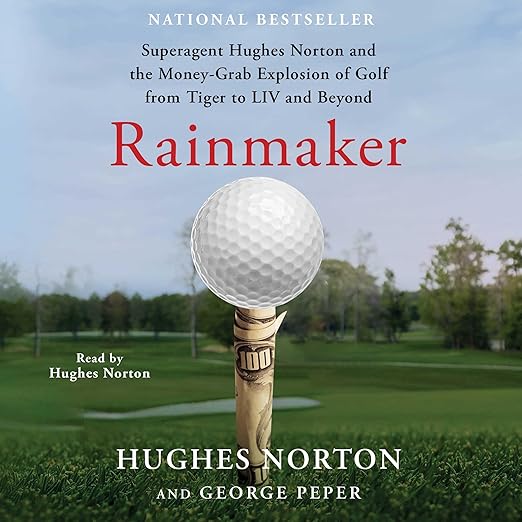
Quick Take
- Narration: Hughes Norton reading his own memoir adds irreplaceable texture and credibility, though he is a storyteller rather than a trained narrator and the difference occasionally shows.
- Themes: Sports agency and power, ethical compromise under pressure, golf’s commercialization
- Mood: Candid and brisk, with an undercurrent of hard-won regret
- Verdict: A rare behind-the-curtain account that is honest about its own protagonist’s failures, which makes it considerably more interesting than a victory lap would have been.
I grew up hearing about Tiger Woods from every direction, so I came to Rainmaker expecting another Tiger story. What I found instead was something more complicated: a memoir by the man who was there at the center of Tiger’s early career, who helped negotiate the deals that made Woods a billionaire-adjacent phenomenon, and who was fired from IMG before any of that finished playing out. Hughes Norton is not telling a success story. He is telling a story about what it costs to win at a certain kind of game for a very long time.
Norton came to IMG straight from Harvard Business School in the early 1970s and built himself into the most powerful agent in golf over the following two and a half decades. He represented Greg Norman and Tiger Woods, negotiated the sponsorship deals that helped professionalize the sport globally, and by his own account made moral and ethical choices along the way that he came to regret. That combination of accomplishment and honest self-assessment is what separates Rainmaker from the typical sports memoir.
Our Take on Rainmaker
The two great set pieces of the book are the years with Greg Norman, whom Norton characterizes with characteristic bluntness as narcissistic, and the early Tiger relationship, culminating in that famous Masters embrace in 1997 when a 21-year-old Tiger won by twelve strokes and sought out his agent in the crowd along with his parents. Norton was, by that point, one of the three most important people in Tiger’s professional life. He was let go not long after. The circumstances of that departure, and Norton’s account of the institutional politics at IMG that preceded it, are among the most candid passages in any golf memoir I have encountered.
What reviewer vegasbill called “not pulling punches regarding the greats and near greats” is accurate, but Norton also does not spare himself. The seventy-hour work weeks, the constant international travel, and the eventual divorce are described without melodrama but with genuine accounting. He was not simply a victim of his industry’s demands. He made choices that prioritized career over family, and he knows it.
Why Listen to Rainmaker
The decision to have Norton narrate his own memoir was clearly the right call. He is not a polished audiobook narrator, and there are moments where the pacing is slightly uneven or where a more trained voice would have emphasized a different word. But the authenticity of hearing these stories in the voice of the man who lived them adds something that no professional actor could replicate. When Norton describes a phone call with Tiger or a negotiation with a major sponsor, you are not hearing a performance of those events. You are hearing someone who was actually in the room.
At 9 hours and 11 minutes, the runtime covers a lot of ground without ever feeling rushed. The structural choice to move roughly chronologically through Norton’s career means the book doubles as a history of professional golf’s commercial evolution from the 1970s through today, with particular attention to the meteoric growth that IMG helped engineer.
What to Watch For in Rainmaker
One reviewer noted that for serious followers of the game, little here will be genuinely new. That is probably true at the level of fact. Norton’s account of Norman’s ego and Tiger’s early career are things that have been discussed, written about, and analyzed extensively elsewhere. What Rainmaker offers is a first-person perspective from someone inside those events rather than observing them, which is a different kind of value. It is not revelatory so much as it is confirmatory, and confirmation delivered in the voice of a direct participant has its own worth.
The book also has a contemporary dimension: Norton’s thoughts on what he calls golf’s current money-grab era, the LIV Golf controversy and the broader restructuring of the sport’s economics, give the memoir a present-tense relevance beyond nostalgia. Those passages are more evaluative than narrative, but they root the historical material in ongoing questions.
Who Should Listen to Rainmaker
This is first and foremost for golf fans with an interest in the sport’s business history and its major personalities. It works well for listeners drawn to sports memoir more broadly, particularly those interested in the agent side of professional athletics rather than the player side. Non-golf fans will find less to hold them unless they have a particular interest in the IMG empire, the economics of athlete sponsorship, or the specific dynamic between Norton and his two most famous clients. For anyone with a passing familiarity with Tiger’s career who has wondered what the machinery behind that 1997 Masters moment actually looked like, this is the closest thing to a direct answer currently available.
Frequently Asked Questions
How much of Rainmaker is actually about Tiger Woods versus Greg Norman and Norton’s broader career?
Tiger Woods is the memoir’s most prominent figure but does not dominate it numerically. Norton devotes significant attention to Greg Norman, the founding and growth of IMG’s golf division under Mark McCormack, and his own career arc from the early 1970s onward. Tiger is the emotional and commercial climax of the story, but the book is structured as a career memoir rather than a Tiger biography.
Does Norton narrating his own memoir cause any problems with the audio experience?
He is a storyteller rather than a professional narrator, and the uneven pacing shows occasionally. Listeners who are accustomed to polished audiobook performance may notice it. But the authenticity of hearing these stories in Norton’s own voice is widely considered worth the trade-off, and his delivery becomes more comfortable as the book progresses.
Is Norton honest about his own failings, or does the memoir read as self-justifying?
Reasonably honest. He acknowledges the moral compromises he made to protect his clients and career, describes his divorce as a consequence of his own choices, and admits that he needed to be humbled. The account is not entirely without self-flattery, but it is more self-critical than the average sports memoir, and that honesty is one of the book’s most frequently praised qualities.
Is Rainmaker useful for understanding the current LIV Golf situation and the economics of professional golf today?
Norton includes commentary on what he characterizes as a current money-grab era in professional golf, and those sections situate the historical material in an ongoing conversation. His perspective is that of someone who participated in building the commercial structures now being disrupted, which gives his assessment a particular vantage point, though readers should weigh it as one insider’s view rather than a definitive analysis.