Quick Take
- Narration: Joel Froomkin handles Schrefer’s blend of scientific exposition, personal memoir, and researcher interviews with a warmth and lightness that makes the material genuinely approachable for its YA audience.
- Themes: Same-sex behavior in the animal kingdom, scientific bias, queer identity and belonging
- Mood: Warm and curious, occasionally funny, consistently generous toward its subject and its readers
- Verdict: An unusually well-researched YA nonfiction title that works equally well for curious adults, with Froomkin’s narration making even the denser scientific content feel like a conversation.
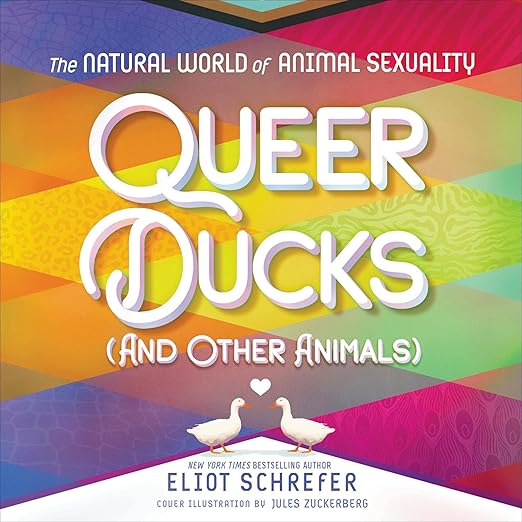
A reviewer on this audiobook’s page described buying copies for everyone in their extended family, which is an unusual response to a YA science book about animal sexuality. It tells you something about what Eliot Schrefer is doing here that does not fit neatly into any single genre category. This is simultaneously a scientific survey, a brief cultural history of how researchers have suppressed or ignored evidence of same-sex behavior in animals, a memoir of Schrefer’s own experience growing up queer, and an argument about what the natural world actually contains versus what we have been culturally prepared to see.
I listened to this on a long afternoon walk, which turned out to be an ideal context. Joel Froomkin’s narration has an engaged, conversational quality that makes even the more technically dense passages feel like someone explaining something they find genuinely fascinating rather than reciting information at you. By the time I got home I had learned about albatross pair bonding, bonobo social structures, the sexual behavior of doodlebugs, and a great deal about the history of how Victorian-era scientific assumptions about nature shaped research methodology in ways that persisted well into the twentieth century. That is a lot of ground covered in five hours and forty-four minutes, and none of it felt rushed.
Our Take on Queer Ducks and Other Animals
The book’s central scientific argument is well-supported and increasingly mainstream: a substantial body of research has documented same-sex sexual behavior across hundreds of animal species, from penguins to bonobos to clownfish. The question Schrefer is examining is not whether this behavior exists, which the evidence has long since settled, but why it took so long for scientific consensus to acknowledge it, and why public discourse still often treats it as aberrant. His answer points to cultural conditioning that caused researchers to avoid publishing their observations or to reframe what they saw through heterosexual interpretive frameworks.
The researcher interviews woven throughout the book add significant weight to the scientific argument. These are not rhetorical voices but working scientists discussing their own experiences with academic resistance and publication challenges. They make the book feel like a live conversation with a field rather than a static summary of settled information.
Why Listen to Queer Ducks and Other Animals
Schrefer’s decision to braid his own memoir into the scientific exposition is what elevates this beyond a clever science popularization. He describes knowing he was gay from a young age and spending years unable to articulate that knowledge within the frameworks available to him. The animal evidence becomes personally resonant rather than merely intellectually interesting, and he is explicit about the connection: knowing that same-sex behavior is abundantly documented across the natural world does not validate queer identity because it requires natural precedent, but it does dismantle the specific argument that it is unnatural, which is the argument that has caused the most damage in most legal and social contexts.
One reviewer quoted Mary Oliver in their response to this book, which is a meaningful signal about the emotional register it reaches despite being a science nonfiction title. Froomkin’s narration carries that emotional availability alongside the scientific rigor without letting either swamp the other.
What to Watch For in Queer Ducks and Other Animals
The book is shelved as YA but functions effectively for adults, and multiple reviewers noted this explicitly. Reviewer Richard Pastore, who works in the life sciences, recommended it specifically for people with scientific training who want a perspective that will make them reconsider familiar studies. The supplemental PDF mentioned in the metadata is available alongside the audiobook and likely contains source citations and visual materials that the audio format cannot convey. For science-minded listeners, downloading that PDF before listening will add useful context.
Listeners who approach this book as a political document rather than a scientific one may be frustrated by Schrefer’s deliberate effort to let the research carry the argument. He is not writing a polemic, though the implications of his findings are politically significant. The book’s power comes from restraint and specificity, not from rhetorical escalation.
Who Should Listen to Queer Ducks and Other Animals
This works for any curious listener regardless of age, though it was written for young adults and carries the best qualities of that genre: accessibility without condescension, genuine enthusiasm for ideas, and a willingness to take the reader seriously as someone capable of engaging with complex material. It is particularly valuable for parents looking for science-grounded conversations about sexuality with teenagers, for anyone who has encountered the nature argument against queer identity and wants a thorough evidence-based response, and for science readers interested in how cultural bias operates within research methodology. Skip it if you are specifically looking for an advanced academic treatment of the same research, which exists in sources like Bruce Bagemihl’s Biological Exuberance that Schrefer himself references.
Frequently Asked Questions
Is this audiobook accessible to teenagers, or is it written at an adult reading level?
It was specifically written for a YA audience and is genuinely accessible to teenagers while being engaging for adults. Schrefer’s prose is witty and clear, and Froomkin’s narration makes even the science sections feel like conversations rather than lectures.
Does Joel Froomkin handle the shift between scientific exposition and Schrefer’s personal memoir effectively?
Yes. The memoir sections have a slightly warmer quality in his reading than the scientific sections, which creates a natural tonal shift without a jarring break. He is particularly good in the researcher interview passages, giving each scientist a slightly distinct presence.
What is the supplemental PDF that accompanies this audiobook?
The metadata mentions a supplemental PDF available in the Audible Library alongside the audio. For a nonfiction science title like this, the PDF likely includes source citations, bibliography, and possibly visual materials that cannot be conveyed through audio alone.
Is the book primarily advocacy or primarily science?
Primarily science, with advocacy emerging as a consequence of the evidence rather than being imposed on it. Schrefer is deliberate about letting the research drive the argument. The memoir sections add personal stakes without turning the book into a polemical document.