In Brief
- Performance: Elizabeth Evans sustains full command of the series's multiple POVs across 20+ hours, making her the definitive voice of this world in audio.
- What it covers: Identity reclaimed through action, the cost of loyalty, power that demands more than it promises, and found family tested by war.
- Feel: High-stakes and propulsive, with emotional depth in the quieter scenes that makes the action sequences carry real weight.
- Our call: The series operating near its ceiling, with a protagonist transformation that reshapes the entire arc retroactively.
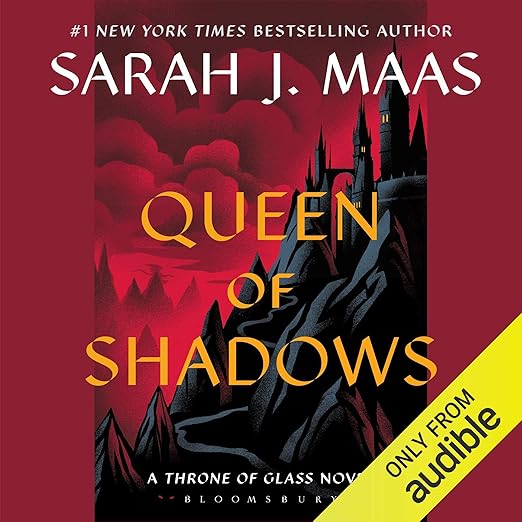
Sarah J. Maas wrote a book about a name change that is really about an identity rebuilt from the ground up. In this audiobook, Elizabeth Evans narrates Celaena Sardothien's arrival in Rifthold no longer as the assassin hiding what she is, but as Aelin Galathynius, Queen of Terrasen, with a reckoning years in the making. Queen of Shadows, fourth in the Throne of Glass series and a Goodreads Choice Award winner for Best Young Adult Fantasy in 2015, marks the pivot where the series stops being about survival and starts being about consequence.
Celaena Becomes Aelin, a Queen Who Acts
The shift in protagonist identity is not cosmetic, and Maas makes sure you feel the difference. Celaena was a character defined by concealment: her real name, her heritage, the extent of her power, her emotional attachments. Aelin is defined by decision. She returns to Rifthold not to blend in but to act, to pull the threads of obligation that have accumulated across the previous three books into something purposeful. The structural effect is that Queen of Shadows feels more intentional than its predecessors even when its plotting gets complicated.
The book runs over twenty hours in Evans's performance, and the multiple POV structure Maas employs requires a narrator capable of sustaining distinct voices across a long runtime. Evans manages this. Aelin's voice carries confidence and urgency. Manon Blackbeak, whose chapters become increasingly significant in this volume, gets a colder, more controlled delivery that marks her chapters from Aelin's without the distinction becoming a performance trick. Dorian, trapped and diminished for much of the book, sounds diminished in Evans's rendering without losing the intelligence that characterizes him. The differentiation holds across the full length.
The relationship between Aelin and Rowan Whitethorn takes a significant step in this volume, and the tension surrounding it has been one of the central draws for series readers. Maas handles the development with patience: the shift is earned rather than accelerated, and Evans's narration of their scenes together gives the emotional weight appropriate space without overselling it.
The villain work in Queen of Shadows is among the best in the series. Arobynn Hamel, Aelin's former master, receives his most complete treatment here, and the moral complexity of that relationship, the history of cruelty layered under something that once resembled mentorship, gives the confrontation at its center a darkness that goes beyond standard antagonist showdown. Maas does not simplify what Arobynn is or what his relationship with Aelin cost her.
The Manon storyline, which has been building since Heir of Fire, opens up significantly in this volume. Maas is clearly writing the Blackbeak chapters as a counterpoint to Aelin's arc: two women of power operating within different constraints, both discovering the limits of loyalty to institutions that do not deserve it. The two storylines don't converge in this book, but the structural parallel is legible and rewarding.
Evans Keeps Aelin, Manon, and Dorian Distinct
Elizabeth Evans has narrated the entire Throne of Glass series, and that continuity is a significant asset for listeners who have been following in audio. Her command of the world's terminology, character voices, and emotional register is complete in a way that would take a new narrator significant time to develop. At over twenty hours, a narrator who doesn't know this world would show the gaps; Evans never does.
The pacing of this volume rewards listeners who have been patient with the series's world-building investment. Queen of Shadows pays off threads that were laid in earlier books, and the audio experience of hearing those callbacks is different from reading them: Evans's narration carries the series's emotional history in her voice in a way that makes the payoffs feel accumulated rather than mechanical.
For listeners who enjoy high fantasy with a strong female protagonist at its center, this volume represents the series operating at near its full capacity. The scale of what Aelin is attempting, against the scale of what she has to lose, gives the plot genuine stakes.
Multiple POVs Strain the Final Third's Threads
This is book four in a series, and the density of prior-book context is high. Listeners who haven't read or listened to the first three books will find significant portions of the character dynamics and plot references opaque. The book makes no effort to catch up newcomers, which is correct for a fourth installment but means entry here is not advised.
The plotting in the final third is ambitious and occasionally overloaded. Maas is managing multiple POVs and several converging storylines, and not all of them resolve with equal clarity. Some secondary threads feel more wrapped than closed. This is a characteristic of the series's overall structure rather than a failure specific to this volume.
Listeners who found the series's romantic elements overshadowing its plot in earlier volumes may find that tension shifted here, but not eliminated. The Aelin-Rowan dynamic is central and receives considerable page time.
Loyal Series Readers Should Not Miss This Volume
Series readers who have been following Celaena's story since Throne of Glass should not miss this volume. It is the point at which the series earns the scale of its ambitions, and the shift in the protagonist's self-understanding gives the entire earlier series new meaning in retrospect.
Listeners who enjoy high fantasy with complex female leads, found-family dynamics in adversity, and antagonists who are threatening because they're intelligent rather than simply powerful will find Queen of Shadows a rich twenty-hour listen.
New listeners to the Throne of Glass world should start at the beginning and work forward. The payoff at this point in the series is real, but it depends on the foundation that has been built across three prior volumes.
Questions Listeners Ask
Can I start the Throne of Glass audiobook series with Queen of Shadows?
No. Queen of Shadows is the fourth book in the series and relies heavily on events and character developments from the first three volumes. Starting here will leave significant context gaps.
How does the audiobook handle the Manon Blackbeak chapters relative to Aelin's storyline?
Evans differentiates Manon's chapters with a cooler, more controlled vocal register that marks them clearly from Aelin's chapters. The two storylines run in parallel without converging in this volume, and the tonal distinction helps listeners track whose perspective they're in.