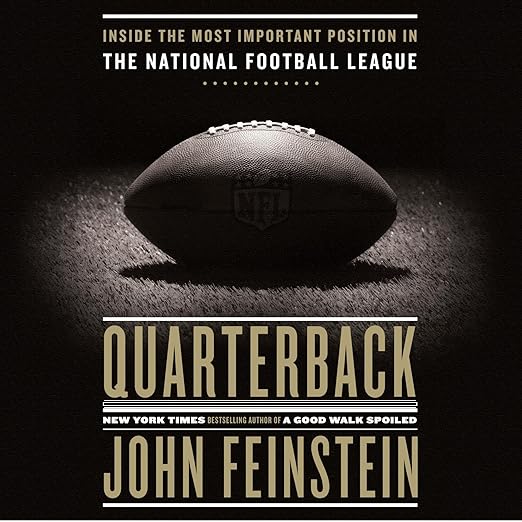
Quick Take
- Narration: Feinstein narrates his own work with a journalist’s measured cadence, authoritative but occasionally flat when transitioning between subjects.
- Themes: pressure and identity in elite sport, the weight of franchise expectations, life behind the public persona
- Mood: Intimate and unhurried, like a long sideline conversation
- Verdict: A rewarding portrait of five NFL quarterbacks that earns its runtime through access and specificity, though fans of just one of the five subjects may find the breadth dilutes the depth.
I started this one on a Sunday afternoon in late autumn, the kind of day where NFL highlights play in the background and you find yourself thinking about the mechanics of that one job, the one position in American sport that carries everything. John Feinstein has spent decades in the press boxes of college basketball arenas and golf courses, and bringing his long-form sensibility to the NFL quarterbacks felt like a genuine departure. Twelve hours in, I was mostly convinced he pulled it off.
The audiobook covers five starting quarterbacks from the 2017-2018 season: Alex Smith, Andrew Luck, Joe Flacco, Ryan Fitzpatrick, and Doug Williams. That casting alone makes the book fascinating in retrospect. Smith suffered a catastrophic leg injury. Luck retired abruptly and shockingly young. Flacco was replaced in Baltimore. Fitzpatrick did his mercurial thing for a few more seasons before hanging it up. Williams, the legendary barrier-breaking quarterback, brought a historical dimension the others simply could not. That the book captures all five at a particular frozen moment, before their subsequent trajectories, gives it an unintentional poignancy that no amount of sports journalism craft could manufacture.
Our Take on Feinstein as Narrator and Reporter
Feinstein narrates his own work here, and the effect is double-edged. His voice carries the confidence of someone who has had the best seats in the house for four decades, and there is something comfortable about hearing the prose delivered exactly as the writer intended it. But he is not a trained narrator, and in longer stretches, particularly when shifting from one subject to another, the rhythm can feel a little unvaried. Listeners accustomed to character-differentiating voice actors may need a short adjustment period. For fans of his writing, it will feel natural almost immediately.
What impresses most is the access. One reviewer noted that athletes these days are so media-trained they rarely say anything interesting. Feinstein clearly spent enough accumulated time with these five quarterbacks that they relaxed enough to be genuinely thoughtful. There are moments, particularly with Andrew Luck discussing the intellectual demands of reading a defense, and with Doug Williams reflecting on what his 1988 Super Bowl victory meant beyond football, that feel like real journalism rather than a polished press conference.
Why Listen to Quarterback if You Already Watch a Lot of Football
The question a dedicated NFL viewer might ask is: what does this add to what I already know? Quite a bit, actually. Television coverage of quarterbacks is almost entirely real-time and reactive, the snap count, the release point, the third-down conversion. What Feinstein excavates is the preparation, the film study, the specific anxieties that live in those hours before a game. Fitzpatrick’s position, perpetually one poor week from losing his starting spot to a younger, higher-drafted player, is examined with particular empathy. The insecurity that lives inside even a long-tenured NFL quarterback is counterintuitive and worth understanding.
One reviewer noted that the non-fiction writing can feel occasionally disconnected, and I would agree that the structural choice of rotating between five subjects means some momentum gets lost each time Feinstein pivots. A listener deeply invested in one quarterback may feel impatient during the chapters dedicated to another. That is a real limitation. But as a composite portrait of what the position actually demands, the breadth is also the point.
What to Watch For in the Historical Dimensions
The Doug Williams chapters carry a different weight than the rest of the book, and appropriately so. Williams was the first Black starting quarterback to win a Super Bowl, and his presence in this quintet keeps the book from being purely a contemporary snapshot. Feinstein handles this historical dimension without turning it into an obligatory detour. Williams himself is reflective and specific, and the contrast between his era and the present-day NFL is made implicit rather than lectured.
Who Should Listen to Quarterback
This audiobook will work best for listeners who follow the NFL at more than a casual level and who appreciate long-form sports journalism, the kind that treats athletes as full human beings rather than stat lines. It is also a natural fit for fans of Feinstein’s earlier work like A Good Walk Spoiled or A Season on the Brink, who are curious how his sensibility translates to football. Listeners looking for a season-by-season NFL history, or expecting deep tactical analysis of play-calling and scheme, will not find that here. The book is character study first and X-and-O breakdown never.
Frequently Asked Questions
Does John Feinstein narrating his own book work well for a nonfiction sports audiobook?
Reasonably well. His delivery is authoritative and measured, which suits the material, though it lacks the dynamic range of a professional voice actor. Fans of his journalism will find it comfortable.
Is Quarterback too dated to be worth listening to now, given how the careers of all five quarterbacks ended?
Not at all, the fact that you know what happened to Smith, Luck, Flacco, Fitzpatrick, and Williams actually adds poignancy. Hearing them speak at this particular moment, before their subsequent trajectories, gives the book an accidental historical weight.
Do you need to be a deep NFL fan to enjoy this audiobook?
A general interest in football and sports stories is enough. Feinstein writes accessibly and provides enough context that a casual fan can follow, though dedicated NFL followers will get more out of the locker room and preparation detail.
Is the book evenly split between all five quarterbacks, or does it favor some over others?
Reasonably even, though Doug Williams receives somewhat different treatment given his historical significance. Some reviewers felt the rotation between subjects broke momentum, particularly for listeners most interested in a single player.