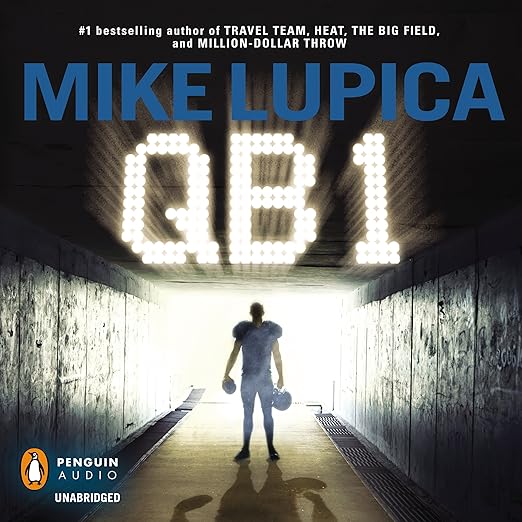
Quick Take
- Narration: Nicolas Tecosky captures the adolescent register of Jake Cullen without condescension, keeping the pacing brisk and the emotional beats honest for the target age group.
- Themes: Legacy and individuality, sibling rivalry under public pressure, finding your own version of success
- Mood: Earnest and warmly competitive, with genuine emotional stakes for the target audience
- Verdict: A well-crafted sports novel for young listeners that earns its emotional moments through character rather than coincidence.
My nephew, who is twelve and has very little patience for books that feel like they are trying to teach him something, finished QB 1 in three days. He listened during school lunch, after dinner, and during what I can only assume was supposed to be homework time. I asked him what he liked about it. He thought for a moment and said: Jake feels real. That is the most useful review I can offer, and everything I say below is essentially an elaboration of that observation.
Mike Lupica has spent decades writing sports novels for young readers, and QB 1 reflects a mastery of the form that you cannot fake. The premise is drawn from real life, specifically the Manning family, in which an NFL quarterback father produced not one but two Super Bowl-winning sons, and Lupica uses that template to build a story about what it feels like to be the third version of a legend. Jake Cullen is a freshman quarterback in the high-pressure world of Texas high school football, where his father Troy was a local legend and his older brother Wyatt just won a state championship. The shadow Jake lives in is not theoretical. It is structural, built into how the town sees him before he has thrown a single pass.
The Weight of a Name in Texas
Lupica is careful about how he handles the Texas high school football culture. He takes it seriously rather than satirizing it, which is the right choice. For the people in Jake’s world, this is not an obsession that deserves mockery; it is the organizing principle of community life, the way certain towns in certain parts of the country have always processed their values and their ambitions. The Friday Night Lights world the book inhabits is specific and recognizable, and Lupica uses it as a genuine backdrop rather than a convenient shorthand.
What the book refuses to do is make Jake’s path simple. His teammates assume the starting job will be handed to him because of his family name. It is not. He has to earn every snap and every ounce of respect, and Lupica shows that process in enough specific detail that it feels like athletic reality rather than narrative convenience. The rivalry with the other quarterback competing for the starting position is handled with fairness that is relatively rare in this genre. Nobody is a cartoon obstacle. Everyone has a comprehensible point of view, and that fairness is part of what makes the story work for young readers who can recognize complexity when they encounter it.
Off the Field and Into the Rest of Being Fourteen
One reviewer described QB 1 as including sibling rivalry, parental favoritism, budding romance, and the developing talent of a young quarterback, and that list captures the book’s range without conveying how naturally Lupica integrates all of it. Jake’s awkwardness around a girl he likes, his complicated admiration for his brother who seems to find everything effortless, his relationship with a father who loves him genuinely but sometimes does not quite see him clearly: these elements are not decoration around the sports story. They are the sports story, told by other means.
Nicolas Tecosky narrates with a sensitivity to the age group that makes a genuine difference. He does not play the emotional moments for adult listeners. His Jake sounds like a fourteen-year-old navigating something legitimately hard, which keeps the audiobook functioning as something a twelve-year-old can enter fully rather than something that flattens the protagonist into a symbol.
Lupica’s Craft and the Manning Inspiration
The book’s acknowledgment of the Manning family as inspiration is not cosmetic. Lupica has spent decades covering professional and amateur sports for major newspapers, and that background shows in how specifically he renders the mechanics of high school football, the way plays develop and fall apart, the particular pressures on a freshman who has not yet learned that talent and preparation are different things. The sports detail is real enough to satisfy readers who know the game and accessible enough not to exclude those who do not. Archie Manning’s endorsement, calling it a wonderful book by a great writer that all football fathers and sons will enjoy, is earned rather than promotional.
Reading Level, Audience, and a Word for Adults
QB 1 is designed for readers roughly aged ten through sixteen, and it works especially well for kids who love football but have found literary fiction alienating or slow. Parents looking for free audiobook options to share with sports-obsessed children will find this a reliable choice. Adults who grew up in football-centric communities may find more to appreciate here than they expect, partly because Lupica is writing about dynamics that are not exclusive to adolescence: the pressure of expectation, the desire to be seen on your own terms, the difficulty of stepping out from behind someone else’s achievement. It is not a book that reaches for the complexity of adult literary fiction, and it does not pretend to. Within its chosen form and audience, it is excellent. The book is also notable for how cleanly Lupica renders the specific loneliness of athletic pressure. Jake cannot talk to his father about being afraid of failing because his father is part of the standard he is afraid of not meeting. He cannot talk to his teammates because they already resent the advantages they assume he has. He has to find his own way through, and the audiobook gives that process enough room to unfold at a pace that feels true to the age it depicts. Nicolas Tecosky understands this, and his narration reflects it.
Frequently Asked Questions
What age group is QB 1 most appropriate for?
The book is aimed primarily at readers between ten and sixteen, with the central protagonist being a fourteen-year-old high school freshman. Multiple reviewers mention using it as a summer reading book for twelve-year-olds, and it has also been selected for school summer reading programs.
Do you need to know football to enjoy QB 1?
Basic familiarity with the sport helps. The book includes enough football detail that some understanding of positions and gameplay enriches the experience, but Lupica does not write for specialists. Reviewers with general sports knowledge report finding it accessible and engaging.
Is this audiobook connected to the Manning family and Friday Night Lights in ways that would confuse younger listeners?
Lupica draws inspiration from the Manning quarterback dynasty and sets the story in Texas football culture, but the book is fiction with its own characters. Younger listeners unfamiliar with the Mannings or the Friday Night Lights franchise will follow the story without any gaps.
How does Nicolas Tecosky’s narration serve the story’s young protagonist?
Very well. Tecosky captures the adolescent register of Jake Cullen without exaggerating it into parody or flattening it into an adult’s impression of a teenager. The narration keeps the emotional beats honest and the pacing brisk enough for the target audience.