Quick Take
- Narration: Mark Garkusha handles the thriller pace competently, though the dense character ensemble in this installment tests any narrator’s ability to maintain clear voice differentiation throughout.
- Themes: Cult power dynamics after a leader falls, leverage as survival strategy, the unfinished cost of incomplete freedom
- Mood: Tense and complicated, with more political maneuvering than action compared to the earlier books in the series
- Verdict: A third installment that divides the series’ readership, stronger on structural complexity than propulsive momentum, and honest about the difficulty of dismantling a cult from within.
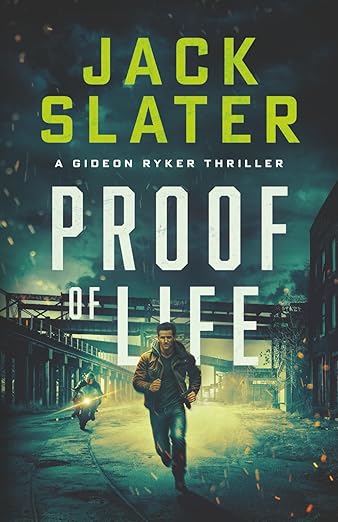
I came to Proof of Life midway through a review of the action thriller genre’s current landscape, where independently published authors have built audiences that rival traditional imprints. Jack Slater belongs to that cohort, and the Gideon Ryker series has clearly found readers who return because the books earn that return. This third entry is interesting precisely because it is the most structurally ambitious of the three and the one that has divided readers most sharply.
The setup is genuinely compelling as a thriller premise. Gideon Ryker has Father Gabriel, the tyrannical messiah of the Brotherhood cult known as New Eden, chained in a cellar. It sounds like the problem is solved. It is not. A brutal new leader has seized power in Gabriel’s absence, and the question of what to do with a dangerous prisoner who is also leverage over an unpredictable successor is exactly the kind of tangled situation that good thrillers can mine for sustained tension. What happens in practice is more complicated than that clean premise suggests.
Too Many Moving Parts, or a More Honest Kind of Thriller
The criticism that surfaces most consistently in reader reviews is the abundance of moving parts. Multiple characters, multiple factions, the Brotherhood’s internal power struggle, Gideon’s French Foreign Legion contact, his sister’s fragile freedom, and the intelligence agencies orbiting the situation all demand attention simultaneously. Several reviewers found this hard to track. Others found it precisely what makes the book different from a straightforward action thriller where Gideon simply outfights everyone in his path until the climax resolves everything cleanly.
My own read of the evidence is that Slater is doing something legitimate here. Dismantling a cult is not a clean operation. The people inside New Eden are not a unified force that can be defeated in a single confrontation. They are a community of true believers, trauma survivors, opportunists, and people who want out but cannot figure out how. Proof of Life attempts to represent that complexity honestly, and the resulting narrative does move differently from the tighter first two books. Whether that is a flaw or a genuine expansion of what the series is capable of depends on what you valued in those earlier entries and how much patience you bring to a thriller that asks you to hold multiple threads at once.
Father Gabriel as Leverage, Not Resolution
The most interesting structural choice in this book is keeping Father Gabriel imprisoned and alive rather than resolving his storyline with finality. He is a tool in someone else’s game rather than the active antagonist of prior installments. This requires the book to build a new antagonist from scratch, the brutal successor who seized power in Gabriel’s absence, while maintaining Gabriel as a destabilizing presence in the background. Slater manages this better than the more frustrated reviews give him credit for, but it does demand patience with a narrative that keeps redirecting your attention before any single thread reaches a satisfying conclusion.
One reviewer noted that the ending is less a cliffhanger than a question of what comes next, and that is accurate and worth knowing before you start. This is a book that moves pieces rather than closes arcs, and readers who came expecting the same clean momentum as Books 1 and 2 will feel the structural difference in a way that may or may not work for them.
Mark Garkusha Under Pressure From an Ensemble Cast
Mark Garkusha is a competent thriller narrator who manages pacing well, and the eleven-hour runtime is handled efficiently. The action sequences land with the forward momentum they need. The challenge in this particular book is the ensemble: when multiple reviewers are struggling to track characters, part of that responsibility falls on narration differentiation. Garkusha maintains adequate vocal distinction across the main cast but does not always help the listener identify secondary characters quickly enough in a narrative this populated. Listeners who have the prior books fresh in memory will navigate this more easily than those returning after a gap.
One structural observation that neither the enthusiastic nor the frustrated reviewers make explicitly: Proof of Life is doing something genuinely difficult in keeping Father Gabriel alive and imprisoned rather than resolving his arc in the climax. Antagonists who survive past their peak moment of power are hard to write without diminishing them, and Slater navigates this by making Gabriel’s continued existence a source of instability in the new power structure rather than simply a loose end. The new antagonist who seized power in his absence is specifically empowered and constrained by Gabriel’s shadow, which is a more sophisticated arrangement than most thrillers bother to construct. Whether that sophistication compensates for the reduced momentum is a genuine question, but it is worth recognizing as a deliberate choice rather than a structural failure.
It is also worth acknowledging what this series does well even in its most contested installment: Slater writes Gideon Ryker as a character who is genuinely affected by what he has been through. He is not a thriller protagonist whose emotional composure is essentially unlimited. The costs of operating as he has operated, the choices he has made and the things he has witnessed, accumulate in ways that affect his judgment and his relationships. That grounding in psychological realism is what separates the Ryker series from the category of action thrillers where competence and forward momentum substitute for character depth. Proof of Life, whatever its structural limitations, does not abandon that commitment.
Who This Installment Is Built For
Proof of Life rewards readers who valued the first two books for their world-building and faction complexity rather than pure propulsive action. It is a messier book than its predecessors, and that messiness is connected to honest questions about what it actually takes to dismantle a totalistic group from the inside rather than simply escaping it. Readers who need forward momentum and clean antagonist arcs will be frustrated. Readers willing to sit with structural ambiguity will find a thriller attempting something more difficult than the genre usually demands of itself.
Frequently Asked Questions
Is Proof of Life accessible as a standalone, or is prior knowledge of the Gideon Ryker series required?
Prior knowledge is strongly recommended. The book’s emotional and narrative stakes depend on having followed Gideon’s arc through Books 1 and 2, particularly his history with the Brotherhood and his sister’s situation. Starting here would mean missing the context that makes Father Gabriel’s continued presence meaningful and the new antagonist’s threat proportionate.
Multiple reviews mention that this book has too many moving parts. Is the complexity a structural problem or an intentional choice?
Legitimate opinions differ. The ensemble complexity reflects an attempt to represent the messy reality of cult power dynamics after a leader’s removal. For readers who found Books 1 and 2 cleanly plotted, the shift will feel like a narrative problem. For readers who find straightforward thrillers predictable, it will feel like a genuine expansion of the series’ ambitions.
The synopsis mentions Gideon’s sister’s fragile freedom as a stake. How central is that element to the plot?
It is one of several interlocking pressures on Gideon rather than a dominant storyline. Slater uses the sister’s situation as emotional leverage on the protagonist’s decisions, but it does not receive extended attention relative to the cult power struggle and the intelligence agency involvement.
Does the ending of Proof of Life resolve anything, or does it leave everything open for a potential Book 4?
The ending is more a transition than a resolution. One reviewer accurately described it as less a cliffhanger than a question of what comes next. Major stakes are not definitively settled, and the book reads as a middle volume in an ongoing series rather than a self-contained narrative with its own arc.