At a Glance
- Narrator: Kathleen Early handles the dual sister perspectives of Claire and Lydia with distinct emotional registers - Claire's practiced glamour and Lydia's barely-contained grief come through clearly without Early resorting to caricature.
- Subjects: Family estrangement as the aftermath of violent loss, the predatory architecture of domestic privilege, class difference between sisters who survived the same catastrophe differently
- Tone: Dark and relentless, psychologically intense in ways that earn the descriptor
- Bottom line: Karin Slaughter's Pretty Girls is among her most emotionally demanding standalone novels - the violence is specific and the psychology is serious, and both are doing real work.
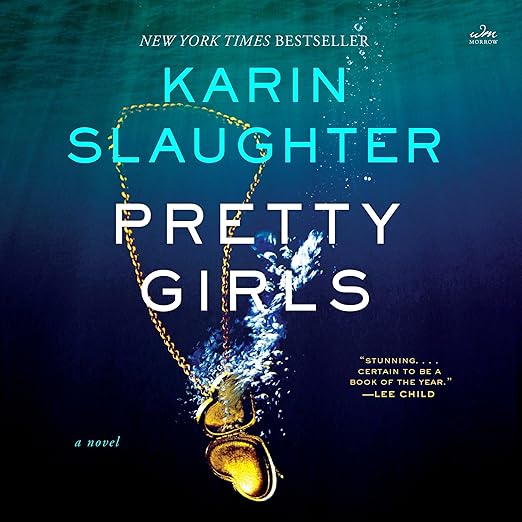
Sisters Claire and Lydia have not spoken in more than twenty years. Karin Slaughter's Pretty Girls audiobook, narrated by Kathleen Early, opens in the aftermath of Julia's disappearance - the teenage sister who vanished when Claire and Lydia were still young, splitting a family that was already under pressure along a fault line that never healed. Lee Child called it stunning. Gillian Flynn said she would follow Slaughter anywhere. Those endorsements are on the jacket, and they are not wrong, but they also do not prepare you for how specifically dark this book becomes or how deliberately Slaughter uses that darkness. This is not atmosphere as branding. It is architecture.
Two Sisters, Two Versions of the Same Truth
The central structural move Slaughter makes is to connect Julia's twenty-five-year-old disappearance to the murder of Claire's husband with a thread that requires both sisters to excavate the worst things their family contained. The two women are rendered as genuine opposites - Claire is the trophy wife of an Atlanta millionaire, performing a class she was not born into; Lydia is a single mother dating an ex-con, living in the financial precarity that Claire escaped - and their estrangement is not a dramatic device but the natural consequence of two different strategies for surviving the same catastrophe. When they are forced back into each other's presence, the collision is not just emotional but epistemological: they have different versions of the truth about Julia's disappearance, and only one of those versions is complete.
What Slaughter handles better than most thriller writers in this register is the domestic predator. The violence in Pretty Girls is specific and procedural in ways that some readers will find difficult, but it is connected to a coherent psychological portrait rather than being deployed for shock. One reviewer cited comparisons to what snuff film culture produces when it has access to infrastructure and impunity - that is the accurate register. The book is interested in how predatory behavior hides behind wealth, social confidence, and the institutional protection that comes with both. That interest gives the darkness a purpose that prevents it from being merely genre horror.
Early Never Cracks Claire's Practiced Composure
Kathleen Early's narration is one of the production's key assets. At eighteen hours and six minutes, this audiobook demands a narrator who can maintain tonal consistency across an extremely wide emotional range, from the surface comedy of Claire navigating her glamorous Atlanta life to the visceral horror of what she discovers underneath it. Early manages the two sister voices with real care - Claire's sentences have a rhythm shaped by decades of performing composure, while Lydia's are rawer and less controlled, and Early distinguishes them through pacing and breath as much as through explicit voice differentiation. The dual timeline, moving between the present investigation and the past circumstances of Julia's disappearance, is handled without the audio confusion that can plague complex thriller structures in this format.
Slaughter's literary credentials are part of what makes Pretty Girls work at the level it does. The comparison to Gone Girl that some readers have made is apt in one specific dimension: both books are interested in what women perform under conditions of vulnerability and what that performance costs. But Slaughter's focus is on class, inherited trauma, and institutional complicity in ways that make Pretty Girls its own distinct object. The indelible characters that the synopsis promises are delivered primarily through the two sisters, who are among the more fully realized protagonists in Slaughter's catalog.
One of the underappreciated structural achievements in Pretty Girls is the way Slaughter uses Claire's apparent privilege as a sustained misdirection. The reader watches Claire navigate a life of material comfort and social standing, and Slaughter allows us to resent her slightly for it - for having escaped what Lydia could not. That resentment is entirely intentional, because it positions the reader to be as wrong as Lydia is about what Claire's life actually contains. The audiobook format is particularly effective at sustaining this misdirection, because Early reads Claire's surface with complete commitment, never allowing the listener to hear a crack in the performance that would cue premature suspicion. The revelation when it comes lands with the force it does because the maintenance was so thorough.
Eighteen Hours of Sustained, Specific Violence
The content warnings that come with Pretty Girls are not performative. This is a book with specific, detailed violence involving women, and listeners who have trauma histories connected to sexual violence or predatory male behavior should approach with genuine awareness of what the book contains. Slaughter does not soften what happens, and the procedural specificity that makes the psychology credible also means that the audiobook goes to places that are genuinely distressing. The length - eighteen hours - means that distress is sustained rather than brief. Listeners who want their psychological thrillers to remain relatively abstract about the nature of the violence will find Pretty Girls more concrete than they want it to be. The twist that the narrative has been building toward requires retrospective re-assessment of almost everything you understood about Claire's life, and some readers find the implications of that reframing more difficult to process than the violent content itself.
Slaughter's Most Ambitious Standalone Work Yet
Psychological thriller listeners who are prepared for darkness that serves a structural purpose rather than simply performing genre will find this among Slaughter's strongest standalone work. Fans of character-driven literary thriller who want the full depth of a sibling relationship shaped by traumatic loss will find Claire and Lydia's estrangement and wary reunion genuinely moving alongside the horror. Listeners who are sensitive to detailed sexual violence or who want their thrillers lighter in emotional weight should not begin this audiobook without reading the content warnings carefully. Readers who followed the Flynn endorsement and want to understand Slaughter's place in the contemporary psychological thriller landscape will find Pretty Girls a fair representation of what she does at her most ambitious.
Does this audiobook contain graphic violence or sexual content?
Yes - Pretty Girls contains specific, detailed descriptions of violence against women and references to predatory sexual crime. This content is structurally central rather than incidental, and Slaughter does not soften it. Listeners with relevant trauma histories should approach with awareness.
Is Pretty Girls part of a series or a standalone audiobook?
Pretty Girls is a standalone novel, not part of Slaughter's Will Trent or Grant County series. No prior familiarity with Slaughter's work is required, and the book's characters and plot are self-contained.