Quick Take
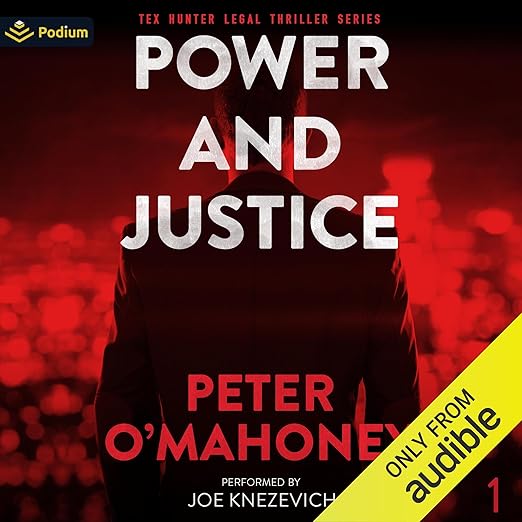
- Narration: Joe Knezevich brings Tex Hunter’s courtroom confidence across cleanly, a reliable performance that keeps legal proceedings engaging without showboating.
- Themes: Political corruption and cover-up, legal defense against institutional power, personal legacy and inherited shame
- Mood: Fast-paced and propulsive
- Verdict: A brisk, well-constructed legal thriller that does exactly what the genre demands and occasionally does more, a solid series opener worth the seven-plus hours.
I have a particular affection for legal thrillers that take their courtroom mechanics seriously without letting them slow the narrative to a crawl. Peter O’Mahoney’s Power and Justice manages that balance well enough that I finished it on a single long Sunday, the kind of day where you find reasons to extend a walk or delay lunch because you want to know how the next complication resolves.
The setup is economical and effective: Robert Sulzberger, a City Council member with what appears from outside to be a perfect life, has been drawn into a world of corruption he cannot escape. When he tries to walk away, he finds himself behind bars and accused of murder. Enter Tex Hunter, criminal defense attorney and son of a convicted serial killer, which gives him, as the synopsis notes pointedly, a particular understanding of how dangerous the forces of politics and public perception can be. That backstory detail is one of the things O’Mahoney does thoughtfully. Hunter’s inheritance of his father’s shadow is not a gimmick; it shapes how he approaches a case where public narrative may be as powerful as evidence.
Our Take on Power and Justice
O’Mahoney writes efficient prose that serves the genre well. The case against Sulzberger is complicated by deception, fraud, and cover-ups, and Hunter has to disentangle the political from the criminal while protecting a client the public has already convicted in absentia. The dark forces of politics that the synopsis promises are rendered with enough specificity to feel like more than backdrop, O’Mahoney understands that institutional corruption operates through mundane systems as much as dramatic villainy, and he uses that understanding to keep the legal proceedings from feeling staged.
Joe Knezevich’s narration is a good fit. He has the measured authority the courtroom sequences require and finds the moments of genuine tension without over-performing them. Several reviewers noted that they didn’t anticipate the ending, which is the highest compliment you can give a legal thriller. One flagged a plot hole they couldn’t set aside, though they refrained from specifying it, worth keeping in mind if you find yourself noticing an unresolved logic gap around the midpoint.
Why Listen to Power and Justice
The Tex Hunter character is the series’ strongest asset, and this debut installment earns the setup. His backstory gives him a moral complexity that distinguishes him from the genre’s standard brilliant-attorney template: he knows what it is to have a parent whose actions define public perception, which means he understands Sulzberger’s dilemma at a level that transcends professional investment. That emotional dimension keeps the book from feeling like an exercise in plot mechanics, even when the pacing runs at the kind of clip that doesn’t leave much room for reflection.
O’Mahoney has published numerous books across multiple series, and the craft shows. Transitions between scenes are clean, witness examinations are handled with enough specificity to feel authentic without requiring legal expertise from the listener, and the villain machinery operates at a scale, media attention, political machinery, dark money, that feels proportionate to the case rather than inflated for effect.
What to Watch For in Power and Justice
The book is listed as standalone-compatible, and it functions that way, but O’Mahoney is clearly establishing a series here rather than writing a one-off. Some of the Tex Hunter personal mythology, his father’s crimes, his own complicated public identity, is introduced with the kind of deliberate pacing that suggests it will pay off across multiple installments. Listeners who start here and want more should know the series is well-established with Podium Audio. The plot hole noted by at least one reviewer is something to file away rather than fret over, the story functions despite it, but listeners who need every gear to mesh precisely should be forewarned.
Who Should Listen to Power and Justice
This is the right listen for legal thriller fans who want their courtroom drama embedded in political corruption rather than isolated in a vacuum, and who appreciate a protagonist whose personal history informs his professional approach. If John Grisham’s earlier conspiracy-adjacent legal work appeals to you, O’Mahoney is operating in recognizable adjacent territory with his own particular wrinkle on the attorney protagonist. Listeners looking for a series they can commit to will find a well-conceived entry here.
Frequently Asked Questions
Does Power and Justice work as a standalone or do I need to read other Tex Hunter books afterward to feel satisfied?
It works fully as a standalone. The Sulzberger case is resolved, the political corruption thread reaches a conclusion, and Tex Hunter’s professional situation is closed by the final chapter. Some personal backstory elements are introduced that suggest future development, but nothing essential is left hanging.
How much legal procedure does Power and Justice actually involve, and will listeners without legal knowledge get lost?
O’Mahoney calibrates the courtroom material well for general audiences. The proceedings are specific enough to feel authentic but explained clearly enough that no legal background is required. The thriller pacing means the legal mechanics serve the drama rather than interrupting it.
What makes Tex Hunter distinctive from other fictional criminal defense attorneys in the legal thriller genre?
The most unusual element is his parentage: Hunter is the son of a convicted serial killer, which gives him an intimate understanding of how public perception can weaponize identity against a defendant. That background shapes his approach to Sulzberger’s case in ways that distinguish him from the genre’s standard brilliant-loner archetype.
Is the plot hole reviewers mentioned significant enough to affect the listening experience of Power and Justice?
The reviewer who flagged it gave four stars despite the issue and described it as preventing a five-star rating rather than damaging the book’s core appeal. Based on context, it appears to be a logic gap in the case mechanics rather than a fundamental story problem. Most listeners who enjoyed the thriller aspects reported not noticing it or not finding it disqualifying.