In Brief
- Narration: Jennifer Jill Araya delivers Heather Hansman's prose with the insider energy the subject demands - she sounds like someone who knows what it means to build your life around a cold-weather obsession rather than performing enthusiasm from the outside.
- Themes: Ski bum subculture and its economic obsolescence, skiing's arc from counterculture roots to corporate megaresort, climate change as existential threat to a way of life
- Mood: Exhilarating and elegy-tinged, like a perfect powder run you already know is ending
- Verdict: Powder Days is the essential audiobook for anyone who has structured a life around a mountain and wants to understand where that culture came from and where it is now going.
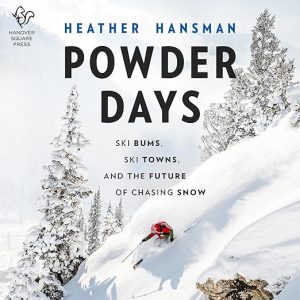
Powder Days earns its Outside Magazine Book Club placement because it accomplishes what most books about subcultures only attempt: it treats skiing's underground as worthy of genuine historical and sociological reckoning without sacrificing the physical joy that makes the subject worth caring about in the first place. Heather Hansman is a veteran ski journalist and a former ski bum herself, and that combination of insider experience and journalistic discipline is the audiobook's central and irreplaceable asset. The Wall Street Journal described it as a sparkling account, and that assessment holds across nearly eight hours of Jennifer Jill Araya's narration. This is the full arc of American ski culture, from the Tenth Mountain Division veterans who came home from World War II and helped build the first organized resorts, through the expansion era, through the corporate consolidation of mom-and-pop hills into megaresort chains, and into the existential threat that climate change now poses to the entire enterprise and the communities that grew around it.
Our Take on Powder Days
The most compelling and ultimately the saddest argument in Powder Days is one Hansman makes persistently without ever belaboring it: the ski bum as a viable life choice is economically extinct in most of the places where the culture was born and where it mattered most. She profiles people who built their lives around the mountain in Vermont, Colorado, Montana, and West Virginia - diehards who accepted poverty wages, shared and overcrowded housing near the slopes, and profound seasonal instability for access to the runs that justified everything else. The portrait that emerges is of a subculture that depended on three conditions simultaneously: cheap lift passes, affordable housing within reach of the mountain, and seasonal work that left real room for powder days. All three of those conditions have been eroded by the consolidation of ski resorts into multinational leisure companies and the general transformation of mountain towns into destination real estate markets for remote workers and wealthy second-home buyers. One reviewer captures this with precision: well-written and sad that this way of life is now unaffordable. Hansman does not romanticize the ski bum ideal uncritically - she is honest about the whiteness of the culture, its sometime insularity, the ways it historically excluded people who did not fit its unspoken assumptions. But she writes about the genuine thing that existed and about the genuine loss of it with the seriousness that any real cultural phenomenon deserves when it passes.
Jennifer Jill Araya's narration makes the individual profiles feel like actual portraits rather than data points arranged to support a thesis. When Hansman hops from Vermont to Colorado to West Virginia to Montana, following the subculture's geography across decades, the audiobook needs a narrator who can convey the specificity of each place and each person without losing the larger historical arc that connects them. Araya manages it. She brings different registers to the oral history sections and the more analytical passages about economics and climate without making the transitions feel jarring or the tonal shifts feel unearned. Hansman's prose style has the compression and precision of good magazine writing - she is a journalist first, and the audio format suits that style. The audiobook is particularly effective for the oral history sections, where Hansman quotes and paraphrases the ski bums she has interviewed across multiple seasons and years. Araya renders these voices with enough distinctiveness that you can feel the difference between the old-timers who built the culture and the younger practitioners trying to survive inside what it has become. The climate sections, which some reviewers found heavier-handed than the cultural history portions, are handled with documentary straightforwardness rather than advocacy rhetoric, which keeps the audiobook's overall tone from tipping into environmental lament and away from the cultural celebration that brought listeners here.
What to Watch For in Powder Days
The sections on climate change and the environmental future of skiing are where the book most deliberately places its cultural celebration into a contemporary frame of crisis, and for some listeners that integration will feel essential to the book's honesty while for others it will feel like a tonal disruption from the celebration they came for. One reviewer appreciated the ski industry evolution coverage while flagging the climate sections as over their preferred territory - a response that honestly reflects the book's hybrid nature between cultural affection and honest reckoning with that culture's future. Hansman is committed to both aspects and does not allow you to enjoy the cultural history without confronting the forces that are ending it. Whether that feels like intellectual honesty or like an unwelcome complication to a book about skiing depends on what you came for. The book is richer for refusing to separate those threads, but readers who want pure ski bum nostalgia without the economic and environmental accounting will not entirely find that here, and knowing that going in will help you receive what the book is actually offering.
Who Should Listen to Powder Days
This audiobook is for skiers, former ski bums, and outdoor culture enthusiasts who want to understand the history and sociology of a subculture they have lived in or observed with admiration. It is equally valuable for readers interested in how American recreational industries evolved from grassroots counterculture into corporate consolidation - the ski industry is a particularly clear and well-documented case study in that transformation. Skip it if you want purely celebratory ski content without the cultural and environmental reckoning; Hansman is too honest a journalist to provide that version. Listeners who have found meaning in long-form outdoor journalism or in books about how places and their communities change under economic pressure will find Powder Days a serious and rewarding listen.
Good to Know
Does this audiobook require skiing experience to enjoy, or is it accessible to non-skiers?
Non-skiers can follow the cultural and historical argument without difficulty. The book is as much about the sociology and economics of ski culture as it is about the sport itself, and Hansman writes for readers who may be encountering this world for the first time. Listeners with direct ski bum experience will recognize the texture of what she is describing, but that recognition is not required to find the audiobook engaging.
How does the audiobook handle the climate change sections relative to the cultural history?
The climate sections are integrated into the larger argument about why the ski bum way of life is under pressure, rather than treated as a separate environmental manifesto. Hansman presents climate change as an existential threat to the culture she is documenting, grounding it in specific resorts and snowpack data. Some reviewers found this coverage heavier than they preferred; others found it the book's most important contribution.
Is Jennifer Jill Araya's narration a good fit for this kind of narrative nonfiction audiobook?
Araya handles both the profile-driven sections and the historical and analytical passages with consistent energy, making the nearly eight-hour runtime feel propulsive rather than exhaustive. For outdoor culture journalism, her approach suits material that depends on a sense of insider familiarity with the world being documented.