Quick Take
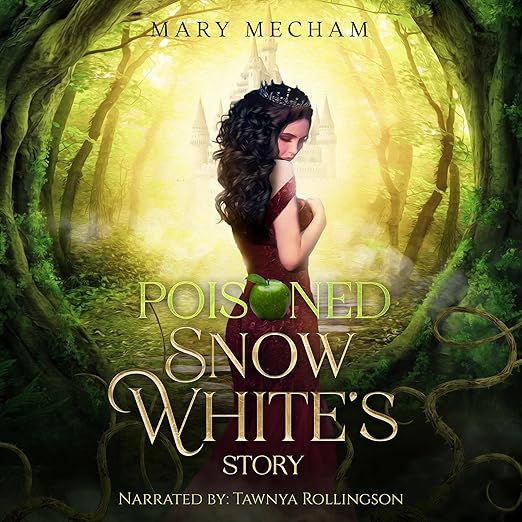
- Narration: Tawnya Rollingson gives the story a warm, unhurried reading that suits the fairy tale register without flattening its more emotionally complex moments.
- Themes: Disability representation and caregiver relationships, the slow erosion of controlling partnerships, the redefinition of happily-ever-after
- Mood: Gentle and quietly subversive, a fairy tale that takes its realism seriously without losing its warmth
- Verdict: A thoughtful, emotionally resonant Snow White retelling that handles its disability representation with genuine care, most affecting for readers who have personal experience with caregiving.
I had been watching disability representation in YA fiction gradually improve for a few years before I came across Mary Mecham’s Poisoned. The improvement tends to be uneven, books that handle visible disability well but trip over the emotional labor of caregiving, or that represent neurodivergence in ways that feel like research rather than understanding. Poisoned handles both more honestly than most.
The premise updates Snow White with a sharp structural choice: the magical elements remain present but largely unexplained, and the story picks up after the famous kiss rather than centering on it. Snow wakes from her poisoned sleep, finds herself accused of her stepmother’s murder, and discovers that the prince she is engaged to is not what the fairy tale promised. She retreats to the cottage of the seven brothers, here recast as adult siblings rather than dwarfs, and forms the central relationships of the book with Oliver, the youngest, who is nonverbal, and Malcolm, his ill-tempered caregiver and older brother.
Our Take on Oliver and the Disability Representation
The most significant departure Mecham makes from the Disney version is the treatment of Oliver, who is clearly positioned as a rewrite of Dopey. Rather than a figure of comic relief, Oliver is a nonverbal person with a disability that is never explicitly named but is rendered with enough specificity to feel grounded rather than symbolic. One reviewer who is a parent of a nonverbal autistic child wrote about recognizing the emotional textures of that relationship, the fatigue, the moments of resentment, the great love, in both Snow’s developing friendship with Oliver and in Malcolm’s role as his primary caregiver. That review is worth reading in full if you have the chance, because it identifies exactly what Mecham gets right: the caregiving relationship is allowed to be complicated without being pathologized.
A reviewer who described themselves as a primary caregiver for a sibling with severe disabilities for over a decade had a more mixed response, appreciating the subject matter while finding some tension with the writing style. That friction is worth noting, this is a YA novel, and the emotional register of YA does not always accommodate the full weight of what long-term caregiving actually costs. The book makes a genuine attempt, but readers with deep personal experience may find the edges simplified.
Why Listen to This Rather Than a Standard Fairy Tale Retelling
Most Snow White retellings are interested in Snow herself, her agency, her awakening, her relationship to the magical economy of the original. Poisoned is unusual in that the disability community around the cottage genuinely shares the story’s center. Oliver and Malcolm are not backdrop characters against whom Snow’s growth is measured; they are subjects with their own interior lives, and the book is as much about what Snow learns to see in them as it is about her own situation. That structural generosity is what elevates this above the standard retelling format.
The controlling fiance, Snow’s engagement to a prince whose charm turns out to be a mechanism of control, is a recognizable contemporary update. The book handles that thread with enough specificity to feel current rather than generic, the way Snow’s time with the brothers is surveilled and eventually forbidden is a convincing portrait of how coercive relationships function.
What to Watch For in Tawnya Rollingson’s Narration
Rollingson reads the material with warmth and an unhurried pace that suits the fairy tale world while making room for the quieter emotional beats. The scenes with Oliver, which rely on action and atmosphere rather than dialogue, require a narrator who can carry meaning without spoken words as a crutch, and Rollingson manages this well. At just under nine hours, the audiobook fits comfortably into a weekend listen. The narration does not reach for drama where the prose is deliberately gentle, which is exactly the right call for this material.
Who Should Listen to This Audiobook
YA readers who appreciate fairy tale retellings with meaningful contemporary themes will find this one of the more thoughtful examples of the genre. Listeners with personal experience of caregiving, parenting a disabled child, caring for a sibling, will likely find the emotional resonance sharpest. Skip it if you want a heavily magical Snow White story with a fast-paced plot; the magic is minimal and largely unexplained, and the pacing is deliberate. And note that the cover and some descriptions may mislead about how central the fantasy elements are, several reviewers flagged the realistic register as a surprise.
Frequently Asked Questions
How much magic is in this Snow White retelling, is it a full fantasy novel?
Very little and largely unexplained. Several reviewers noted that the setting is close to contemporary reality with minimal magical infrastructure, and that the true love’s kiss mechanism is not explained until late in the book. If you come expecting a traditional fairy tale world with magic systems and fantastical elements, you will need to adjust expectations. Mecham is more interested in the human relationships than in world-building the magic.
How accurate and respectful is the representation of Oliver’s disability?
Reviewers with direct personal experience, a parent of a nonverbal autistic child and a long-term caregiver for a disabled sibling, gave mixed but generally positive assessments. The emotional complexity of caregiving is treated with unusual honesty for YA, including fatigue and resentment alongside love. Some readers with deep caregiving experience found certain edges simplified, which is a fair criticism, but the overall representation is handled with genuine care rather than as a plot device.
Is this appropriate for the younger end of the YA readership, or does the content skew older?
The content is appropriate for younger YA readers, there is no explicit content, and the romance develops slowly and chastely. The themes of caregiver burnout and coercive relationships are handled in a way that is accessible without being graphic. Younger readers who know someone with a disability may find the emotional specificity particularly resonant.
Does Snow White have meaningful agency in this retelling, or is the story primarily about Malcolm and Oliver?
Snow is the primary narrator and protagonist, and her growth, learning to see beyond social conditioning, recognizing the coercive nature of her engagement, choosing connection over social approval, is the novel’s central arc. Malcolm and Oliver are central to her story, but the book is Snow’s, and her agency is treated as something she earns through changed perception rather than something she starts with.