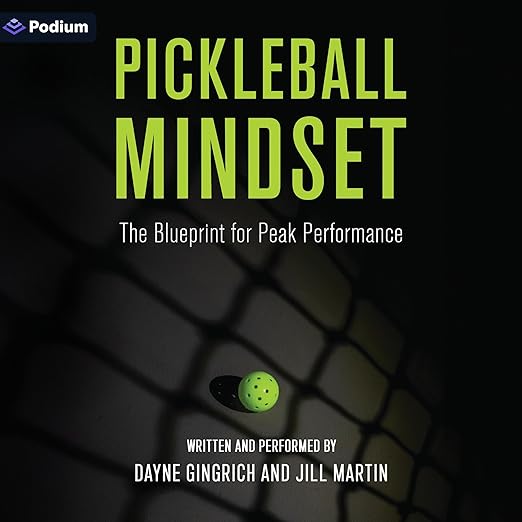
Quick Take
- Narration: Gingrich self-narrates with the measured confidence of an experienced coach; the dual-perspective structure between his coaching chapters and Martin’s experiential accounts is clearly marked and easy to follow.
- Themes: mental dominance in competition, coach-athlete relationship as growth laboratory, translating sport psychology to everyday life
- Mood: Conversational and encouraging without being saccharine
- Verdict: The dual-voice structure, coach and student processing the same material from different vantage points, makes this one of the more honest sports psychology audiobooks available for any racquet sport player.
Pickleball has a visibility problem in the sports psychology space. Despite its explosive growth, from niche retirement sport to one of the fastest-growing recreational activities in North America, the serious mental game literature has not caught up. Most of what exists is technical instruction dressed as psychology. Pickleball Mindset arrives as something genuinely different, and the structural choice at its center is what sets it apart: two authors, two perspectives, one year-long coaching relationship documented in real time.
Dayne Gingrich is a top senior professional pickleball player and mental performance coach. Jill Martin is an attorney who became a personal trainer and pickleball obsessive. Neither of those backgrounds is incidental, they are the engine of the book’s structure. Each chapter presents a mental performance strategy through Gingrich’s coaching lens, then shifts to Martin’s first-person account of trying to implement that strategy in actual competition. The bruises and celebrations she describes are unfiltered in a way that makes the theoretical framework land with practical weight rather than landing as abstract principle.
Our Take on Pickleball Mindset
The what-why-how structure Gingrich uses for each strategy is one of the cleaner organizational frameworks in sports performance audio. He does not simply tell you to build unbreakable self-belief and move on, he works through the mechanism of why belief erodes under pressure, then offers specific practices for rebuilding it before and during competition. The tournament preparation and performance chapter is particularly strong, covering the mental arc from the week before a match to the first point of a new game after a bad one.
Martin’s sections are the surprise strength of the book. She writes like someone who has genuinely struggled with the material rather than someone retrospectively narrating a clean transformation arc. Her account of incorporating the make-or-break moment strategies into a real competitive situation that did not go perfectly is more instructive than a success story would have been. The coaching relationship she documents is not idealized, there are setbacks, resistance, and recalibration, which makes it more believable and more useful as a model.
Why Listen to Pickleball Mindset
The audio version benefits from Gingrich’s self-narration, which brings the coaching chapters a naturalness that a third-party reader would flatten. There is a PDF companion document included with the Audible version, noted in the synopsis, which allows listeners to use the book as a workbook alongside their practice rather than as passive listening. At four hours and fifty-one minutes, the runtime is substantial enough to feel complete without overstaying its welcome.
A key point reviewers consistently raise: this book is useful across skill levels. Beginners who have just discovered pickleball will find the mental game framework gives them a foundation to build their game on rather than retrofitting psychology after years of technical habits. Advanced players who have plateaued will find the partner-selection and self-belief chapters directly address the stagnation that competitive experience can sometimes create.
What to Watch For in Pickleball Mindset
The book is sport-specific enough that listeners seeking a general sports psychology framework applicable across multiple disciplines will find it somewhat narrower than alternatives. The pickleball context is embedded in the examples and language throughout. That specificity is a feature for pickleball players but a limitation for readers hoping to transfer the content wholesale to tennis, golf, or another racquet sport without doing mental translation work.
The co-authorship structure also means some chapters feel slightly uneven in depth, Gingrich’s coaching chapters are typically denser with framework, while Martin’s experiential chapters vary in how much tactical insight they extract from the anecdote. When she is struggling with a strategy, those chapters are some of the most useful in the book. When the struggle resolves quickly, the experiential section can feel thinner than the coaching chapter that preceded it.
Who Should Listen to Pickleball Mindset
Pickleball players at any competitive level who feel their mental game is limiting their performance more than their technical game. Coaches looking for a framework to introduce to students who are technically solid but mentally inconsistent under pressure. Also genuinely useful for players who have struggled with partner dynamics or tournament nerves specifically. Listeners with no interest in pickleball will find little reason to choose this over sport-agnostic mental performance titles, where the examples will not require constant translation.
Frequently Asked Questions
Is Pickleball Mindset applicable to other racquet sports like tennis or padel, or is it too pickleball-specific?
The mental performance strategies Gingrich teaches, self-belief building, tournament preparation, excelling under pressure, are applicable across racquet sports. However, the examples and language are rooted in pickleball throughout. Tennis and padel players will need to do some mental translation, which reduces the friction-free applicability compared to sport-agnostic alternatives.
How does the dual-author structure work in the audiobook format?
Gingrich narrates throughout, handling both his coaching chapters and Martin’s experiential sections. The structural shift between the two voices is marked clearly in the writing, so the transitions are easy to follow even without a second narrator.
Does the book come with any supplementary material in the Audible version?
Yes. The synopsis notes that a PDF companion document is included in the Audible library alongside the audio, which allows listeners to use the book as a workbook rather than purely as passive listening.
Is Pickleball Mindset appropriate for complete beginners to the sport, or does it assume competitive experience?
Multiple reviewers confirm it works for beginners as well as advanced players. Beginners may find the framework gives them a mental foundation to build alongside their technical development, while experienced players who have plateaued will find specific chapters directly address competitive stagnation.