Quick Take
- Narration: Buck Schirner delivers Koontz’s atmospheric prose steadily; his voice suits the investigative, procedural pacing of the middle sections even as the opening horror sequences demand more intensity.
- Themes: Ancient evil confronting modern rationalism, the inadequacy of conventional explanations, small-town isolation
- Mood: Oppressively atmospheric in the first half, more procedural and drawn-out in the second
- Verdict: A Koontz classic that shows its age in pacing and structure; the opening hours are masterful and the payoff is genuinely original, but the middle stretch requires patience.
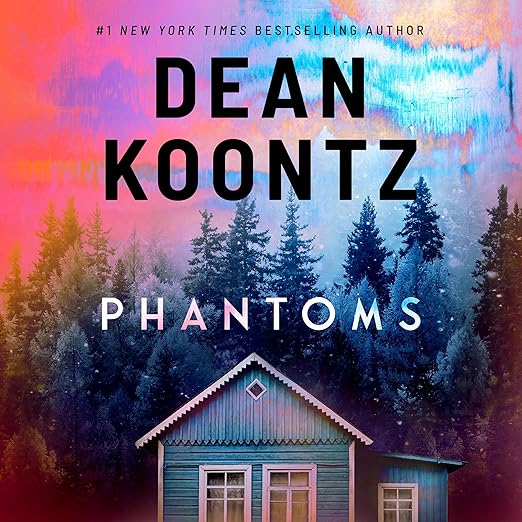
I came to Phantoms the same way several reviewers apparently did: as a revisit to something encountered in a different decade, now filtered through the audiobook format and the particular strangeness of hearing a horror novel while going about ordinary daily tasks. I listened to the first few hours on a Monday morning commute, which is probably not the ideal context for Dean Koontz at his most unsettling. By the time I arrived at my destination, Snowfield, California had lodged itself firmly in my imagination in a way that required some deliberate dislodging.
The setup is almost withheld from the reader, which is the right instinct. Two sisters arrive in the small mountain town of Snowfield to find it silent. Then they find the first body. Then more. One hundred and fifty dead. Three hundred and fifty missing. The remaining population is simply gone. That opening section is among the most effective horror scene-setting Koontz has produced: it is specific, patient, and builds dread through accumulation rather than event. Every reasonable explanation the characters and the reader reach for gets quietly dismantled. The procedural exhaustion of wrong answers is itself part of the horror.
Our Take on Phantoms
The investigators arrive, and this is where the book shifts register. Koontz constructs a plausible scientific framework for what is happening in Snowfield, and the process of that construction is genuinely interesting. He draws on actual historical instances of mass death and disappearance to contextualize the events, which gives the explanation a grounded quality that pure supernatural horror often lacks. The reveal, when it comes, is original enough to reward the patience the middle section demands. The epilogue then recontextualizes the entire story in a way that several reviewers describe as the moment the narrative fully coheres.
Why Listen to Phantoms
The audiobook format works particularly well for the first half of this novel. Koontz’s descriptive prose, which one reviewer specifically notes for its eerie specificity, benefits from the audio pace that prevents the skim-reading that can undermine horror’s atmospheric accumulation. Buck Schirner’s narration is consistent and clear; he does not push for effect in the quieter investigative passages, which is the correct reading of Koontz’s intent. The 14-hour runtime also gives the book room to breathe in ways that abridged versions of Koontz’s work historically did not, and the full text is worth having.
What to Watch For in Phantoms
Multiple reviewers identify the same structural issue: the book reels you in completely in the first half and then loses momentum in the middle sections as the investigation becomes procedural. One listener noted that they were able to finish passively via audiobook in a way they could not have sustained if reading the text directly, which is an honest observation about where the pacing falters. The use of a 14-year-old character, Lisa, for horror effect is noted by one reviewer as feeling unnecessary; it is a fair criticism that points to a broader Koontz tendency of this period to use child vulnerability as a horror amplifier. Those who read this in the 1980s or 1990s will find some elements showing their age; those encountering it fresh in audio may find the middle stretch tests their patience.
Who Should Listen to Phantoms
Koontz fans who have not read this title are the obvious audience; it represents him operating at the height of his powers in terms of atmospheric scene-setting and plausible supernatural invention. Horror listeners who enjoy the procedural investigation structure alongside the horror will tolerate the middle sections more readily than those who want continuous escalation. Those who bounced off the physical book’s pacing may find the audio format provides just enough passive engagement to carry them through the slower passages to a payoff that is worth the investment. This is not a book that rewards speed; it is a book that rewards patient, immersive listening. Buck Schirner’s narration is part of what makes that patience sustainable; his steady delivery prevents the middle sections from becoming actively frustrating even when the pacing slows.
Frequently Asked Questions
Is the horror reveal in Phantoms supernatural or does Koontz provide a scientific explanation?
Koontz constructs a plausible scientific framework for the events in Snowfield, grounding the explanation in actual historical instances of mass death and disappearance. The explanation is original rather than relying on standard supernatural conventions, which is part of what reviewers find rewarding about the payoff.
How does the 14-hour runtime hold up throughout, or does the book drag in places?
Multiple reviewers identify a pacing drop in the middle sections as the investigation becomes procedural after the very strong opening. The first few hours and the conclusion are the book’s strongest passages. The audio format helps carry listeners through the slower middle stretch because it enables passive engagement.
This was published in the mid-1980s. How well does the horror hold up for contemporary readers?
The atmospheric setup and the originality of the central concept hold up well. Some structural elements, including the use of a child character for horror effect, feel more dated. Reviewers who revisit it from the 1980s consistently describe the opening as effective regardless of when they encounter it.
Does the epilogue change how the rest of the novel reads, and is it worth listening through to the end?
Yes, significantly. Multiple reviewers describe the epilogue as recontextualizing the story and making the whole narrative cohere in ways that were unclear before it. Stopping before the epilogue would leave the experience incomplete.