Quick Take
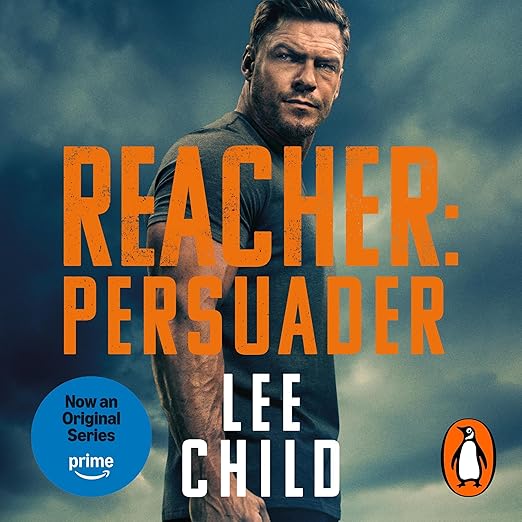
- Narration: Jeff Harding is the canonical Jack Reacher voice for British editions , authoritative, dry, and exactly calibrated to the character’s particular brand of controlled menace.
- Themes: Undercover deception, moral complexity, the weight of past missions
- Mood: Tense and procedural, with the satisfying rhythm of a well-oiled thriller machine
- Verdict: One of the stronger entries in the Reacher series, with an unusually personal stake and a dual-timeline structure that rewards patience even when it occasionally frustrates.
I have listened to a fair number of the Jack Reacher novels at this point, and I have learned something about how to place them in my week. Persuader is not background listening. It is the kind of audiobook that sits in your earbuds and demands your attention , not because it is complicated in the literary sense, but because Lee Child plants information early and retrieves it late, and missing a detail costs you. I gave this one my evening commutes and two long walks, and Child earned every minute.
Persuader is the seventh novel in the Jack Reacher series, though Child has been clear that these can be read in any order. This particular entry is notable for being written in first person , a choice Child uses infrequently and one that changes the texture of the Reacher experience considerably. One reviewer described it as a pleasant surprise, noting that this quality of directness is part of what makes Reacher’s rare first-person outings feel different from the more common third-person entries. The immediacy works for this story in particular, which is built on a deeply personal mission.
Our Take on Persuader
The setup is a kidnapping that Reacher witnesses and intervenes in , with consequences that include a dead cop and a Reacher who appears to have crossed a line. It is not a setup, exactly, though it becomes one. The plot coils around an undercover operation that connects Reacher’s present to an unresolved past involving an adversary named Quinn, and the dual timeline structure , cutting between current events and flashbacks to a mission from ten years earlier , is both the novel’s most interesting structural choice and its most debated one.
A reviewer called it somewhat confusing and a bit verbose, while another described the same back-and-forth as one of those books with my stomach in knots and had me turning pages one right after the next. Both responses are valid, and they reflect something real about Child’s approach in this novel: the payoff is proportional to your willingness to sit with the structure. Quinn’s apparent death and recovery draws some skepticism, and the back-and-forth between timelines asks for more patience than a standard Reacher installment. But Child earns the dual structure by the time the threads converge.
Why Listen to Persuader
Jeff Harding is the right narrator for this material. His delivery has been praised by The Sunday Times, which noted that his narration captures Reacher’s character perfectly and that you have to savour every minute. That is not hyperbole. Harding brings a quality of controlled authority to Reacher’s inner monologue that makes even the exposition feel propulsive rather than static. The Daily Mail’s description of the novel itself as ballsy and dynamic also applies to Harding’s interpretation of it.
For listeners who have only encountered Reacher through the Alan Ritchson television series, this audiobook will feel both familiar and expanded. The TV show captures Reacher’s physicality and competence; the first-person novel adds an inner life , tactical, self-aware, and occasionally sardonic , that the screen adaptation compresses. Both are good; they are doing different things with the same character.
What to Watch For in Persuader
The dual timeline is the principal structural challenge. Child moves back and forth between Reacher’s present operation and a mission from a decade earlier with regularity, and the transitions can feel abrupt if you are not following closely. The present-tense tension and the historical context are genuinely interdependent by the final third, but getting there requires trust in Child’s architecture. Listeners who prefer a single clean timeline may find this among the more demanding Reacher entries.
The novel’s violence is typically Reacher-calibrated: efficient, consequence-bearing, and occasionally surgical in its detail. Nothing here exceeds what the series has established as its register, but new readers should understand the books are not gentle.
Who Should Listen to Persuader
Recommended unreservedly for established Reacher listeners, particularly those who have been curious about what Child does when he shifts to first person. The personal stakes are higher here than in many entries, and the dual timeline adds genuine structural interest to what might otherwise be a straightforward undercover assignment.
New Reacher readers can absolutely start here, as Child has designed the series for non-sequential reading. But listeners who lack tolerance for extended setups or timeline interleaving will have an easier time with some of the more propulsive third-person entries in the series.
Frequently Asked Questions
Is Persuader written in first person like some other Reacher novels, and does that affect the audiobook experience?
Yes, it is one of the relatively few Reacher novels written in first person. The effect on the audiobook is significant , Harding’s narration becomes more interior and immediate, which most listeners find adds distinctive tension compared to the third-person entries.
Do I need to have read the previous six Jack Reacher novels to follow Persuader?
No. Child designed the series for non-sequential reading. Persuader references some of Reacher’s military past, but provides enough context within the novel that new listeners will not feel lost.
How does the dual timeline structure work in practice, and is it confusing?
Child cuts regularly between current events and a mission from ten years earlier. Some listeners find the structure adds depth; others find it slows the pace. The two timelines converge meaningfully by the end, but it requires closer attention than a single-timeline thriller.
Is Jeff Harding the same narrator as the other UK Reacher audiobooks, and is he good?
Harding has narrated many of the UK Reacher audiobooks and is widely considered one of the better interpretations of the character in audio. The Sunday Times praised his narration specifically for this novel.