Quick Take
- Narration: Susan Ericksen has been the voice of Eve Dallas for decades, and her performance here vibrates with the series’ accumulated energy, new and returning characters handled with equal assurance.
- Themes: LGBTQ+ love and loss, premeditation vs. passion in violent crime, the toll of long police work on character
- Mood: Familiar and propulsive, with an undertone of emotional fatigue that feels genuinely new for the series
- Verdict: Entry 59 in the In Death series delivers what dedicated listeners expect while threading a new emotional note through the procedural machinery.
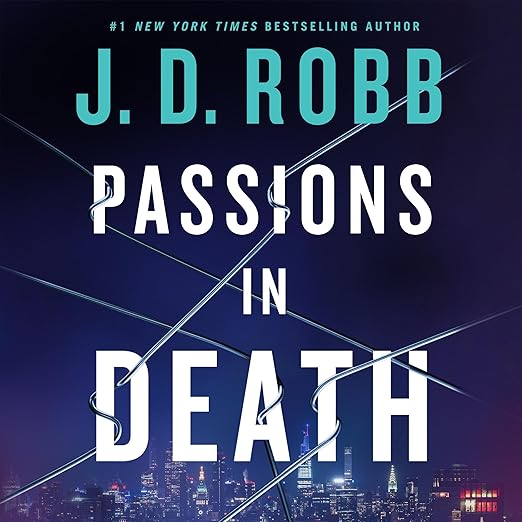
I have been listening to the In Death series for long enough that checking in on Eve Dallas and Roarke has the quality of visiting old friends in a city that changes around them but stays somehow the same. Book 59 is not the place to start that conversation. Passions in Death is a novel built on the accumulated weight of fifty-eight prior entries, and J.D. Robb knows it. She is writing for an audience that does not need the world explained, and the pleasure she delivers is the pleasure of watching a writer move with complete confidence in material she has been developing for decades.
The case begins at the Down and Dirty club, where a pre-wedding girls’ night out turns into a murder scene. One of the brides, Erin, is found garroted in a private room where she was setting up a surprise: two carefully saved tickets to Hawaii for her fiancee’s honeymoon gift. The crime has a particular cruelty to it, and Robb frames it immediately through Eve’s personal history: the club was the site of an assault that Eve herself survived years ago. That biographical thread, the way this case reopens something for Eve, is what gives Passions in Death its emotional texture beyond the procedural scaffolding.
Our Take on Passions in Death
This is not Robb operating at maximum intensity. Several reviewers noted that the mystery itself is less intricate than some prior entries, and one longtime reader found the content not as exciting as previous stories and wished for more of the supporting cast. Both observations are fair. The case resolves through a pattern that careful listeners will likely identify before Eve does, and the investigation spends more time on character reflection than on plot twists. But those reflections are the point. One reviewer identified something interesting: the growing sense that the job wears more on Dallas and satisfies less, a detail that suggests Robb is tracking the emotional sustainability of a fifty-nine-book arc with more care than the average long-running series author.
Why Listen to Passions in Death
Susan Ericksen is the constant that holds the In Death audiobooks together, and her performance in Passions in Death carries the full history of her work with this series. The AudioFile note in the book’s metadata, that her performance vibrates with energy, is accurate. She has been with Eve since the beginning, and she plays the emotional registers of this particular entry, Eve’s quiet recognition of her own past trauma, the grief of Erin’s fiancee, the specific brutality of a crime committed at what should have been a joyful occasion, with the restraint that the material requires. Ericksen does not oversell; she trusts the writing, and the writing trusts her back.
What to Watch For in Passions in Death
At entry 59, this novel is explicitly not designed for new readers. One reviewer stated with characteristic directness: those who have been reading these books do not need a recommendation, yet for those who have not, they need to start at the beginning. That is not protective gatekeeping; it is accurate. The relationship between Eve and Roarke, the dynamics with Peabody and McNab and Summerset, the specific emotional grammar of the series, these are legible only with prior context. First-time listeners who begin here will find a competent mystery novel but miss the accumulated resonance that makes it work for the dedicated audience. The pacing criticism that some reviewers noted, too much time vacillating between suspects in the final section, is worth flagging for listeners who value procedural tightness over character depth.
Who Should Listen to Passions in Death
Dedicated In Death readers will find everything they come to the series for: Ericksen’s narration, the New York of the future, Eve and Roarke’s relationship, the Down and Dirty and Crack’s return, and a case that engages with themes of love, jealousy, and the particular violence that intimate obsession generates. New listeners should start at the beginning of the series, ideally with Naked in Death, and work forward. The fifty-nine-book investment is not a small ask, but the readers who have made it consistently describe the series as one of the most satisfying long-running audio experiences in crime fiction.
Frequently Asked Questions
Is Passions in Death a good starting point for the In Death series, or do I need to start from the beginning?
Start from the beginning. Every reviewer who addresses this question agrees: beginning with Naked in Death and working forward is not just recommended but necessary for the emotional experience to function. Passions in Death is entry 59 and built entirely on prior context.
Does the Down and Dirty club setting in Passions in Death connect to earlier books in the series?
Yes. The club is a recurring setting in the series, and its significance to Eve’s personal history connects to events from earlier entries. Readers who know those events will find the emotional weight of this setting deliberately activated by Robb; those who do not will miss the resonance.
How does Susan Ericksen’s narration hold up across 59 entries, and is her performance still strong in Passions in Death?
Ericksen’s performance is consistently praised across the series, and Passions in Death is no exception. AudioFile noted her Earphones Award-winning work on the previous entry, Desperation in Death, and reviewers here describe the same energized, character-specific precision. She is one of the best long-form audio series narrators working.
Is the mystery in Passions in Death particularly complex, or is it more character-driven than plot-driven?
More character-driven than most In Death entries. Several reviewers noted that the case itself is less intricate than some prior novels and that attentive listeners will likely identify the killer before Eve does. The book’s real interest is in Eve’s emotional processing of a crime that mirrors her own past trauma rather than in procedural complexity.