Quick Take
- Narration: Lincoln Hoppe brings energy and range to the young people’s adaptation; he handles the ensemble of characters from multiple countries with clarity and without caricature.
- Themes: Refugee experience, community integration, the universality of sport
- Mood: Inspiring and socially aware, occasionally simplified for younger readers
- Verdict: A story of genuine substance that works on multiple levels, strongest when it trusts the complexity of its real subjects rather than smoothing it for a younger audience.
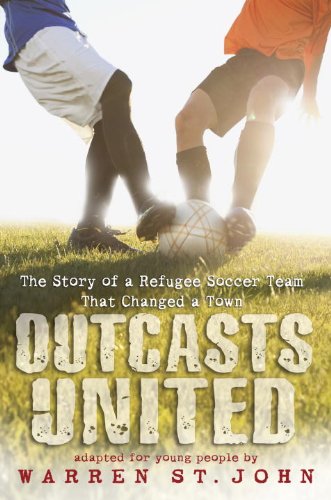
I picked up Outcasts United expecting the kind of inspirational sports narrative that I have learned to approach with measured expectations. The genre has a formula: an underdog team, an unlikely coach, a skeptical community that eventually comes around. Warren St. John’s book earns its place in that tradition, but it does more than coast on the formula. The story of the Fugees and their coach Luma Mufleh is genuinely unusual, and the young people’s adaptation preserves enough of that complexity to make it worthwhile for listeners well outside the stated target age range.
I finished the bulk of this audiobook during a Saturday afternoon run, which felt appropriate given the book’s sustained attention to what it costs to keep showing up. Coach Luma Mufleh, a Jordanian woman who trained in the United States and eventually left a comfortable coaching job to start a refugee soccer team in Clarkston, Georgia, is the kind of subject a writer either does justice to or squanders. St. John does her justice, and Lincoln Hoppe’s narration gives the material the forward energy it needs across thirteen hours.
Clarkston, Georgia, and the Friction of Arrival
One of the book’s genuine strengths is its portrait of Clarkston itself. The Atlanta suburb had been designated a refugee resettlement site, and the arrival of families from Somalia, Sudan, Afghanistan, Iraq, Bosnia, and elsewhere over a relatively short period created a community under real stress from multiple directions. St. John does not pretend that all long-term residents embraced the change or that all the refugees understood what they were arriving into. The tension is real and the book names it rather than skating past it in favor of a simpler inspirational narrative.
The Fugees functioned partly as a social institution rather than purely as a sporting organization. Mufleh set academic standards alongside athletic ones and cut players who could not meet them, a choice that created friction but also signaled to the players that she saw them as full human beings with futures rather than charity cases to be managed. Multiple reviewers describe this element of the story as the one that stays with them longest, because it represents a form of respect that is more demanding than simple accommodation.
What Luma Mufleh’s Coaching Actually Looked Like
The young people’s adaptation wisely keeps Mufleh’s methods complicated. She was demanding in ways that could read as harsh, and some families initially resisted her authority. The boys she worked with came from backgrounds where authority figures had been genuinely dangerous, and learning to trust a female coach required time and real experience of her consistency. Lincoln Hoppe’s narration captures the range of the characters she worked with without reducing anyone to a single defining trait.
The athletic scenes are handled with enough specificity to satisfy listeners who care about soccer and enough context to keep those who don’t from losing the thread. The team’s lack of resources, no home field for much of their existence, minimal funding, no sideline support at early matches, is woven through the narrative rather than dropped in as exposition. It makes the matches, when they come, feel genuinely earned rather than structurally inevitable.
The Young People’s Edition and Its Tradeoffs
This audiobook is based on the young people’s edition of the adult bestseller, and that distinction matters for adult listeners considering the recording. The adult version of Outcasts United contains more political and historical context about the refugee situations that drove each family’s displacement. The young people’s edition streamlines some of that material. For the intended audience, the streamlining is appropriate. For adult listeners, the original may offer more on the political dimensions of resettlement policy and international displacement.
Starred reviews from School Library Journal and Kirkus Reviews praise it for motivating messages that resonate with teen readers, and that assessment is accurate. The book works best not as a motivational exercise but as an honest portrait of what community-building actually requires from everyone involved. That portrait is present even in compressed form. St. John writes at a pace that one reviewer accurately describes as fast, which benefits both teen readers and adult listeners who want the story to move.
Where the Story Earns Its Standing
The most affecting dimension of Outcasts United is its honesty about what did not happen after Mufleh’s team formed. The community did not seamlessly transform. Long-term residents did not universally celebrate what refugee resettlement meant for their neighborhood. And the kids on the Fugees themselves carried experiences of loss and displacement that a soccer team could not resolve. St. John respects those limits rather than pretending the sport solved problems it could only partially address. That restraint is what makes the book worth recommending to listeners of any age.
Frequently Asked Questions
Should adult listeners seek out the original adult edition rather than this young people’s adaptation?
Possibly. The adult edition contains more political context about the refugee crises driving each family’s displacement. The young people’s edition streamlines this material but preserves the core story. Both are worthwhile depending on how much political context you want.
How does Lincoln Hoppe handle the multinational cast from Somalia, Sudan, Afghanistan, Bosnia, and elsewhere?
Reviewers and listeners consistently praise Hoppe for distinguishing the ensemble without resorting to caricature. He provides enough vocal differentiation to track individual stories without making the characterizations feel like performance.
Is Outcasts United suitable for school or classroom listening beyond its young people’s target audience?
Yes. The book’s themes of refugee integration, community tension, and the ethics of coaching are substantive enough for high school and college discussion. Several reviewers describe it as useful for understanding race, class, and culture in the contemporary American South.
How does Coach Luma Mufleh’s coaching philosophy differ from typical youth sports narratives?
Mufleh set academic requirements alongside athletic ones and was willing to cut players who did not meet them. She also built her team without institutional support, which makes her methods more visibly demanding than most inspirational coaching stories acknowledge.