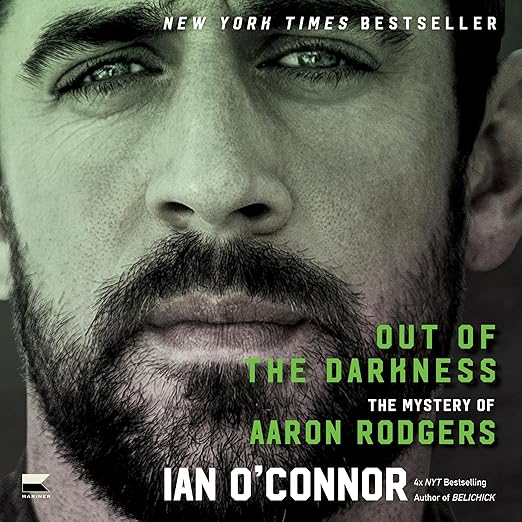
Quick Take
- Narration: Charles Constant delivers a solid, journalistic reading that suits O’Connor’s reporting-driven style, clear and authoritative without attempting to dramatize material that is already dramatic on its own.
- Themes: Athletic genius alongside psychological complexity, the mythology of American football, the cost of estrangement from family and team
- Mood: Methodical and serious, with the measured pace of investigative sports biography rather than fan tribute
- Verdict: The definitive reported biography of Aaron Rodgers, drawing on hundreds of original interviews to produce a portrait that is more honest and more complicated than the NFL’s official narrative, required reading for football fans who want more than highlight reels.
I was listening to Out of the Darkness during the week of the 2024 NFL playoffs, which meant every sports radio segment was either eulogizing or litigating Aaron Rodgers’ legacy in real time. Having Ian O’Connor’s biography in my ears simultaneously was a strange and clarifying experience. The book gave me the architecture beneath the noise, not the takes, but the actual reported account of how one of the two or three most talented quarterbacks in NFL history became also the league’s most polarizing figure. I came away with a more complicated view of Rodgers than I had before, which is exactly what a biography of this quality should produce.
O’Connor is a four-time New York Times bestselling sports biographer who has previously written definitive accounts of Bill Belichick, Derek Jeter, and Jack Nicklaus, among others. His method is reporter-first: hundreds of original interviews, a commitment to presenting multiple perspectives, and a willingness to let contradictions stand rather than resolve them into a clean narrative. The result is a book that does not take sides on Aaron Rodgers. It presents the evidence and lets the reader do the evaluation, which is more intellectually honest than most sports biography.
Our Take on Out of the Darkness
The range of O’Connor’s reporting is the book’s greatest strength. He covers the full arc: Rodgers’ draft experience, in which he fell unexpectedly to the 24th pick despite being considered the best quarterback in the class, watching from the Green Bay table as team after team passed on him, through his complicated succession of Brett Favre, his Super Bowl XLV performance, the long tensions with the Packers organization, his Covid stance and its public fallout, his spiritual searching, his Achilles rupture on Monday Night Football in front of the largest audience in ESPN history, and his remarkable comeback timeline. That is an enormous amount of material, and O’Connor organizes it with the confidence of someone who knows the story thoroughly.
The estrangement from his family is handled carefully but directly. This is one of the aspects of Rodgers’ life that has generated the most public speculation, and O’Connor brings actual reporting to it rather than gossip or inference. The picture that emerges is genuinely complicated, not a simple villain or victim narrative, and O’Connor resists the temptation to adjudicate it. That restraint is the right call for a subject this sensitive.
Why Listen to Out of the Darkness
Charles Constant’s narration suits the material well. O’Connor writes in the clean, authoritative style of long-form sports journalism, and Constant delivers it with the steady pace that allows the reporting to breathe. At thirteen hours, this is a substantial listen, but the pacing does not drag, the material is dense enough that the runtime feels appropriate rather than indulgent.
One reviewer noted that there are perhaps too many game recaps for some tastes. That is a fair observation. O’Connor is thorough in his coverage of Rodgers’ on-field performance because the on-field performance is inseparable from the off-field mythology, the comeback from the Achilles, the precision under the Green Bay pressure, the individual brilliance that made the organizational tensions so costly to ignore. Listeners who are primarily interested in the psychological and personal dimensions may find themselves moving through some of those passages faster than others.
What to Watch For in Out of the Darkness
The book was published in August 2024, which means it captures Rodgers’ return from the Achilles injury and his 2024 season context without having the benefit of his full Jets tenure concluded. Some readers will want a more definitive accounting of whether the New York chapter ultimately redeems or complicates the arc O’Connor is tracing, and the honest answer is that the story was still in progress when this went to press. That is the inherent limitation of a biography of a living subject still actively competing.
The book’s subtitle, “A Biography of Aaron Rodgers”, somewhat undersells its scope. O’Connor is as interested in the institutions around Rodgers as he is in Rodgers himself: the Packers organization, the Jets’ decades-long drought, the NFL’s culture around player control and franchise building. Readers who want a purely psychological portrait of Rodgers himself may find the institutional detail occasionally diverting, but it gives the biography a solidity that purely personality-driven sports bios often lack.
Who Should Listen to Out of the Darkness
NFL fans who want to understand Aaron Rodgers, not the social media version, not the controversial opinion version, but the actually reported account of what shaped him, should start here. O’Connor’s track record with subjects like Belichick and Jeter suggests he knows how to handle complicated sporting figures without hagiography or hatchet job, and he applies the same discipline to Rodgers. Listeners with only casual football knowledge may find some of the Packers organizational history and game analysis requires more background than they have. But for anyone who has watched Rodgers play and wondered what is actually going on beneath the performance, this book is the most rigorous answer currently available.
Frequently Asked Questions
Does Out of the Darkness take a clear position on Aaron Rodgers, sympathetic or critical, or does it maintain journalistic balance?
O’Connor maintains genuine balance. He presents multiple perspectives on every major controversy, the Covid stance, the family estrangement, the Packers tensions, and lets the reporting speak rather than adjudicating between camps. Rodgers fans and critics will both find material that confirms and challenges their views.
How does the book handle Rodgers’ controversial Covid vaccination stance and its public fallout?
It covers the controversy directly and in context, using original reporting to document how the stance developed, how it was received within the organization and league, and what it revealed about Rodgers’ relationship to institutional authority and public scrutiny. O’Connor does not editorialize heavily; he reports and contextualizes.
Does the biography cover Rodgers’ Achilles rupture and recovery in detail, given that it was one of the biggest stories of the 2023 NFL season?
Yes, it is one of the book’s major sections. O’Connor covers the Monday Night Football injury in front of what was then the largest ESPN audience in history, documents the fastest recorded Achilles comeback in professional football, and situates the recovery within the larger arc of Rodgers’ career motivations.
How does Charles Constant’s narration compare to the material’s inherent drama, does the delivery match the subject’s intensity?
Constant’s style is measured and journalistic rather than theatrical, which is the right choice for O’Connor’s reporting-first approach. Listeners wanting dramatic performance may find it understated, but for a reported biography this calibrated, the controlled delivery serves the credibility of the material.