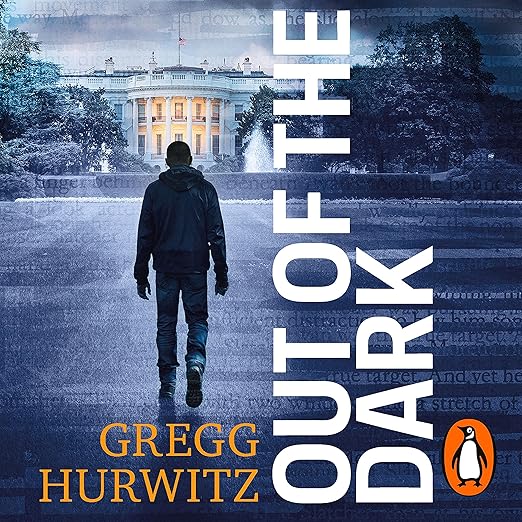
Quick Take
- Narration: Scott Brick is the ideal voice for Evan Smoak, delivering the character’s controlled intensity with practiced authority.
- Themes: Government accountability, the ethics of violence, identity beyond mission
- Mood: Taut and relentless, with unexpected emotional depth in the quieter scenes
- Verdict: The strongest entry in the Orphan X series to that point, and the one where Gregg Hurwitz earns the praise from Lee Child and Harlan Coben on the cover.
I was halfway through a late Tuesday commute when Evan Smoak received the news that the man he needed to kill was the President of the United States. I sat with that for a moment, because Gregg Hurwitz had constructed the preceding hundred pages of Out of the Dark with enough architectural precision that the reveal felt inevitable rather than absurd. That is the trick. The Orphan X series runs on a premise that could collapse into camp at any point, a child taken from an orphanage, trained as an off-the-books government assassin, now operating as a vigilante who helps people the system has failed, and Hurwitz does not let it collapse. By book four, he has found the thing that elevates a thriller series above its premise: a character who is genuinely changing.
Jonathan Bennett is President of the United States and the architect of the Orphan program. He wants the program’s history erased, which means he wants Evan erased. Evan’s solution, one of the more audacious setups in recent thriller fiction, is to take the fight directly to the most protected man on the planet. What follows is twelve hours and forty-eight minutes of exactly what the cover blurbs from David Baldacci, James Patterson, and Lee Child promise, but delivered with more craft than those endorsements typically signal.
Our Take on Out of the Dark
Reviewer Barry Melius identified this as the first Orphan X novel good enough for his rereads pile, the point where Evan morphs from a cardboard cutout to a realistic, sympathetic human. That tracks with what Hurwitz is doing structurally. The earlier books established the character’s competencies, the rigorous training, the specific ethics, the way Evan thinks through problems with the same care he applies to killing. Book four pays on those investments. The scenes with the surviving Orphans, who have tried to build ordinary lives while being systematically hunted, give the action a weight it did not always carry in the earlier installments. Evan is protecting people who chose to stop being what he still is, and that moral complexity is the book’s emotional engine.
Why Listen to Out of the Dark
Scott Brick has been the voice of Evan Smoak throughout the series, and that continuity matters. Brick understands Evan’s register, the controlled flat affect that communicates competence without warmth, and the moments where that affect cracks slightly and something human shows through. At nearly thirteen hours, the audiobook is substantial, but the pacing is tight enough that the runtime feels appropriate rather than indulgent. Hurwitz writes action sequences that Brick navigates with practiced authority, and the quieter scenes, Evan’s Spartan apartment, his careful rituals, the people he lets himself care about, land with the restraint they require. This is a series that rewards listeners who have followed Evan from the beginning, and Brick’s consistency across the books is part of why.
What to Watch For in Out of the Dark
New listeners can technically start here, but the relationships and history that make the action matter are built across the previous three books. The premise depends on an accumulation of trust between reader and character. The thriller mechanics are solid enough that a newcomer will be entertained, but they will not feel the full force of what Hurwitz is doing with Evan’s arc. The White House infiltration sequences are where the book shows the strain of its premise most clearly, the logistics require some suspension of disbelief that Hurwitz mostly earns through pace and detail rather than plausibility. Readers who engage with thrillers on those terms will have no problem. Those who insist on procedural realism in their political thrillers may find themselves resistant.
Who Should Listen to Out of the Dark
Series readers who have been following Evan Smoak should come to this immediately. Those new to Orphan X who enjoy smart, propulsive thrillers with genuine character work should start at book one and work forward. The series is worth the investment, and this is the installment where that investment pays off most clearly. Listeners who want political thrillers with genuine stakes and a protagonist who is more than a vehicle for competence porn will find Hurwitz delivering exactly that.
Frequently Asked Questions
Do I need to read the previous three Orphan X books before Out of the Dark?
The book is designed to be accessible to new readers on the thriller level, but the emotional weight of Evan’s relationships and history depends on the earlier books. Most reviewers and longtime fans consider this the series’ strongest entry, which suggests the investment in the earlier volumes pays off here.
How does Scott Brick compare to other potential narrators for this kind of thriller?
Brick is one of the most experienced thriller narrators working, and his consistency across the Orphan X series is an asset. He has narrated hundreds of titles and his control of pace and tone in action-driven material is reliable. The Evan Smoak character fits his voice well.
Is the premise of killing the President handled seriously or does it veer into pulp territory?
Hurwitz takes the premise seriously enough to build real tension around the logistics and moral implications, while keeping the pacing of a thriller rather than a political novel. The endorsements from Lee Child, Harlan Coben, and David Baldacci on the cover reflect the consensus that he earns the premise rather than simply deploying it.
How does Out of the Dark fit into the overall Orphan X series arc? Is it a good stopping point?
The book resolves its central conflict while leaving Evan’s ongoing life and certain relationships open for future development. It works as a satisfying endpoint for the arc begun in book one, though the series continues. Reviewers describe it as the best entry, which suggests it lands on a high note whether you continue or not.