Quick Take
- Narration: Kevin T. Collins brings the right gravitas to this Depression-era story, handling the racetrack atmosphere and the social history with equal competence.
- Themes: Underdog triumph, the democratization of American sport, working-class pride
- Mood: Warm and propulsive, with a strong sense of historical place
- Verdict: Carroll’s biography of Stymie and Hirsch Jacobs is a richly detailed portrait of two improbable champions that earns its place alongside the best sports history audiobooks in the genre.
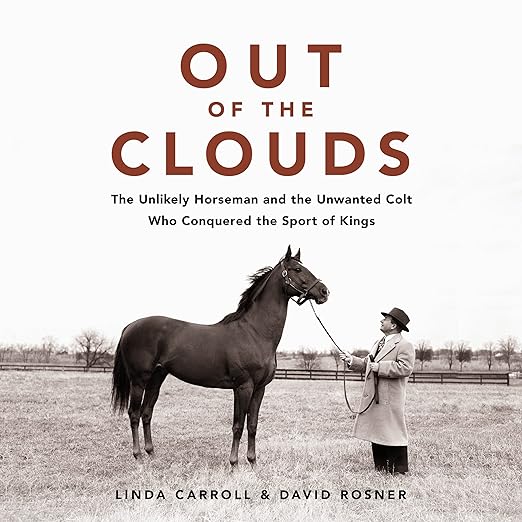
I was halfway through the chapter on Stymie’s improbable claiming price, $1,500 for a colt that had won seven of his first fifty starts, when I had to pause and just sit with that number for a moment. I grew up with a general awareness that horse racing had once held a cultural grip on America comparable to baseball, but Out of the Clouds makes that reality vivid in a way that sports history rarely does. Linda Carroll is not simply telling the story of a horse. She is reconstructing a specific emotional climate, postwar America’s hunger for proof that underdogs could win, and placing Stymie and his trainer Hirsch Jacobs at the center of it with precision and feeling.
The book won the Dr. Tony Ryan Book Award, which is the most prestigious prize in equestrian writing, and that distinction is earned. Carroll structures her narrative as a dual portrait: Stymie, the failed racehorse purchased on the cheap and transformed into the richest Thoroughbred of his era, and Jacobs, the Brooklyn city slicker who learned horse psychology by racing pigeons as a child and applied those instincts to a discipline that looked down on commoners. The parallel between the two subjects, both outsiders in a sport that prided itself on exclusivity, generates the kind of thematic resonance that makes sports biography transcend its subject.
The Cinderella Architecture of American Sport
Carroll’s subtitle framing, the Horatio Alger tale, is accurate but slightly undersells what she achieves. Horatio Alger stories tend toward the triumphalist and the clean. Out of the Clouds is more interested in the texture of the climb than the fact of arrival. Jacobs’s ability to heal what reviewers describe as high-strung horses both physically and mentally draws on an almost intuitive empathy that Carroll traces back to his pigeon-racing childhood, and that biographical thread is one of the book’s most compelling elements. He was not a man who followed conventional horse training wisdom. He was a man who watched carefully and responded to what he saw, and Stymie responded to being seen.
The social history woven through the racing narrative is also genuinely illuminating. Carroll places the sport in its postwar context with care: the golden age when racing rivaled baseball and boxing, the working-class fans who claimed Stymie as their own because his story reflected their aspirations. One reviewer who had loved Stymie since childhood described the experience of reading more in depth about his story as deeply satisfying, and that kind of reader, someone who already carries emotional investment in the material, is served particularly well here.
Kevin T. Collins and the Weight of Racetrack History
Kevin T. Collins is the right choice for this material. The book’s tone oscillates between intimate biography and social panorama, and Collins handles both registers with confidence. He does not romanticize the racetrack language or overplay the dramatic moments, which is the correct instinct for history that already has plenty of inherent drama. One reviewer noted the book becomes somewhat tedious at times for readers who come without prior interest in racing, and I think Collins’s narration actually mitigates that tendency. He keeps the pacing from becoming stationary even in the sections that require detailed recitation of race results and career statistics.
At nearly eleven hours, Out of the Clouds is a substantial listening commitment. The length is warranted: Carroll is tracing careers that span decades and a cultural moment that requires careful contextualization. But listeners who come primarily for Stymie himself may occasionally find the wider social history digressive. That tension between the horse-racing story and the American-history story is real, and it is worth knowing about going in.
The Specific Pleasure of Rags-to-Riches That Actually Happened
Part of what distinguishes Out of the Clouds from sports fable is its documentary fidelity. The statistics Carroll marshals are extraordinary: 131 career starts, 35 wins, a record $918,485 in earnings in 1940s money, retirement at age eight after an injury finally ended his competitive career. These numbers are not embellished. The Cinderella quality of the story is entirely factual, which makes it both more satisfying and more quietly astonishing than any invented version could be. Carroll earns her comparisons to The Eighty-Dollar Champion without leaning on them; she is doing original work here with original material.
Listeners who came up on Seabiscuit, the horse and the book, will find familiar territory in the way Carroll draws the parallel between American optimism and equine charisma. But Stymie has his own story, his own specific personality and method of winning (the charge-from-behind stretch run that drove his fans to their feet), and Carroll honors that particularity throughout.
Carroll is also careful to honor the specific emotional texture of the postwar racing world without romanticizing it. The Sport of Kings earned that title through genuine class exclusivity, and Jacobs’s position as a Brooklyn commoner in that world was never fully normalized even after his successes. The tension between his achievements and the world’s reluctance to fully claim him is one of the more quietly interesting threads in the biography.
Who Should Listen and Who Should Skip
Listen if you love sports biography that doubles as social and cultural history. Listen if the postwar American moment, its mixture of anxiety and optimism, is a period that interests you. Listen if you are already a horse racing fan who wants to understand a champion who has been somewhat overlooked outside specialist circles. Skip if you have no prior interest in equestrian sport and are unwilling to be drawn in by the social history surrounding it. Skip if you want a short, propulsive narrative rather than a thorough, properly documented biography.
Frequently Asked Questions
How does Out of the Clouds compare to Seabiscuit as a horse racing biography and audiobook?
Both books use a Depression-era or postwar horse as a lens for examining American working-class aspiration. Carroll’s book is more focused on the dual portrait of horse and trainer as outsiders in a class-conscious sport, while Seabiscuit gives more space to the cultural phenomenon surrounding the horse. Both reward listeners who care about history as much as racing.
Do you need prior knowledge of thoroughbred racing to follow and enjoy Out of the Clouds?
Carroll explains the racing world clearly enough that prior knowledge is not required, though one reviewer noted that sections heavy with race statistics may drag for listeners with no interest in the sport. The social history and biographical threads make it accessible beyond the racing audience.
Does Kevin T. Collins’s narration serve the historical material well, or is it better suited to fiction?
Collins handles the non-fiction material competently, navigating between intimate biography and panoramic social history without losing energy in either mode. He is a reliable narrator for this kind of serious, well-documented sports history.
Who was Hirsch Jacobs, and why does the book give him equal billing with Stymie?
Jacobs was a Brooklyn-born trainer who became by some measures the winningest trainer in the history of American racing, starting out racing pigeons as a child. Carroll’s central argument is that the story of Stymie is inseparable from the story of the man who saw potential where everyone else saw a failure, making their dual portrait the structural heart of the book.