Quick Take
- Narration: Saskia Maarleveld delivers a tightly coiled performance, capturing Sarah’s controlled fear and barely-suppressed fury with quiet precision, her voice earns every tense scene.
- Themes: Identity and disguise, resistance under occupation, adolescent agency in adult horror
- Mood: Coiled and claustrophobic, with bursts of breathless action
- Verdict: A sharply constructed WWII thriller that treats its teenage protagonist as genuinely dangerous, not just plucky.
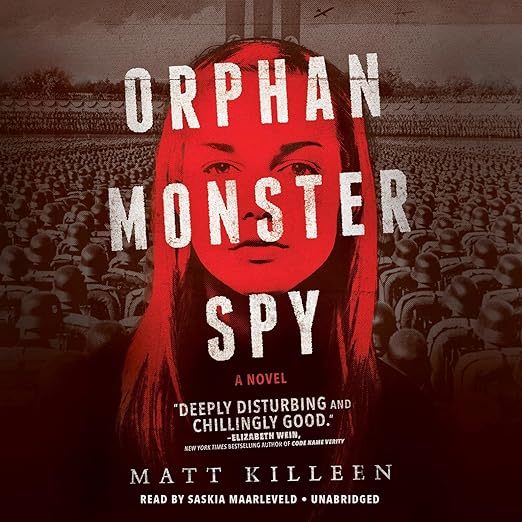
I came to this one on a rainy Tuesday evening with a specific intention: I was building a shortlist of WWII audiobooks aimed at younger listeners that didn’t condescend. I had low expectations, frankly, because the title did me no favors. One reviewer on Audible admitted outright that he almost skipped it entirely because of it, and I understood the hesitation. The phrase ‘Orphan Monster Spy’ sounds like something slapped on a pulp paperback from a gas station spinner rack. It isn’t. What it actually is is one of the more tightly constructed espionage narratives I’ve encountered in the YA space in years.
The setup is lean and brutal: Sarah is fifteen, blonde, blue-eyed, and Jewish in 1939 Germany. Her mother is shot at a checkpoint within the first pages. She is immediately recruited by a man with a lockbox of weapons and an ambiguous accent into something dangerous and barely sanctioned. Matt Killeen doesn’t ease you in. The violence of the historical context is not backdrop. It’s load-bearing.
Our Take on Orphan Monster Spy
What makes this audiobook work is the tension between Sarah’s competence and her vulnerability. She’s trained as a gymnast, she’s quick and physically capable, and she has inherited a performer’s instinct for deception from her actress mother. But she’s also fifteen and grieving, dropped into a boarding school for the daughters of Nazi brass, surrounded by girls who believe in the regime with the fervor of the newly converted. The horror isn’t cartoonish. It is systemic, mundane, and suffocating in the way that Matt Killeen handles the school environment. Sarah’s cover requires her to inhabit the ideology convincingly enough to be invited into the home of a key weapons scientist. The cost of that performance is psychological and cumulative.
Killeen writes with what one reviewer called ‘manic energy,’ and it’s the right phrase. The pacing is almost relentlessly forward-moving, which is both a strength and, occasionally, a slight weakness. There are moments where the plot mechanics are driving so hard that character interiority gets compressed. But Killeen earns it back in the final act, where Sarah’s choices carry genuine moral weight.
Why Listen to Orphan Monster Spy
Saskia Maarleveld’s narration is the key reason to choose the audio format here. She doesn’t soften Sarah or make her sympathetic in an easy way. There’s an edge to the performance, a watchfulness, that mirrors the text’s own refusal to let the character off the hook for her methods. Maarleveld handles the German-speaking characters and the school’s social cruelties with similar precision. She doesn’t play the Nazi students as monsters. She plays them as true believers, which is more frightening.
The audio also benefits from the book’s cinematic quality. Killeen constructs scenes visually. There are chase sequences, infiltration moments, and a series of confrontations that land with real impact in audio. The 11 hours and 51 minutes pass faster than they should.
What to Watch For in Orphan Monster Spy
The relationship between Sarah and her handler, the ambiguous man with the lockbox, is deliberately kept asymmetrical. He is using her. She knows it. The book doesn’t resolve this cleanly, and that’s appropriate, but some listeners expecting a mentor-protege arc will feel slightly wrongfooted. The moral framework here is espionage logic, not YA wish-fulfillment logic. Sarah gets results through methods that the narrative doesn’t entirely celebrate, including deception, manipulation, and occasional violence. That’s a feature, not a flaw, but it’s worth knowing before you start.
Also worth noting: the book ends with series momentum. It’s labeled as part of the Orphan, Monster, Spy series, and while this installment has its own arc and a satisfying central resolution, several threads are clearly positioned for continuation. Listeners who prefer self-contained narratives should factor that in.
Who Should Listen to Orphan Monster Spy
This is a strong pick for teenagers and adults who read YA, particularly those who want historical fiction with genuine stakes and a protagonist who wins through intelligence rather than luck. It also works beautifully for listeners who enjoyed Code Name Verity by Elizabeth Wein or Alan Gratz’s Grenade, books that refuse to make the horror of wartime child-readable in the softened sense. Readers who found those books compelling will be at home here. If you want a reassuring WWII story where good people are rewarded and evil is clearly punished, this may not be your book. If you want a story where a fifteen-year-old becomes genuinely terrifying, it absolutely is.
Frequently Asked Questions
Does Orphan Monster Spy work as a standalone or do I need to continue the series?
The central mission arc resolves within this book, so it functions as a complete story. That said, the relationship between Sarah and her handler has threads that carry forward, and the book is clearly designed to open a series. You won’t feel cheated by the ending, but you’ll probably want the next installment.
Is the content appropriate for younger teen listeners, or is it too intense?
Matt Killeen doesn’t sanitize the setting. There is violence, including the murder of Sarah’s mother early on, and the school scenes contain bullying and ideological cruelty that are realistically drawn. Most YA gatekeepers suggest this for ages 14 and up. Adult listeners should know this is not a soft-pedaled version of WWII.
How does Saskia Maarleveld handle the German language elements and accents in the narration?
She handles them well. German phrases and names land naturally without tipping into caricature. The various character voices are distinct enough to follow without confusion, and she captures the social register differences between students convincingly.
Is Orphan Monster Spy based on a real resistance operation or entirely fictional?
The story is fictional, though it is grounded in the historical reality of Jewish resistance networks in 1939 Germany and the development of weapons technology under the Third Reich. Killeen uses real historical context as scaffolding for an invented mission and cast of characters.