Quick Take
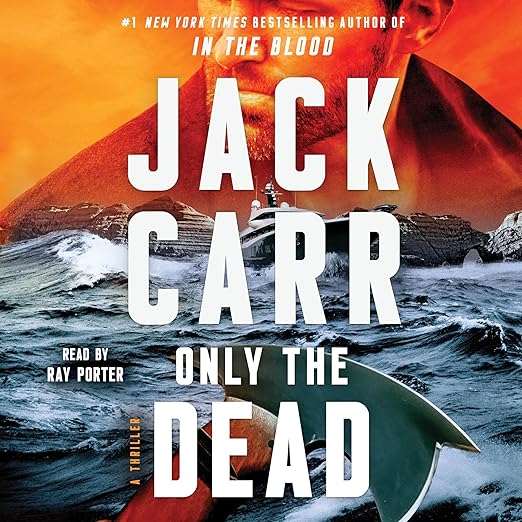
- Narration: Ray Porter is the canonical voice for James Reece at this point, his controlled intensity carries the novel’s conspiracy scope without tipping into parody.
- Themes: deep-state conspiracy, global power structures, the lone operative as last defense
- Mood: Propulsive and politically charged, with a slower build than earlier entries
- Verdict: A satisfying sixth installment for series readers, the conspiracy scaffolding is more elaborate than ever, and Porter holds it together.
I came to Only the Dead having listened to the first five Terminal List books across a particularly demanding stretch of travel last year. Jack Carr’s series is the kind of thing that functions as high-octane auditory company when you are moving through airports and hotels and need something with stakes that feel genuinely large. By book six, I had a clear sense of what to expect and a clear sense of what the series demands of its reader: trust in Carr’s research, patience with the setup, and a willingness to follow James Reece into operational territory that keeps getting more geopolitically sprawling.
Only the Dead picks up from the shocking end of book five, Reece arrested for the murder of the President of the United States, the person who was also his friend and kindred spirit. He begins this novel at his lowest point since the murders of his family in the first book, imprisoned in solitary confinement while a secret cabal of global elites moves to consolidate power in a weakened, divided America. The setup explicitly echoes contemporary political anxieties, rampant inflation, political division, shocking assassinations, and Carr does not soft-pedal the ideological stakes. The book moves from Wall Street to Washington to Moscow as Reece works to escape his confinement and pick up a mission generations in the making.
Our Take on Only the Dead
Carr’s real-world research continues to be a distinguishing feature of the series. His military and tactical detail is as precise as ever, though at least one reviewer notes that the product placement has become more noticeable in this installment, the careful specification of gear and equipment that functions as operational realism in the earlier books starts to feel, in book six, like a catalog that interrupts rather than enriches the narrative. The fight scenes, typically a Carr strength, are also described by at least one reader as less crisp than in earlier entries. These are the notes of an engaged series reader, not a casual one, the baseline quality remains high.
Why Listen to Only the Dead
Ray Porter is the reason this series works in audio. Carr’s prose is efficient and propulsive, but Porter’s delivery is what makes Reece feel like a specific person rather than a generic action protagonist. His voice has a quality of controlled restraint that suits Reece’s operational mindset, the character thinks in tactical terms even when the situation is personal, and Porter projects that. For book six in a long series, the narration is not just consistent but actively sustaining. Listeners who started with the Terminal List audiobooks specifically because of Porter will not be disappointed here. He handles the more complex emotional beats of Reece’s imprisonment scenes with the same competence he brings to the action sequences.
What to Watch For in Only the Dead
One reviewer noted that Reece does not appear until eighteen percent of the way through the book, and that the final ten percent is acknowledgments and glossary. That leaves roughly seventy-two percent of the runtime as actual story, still substantial at fifteen-plus hours, but listeners who open a Carr book expecting Reece from page one will need to adjust expectations for book six. The opening section establishing the historical backstory of the 1980 assassination that drives the conspiracy is well-written but deliberately slow. Carr is building a scaffold that will pay off, and for established series readers that patience is rewarded; newcomers to the series should start with The Terminal List rather than here.
Who Should Listen to Only the Dead
Series readers who have committed to Reece through book five are the obvious and correct audience. This is not an entry point, the emotional weight of Reece’s imprisonment depends entirely on knowing what he lost in previous books, and the conspiracy’s historical roots will land differently for listeners who have been tracking the overarching narrative. Fans of military fiction that takes geopolitical conspiracy seriously rather than treating it as backdrop will find Carr’s ambition in this installment refreshing even when the execution occasionally strains. Those who want tighter, more self-contained thrillers may find the sixth-book architecture too dependent on accumulated investment.
Frequently Asked Questions
Can Only the Dead be listened to without having read the previous Terminal List books?
Not meaningfully. The emotional stakes of Reece’s imprisonment, the conspiracy’s full weight, and the significance of various character relationships all depend on the previous five books. Start with The Terminal List.
How does Ray Porter’s narration hold up across a fifteen-hour listen?
Porter is one of the most reliable audio performers in the thriller genre, and his consistency across long listens is a genuine strength. No fatigue or unevenness reported by reviewers across the full runtime.
The series has been compared to Mitch Rapp and Scott Harvath. Is Reece still in that same tier in book six?
Reviewers who make that comparison confirm Reece remains in that company. The character’s combination of tactical competence and personal moral weight keeps him distinct from more generic special operations protagonists.
Is the political content of this book partisan in a way that might affect listener enjoyment?
Carr’s fiction has always been politically coded, pro-military, skeptical of certain institutional structures. Book six leans into contemporary political anxieties more explicitly than earlier entries. Listeners who found the earlier books ideologically congenial will feel at home; those who found them tendentious may find book six more so.