Quick Take
- Narration: Edoardo Ballerini is outstanding, his handling of 1940s period atmosphere and Archer’s measured, morally clear voice elevates the material significantly.
- Themes: Honor in a corrupt world, the ex-convict as moral compass, postwar American small-town shadows
- Mood: Atmospheric noir with a dry wit, period Americana with genuine menace underneath
- Verdict: A confident series opener from Baldacci that succeeds on the strength of character and Ballerini’s narration, Archer is a protagonist worth following.
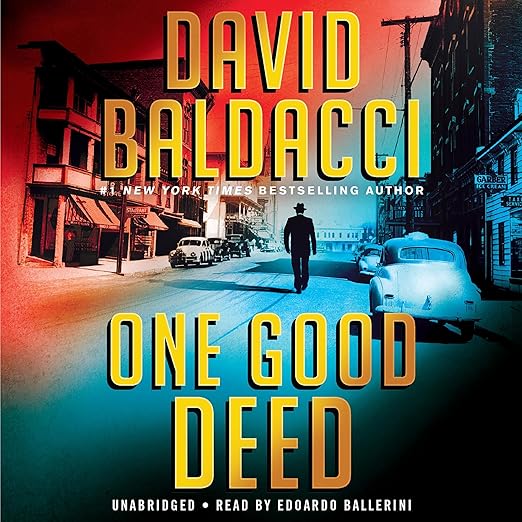
David Baldacci has written in so many modes across his career that it is easy to underestimate what he can do when he decides to build something new from scratch. One Good Deed, the first in his Archer series, is that kind of book, a historical noir set in 1949 that takes genuine care with period atmosphere and introduces a protagonist who earns your attention not through extraordinary competence but through ordinary decency in a world that has very little of it. I listened to this one during a cross-country drive, mostly at night, and the combination of Edoardo Ballerini’s narration and the darkness outside the windshield was exactly right for it.
Aloysius Archer is released from Carderock Prison into a parole arrangement that sends him to Poca City with a short list of do’s and a much longer list of don’ts: no bars, no alcohol, no loose women, get a job, report regularly to the stern Miss Crabtree. Within his first night of freedom, Archer has broken several of these conditions in the pursuit of paid employment, and a simple debt-collection job for the powerful local businessman Hank Pittleman turns into a murder investigation that puts him back in police sights. The structure is noir in the classic sense: a man with limited options, a web of small-town secrets, and a series of bad choices by people who should have known better.
Our Take on One Good Deed
What Baldacci gets right here is the moral texture of the protagonist. Archer is not the brightest person in Poca City, and he knows it. He was convicted of a crime he did not commit, which gives him a kind of patient, wary relationship with the idea of justice, he believes in it without expecting it. That double consciousness makes him interesting to spend time with. He observes everything with the attention of someone who has learned that circumstances can turn against you without warning, and that observational quality is the backbone of the novel’s plotting.
The 1940s setting is handled with confidence. Reviewers consistently praised the vividness of Baldacci’s small postwar town, the particular texture of a community still adjusting to returned veterans, the racial dynamics, the economics of power in a place where one man can own your livelihood. The mystery itself is well-constructed. The clues are fair and the resolution lands cleanly without requiring the villain to be impossibly stupid. One reader with a critical eye noted the opening pages read slightly differently than expected from a Baldacci novel, tonally more deliberate, almost as if he was working in a register he was still calibrating, but the consensus is that the book settles into its voice decisively within the first few chapters.
Why Listen to One Good Deed
Edoardo Ballerini is excellent here, as he is in virtually every audiobook he touches. For the second time in this batch of reviews, I find myself listening to a Ballerini performance and noting that he has an uncanny ability to find the right key for a book and stay in it for twelve hours without slipping. His Archer has the right weight, deliberate, careful, capable of dry humor, neither cynical nor naive. The 1949 setting gives him period-specific cadence to play with, and he handles the multiple character voices in Poca City without caricature. Miss Crabtree in particular is a creation of genuine menace, and Ballerini’s rendering of her makes you understand why Archer is more afraid of her than of the actual criminals.
At nearly twelve hours, this is a full-length listen that earns its runtime. The historical mystery pacing is deliberately unhurried compared to Baldacci’s contemporary thrillers, but that slower accumulation of detail is precisely what makes the postwar atmosphere work. Push play and give it the first hour before making any judgments.
What to Watch For in One Good Deed
A few readers who came to One Good Deed expecting Baldacci’s usual contemporary thriller pacing found the first-person, period-piece approach slightly unfamiliar. The 1949 setting is not a backdrop but an active element of the novel, and readers who want propulsive modern plotting may find the deliberate historical mood a gear shift. That is not a criticism, it is useful orientation for what to expect.
Some mystery readers may also find Archer’s circumstances more constrained than they prefer in a series protagonist, his parole conditions mean he is operating with very little freedom of movement, which limits the investigation. This feels authentic to the period and the character, but it does create a more reactive kind of mystery than the freewheeling private-eye mode some readers prefer.
Who Should Listen to One Good Deed
Historical mystery fans who love the 1940s-1950s American noir tradition, readers who have enjoyed Robert Crais, Dennis Lehane’s work from that period, or James Lee Burke, will find Archer a credible addition to that lineage. Those who enjoy Baldacci’s contemporaries and want to see what he does with a different set of tools will also find this rewarding.
The Archer series currently runs to multiple volumes, and reviewers consistently express interest in continuing. One Good Deed functions as a proper series opener: the mystery is resolved, but the character is clearly positioned for ongoing adventures, and the period world feels rich enough to support them. If you are looking for a historical crime series to settle into, this is a strong starting point.
Frequently Asked Questions
Does One Good Deed work as a standalone mystery, or does it require reading other Archer books?
It works completely as a standalone. The mystery is fully resolved within this volume, and while the character is positioned for a series, nothing essential is left unaddressed. Listeners can enjoy it without any commitment to the subsequent Archer books.
How does Edoardo Ballerini’s narration compare to other Baldacci audiobooks?
Ballerini is among the best possible choices for this material. He brings a measured, period-appropriate quality to Archer’s voice that elevates the historical atmosphere significantly. Listeners who know Ballerini’s work on other literary titles will recognize his characteristic precision and find it well-matched to Baldacci’s historical noir.
How explicit is the treatment of 1940s racial dynamics and postwar social tensions in the book?
Baldacci engages with the period honestly without making the racial dynamics the primary narrative focus. The power structures of a small 1940s Southern town are present in the background and occasionally in the foreground, treated with historical accuracy rather than sanitized. It is not a book about race, but it does not pretend the period was neutral either.
The reviews mention the opening feels slightly different from typical Baldacci, does the voice settle quickly?
Yes. The first chapter has a slightly deliberate quality as Baldacci establishes the period voice and Archer’s particular sensibility, but by the second or third chapter the narrative finds its footing. Listeners who give it that adjustment period consistently report that the book delivers from there on.