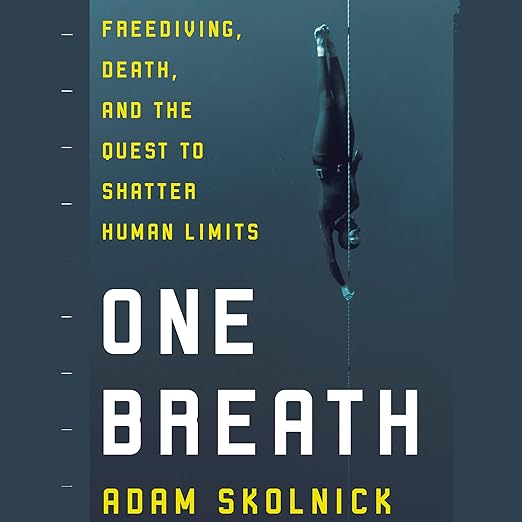
Quick Take
- Narration: Paul Boehmer brings the kind of controlled intensity that serves a book where the emotional stakes are literally life and death; his restraint is the right choice.
- Themes: Freediving as obsession, the cost of chasing the absolute limit, grief and the sporting community
- Mood: Taut and elegiac, with the particular weight of a true story that does not resolve happily
- Verdict: A work of serious narrative journalism about a sport most listeners know nothing about and a man who pushed it further than it could carry him.
I was in the middle of my morning commute, headphones on, standing in a crowded train car, when One Breath arrived at the scene of Nick Mevoli’s death at the Vertical Blue competition in 2013. The commuters around me had no idea what I was listening to. I needed a moment before I could rejoin the ordinary world. Adam Skolnick’s book earns that reaction, and it earns it honestly.
Competitive freediving, for the uninitiated, is the sport of descending as deep as possible on a single breath. No tanks, no rebreathers, just the body and its capacity to adapt to pressure at depths where light disappears and organs compress to fractions of their surface size. Nick Mevoli was twenty-two when he arrived in the Bahamas for Vertical Blue, America’s best freediver and one of the most gifted in the world. He did not leave the competition alive.
Our Take on One Breath
Skolnick had unparalleled access to Mevoli’s world: his family, his training partners, his rivals, and the competitive community that watched his death unfold. What he does with that access is careful and serious. He does not sensationalize Mevoli’s death; he reconstructs the life that led to it, which turns out to be more illuminating than any focus on the final moments could be.
The portrait of Mevoli is one of the book’s great achievements. He was not a reckless athlete chasing adrenaline; he was someone who had grown deeply dissatisfied with a society that felt vapid and commoditized and found in freediving an experience of purity and meaning that he could not locate anywhere else. Skolnick connects this to Mevoli’s earlier life in the Philadelphia squat scene and the Occupy movement, which one reviewer correctly noted makes the book fascinating from entirely unexpected angles.
Why Listen to One Breath
Paul Boehmer is a narrator with the ability to sit in difficult material without dramatizing it. That quality is essential for One Breath, which requires its narrator to convey both the terror and the beauty of what Mevoli and his fellow divers do without tipping into exploitation. Boehmer threads that needle. The twelve-hour runtime contains significant passages about freediving physiology, about the science of hypoxic blackout and shallow water blackout, that could easily become clinical; Boehmer makes them feel urgent.
The peripheral characters, particularly the competitive freedivers who surround Mevoli at Vertical Blue, are developed with unusual care given how many of them there are. Skolnick does not sketch types; he builds people, and the community that emerges from his reporting is as fascinating as its most talented member.
What to Watch For in One Breath
One reviewer who could not finish the book expressed frustration with what she saw as a foolish way to die. That response is honest and worth naming: One Breath does not argue that Mevoli was wise, only that he was human in ways that deserve to be understood. Readers who find extreme risk-taking fundamentally alienating may find the book more objective description than emotional argument. The book also contains genuinely distressing sequences around blackout events and near-drownings; listeners sensitive to those subjects should be aware of what the material covers.
The Question of Responsibility
Skolnick does not shy away from the question of whether the freediving community bears responsibility for Mevoli’s death, and the book’s treatment of that question is one of its most careful achievements. He presents the safety debate within the sport with full fairness to both sides: those who believe proper protocols make the risk manageable and those who believe certain depths simply should not be attempted competitively. That the book refuses to resolve the debate editorially is not a weakness; it is what makes it journalism rather than advocacy.
Who Should Listen to One Breath
Sports journalism readers who appreciate narrative nonfiction at the level of Jon Krakauer or Sebastian Junger will find One Breath operating in that company. Freedivers and ocean athletes will find it essential. Readers with no background in the sport who are drawn to stories about the cost of absolute commitment will also find it fully accessible. Skip it if you need subjects who ultimately survive, or if you want sport celebrated rather than interrogated.
Frequently Asked Questions
Is One Breath primarily a biography of Nick Mevoli or a broader history of freediving?
It is primarily Mevoli’s biography, but it uses his life and death as the frame for a comprehensive introduction to competitive freediving, including its history, its science, its culture, and the specific vulnerabilities that make it dangerous even at elite levels.
How graphic is the description of Mevoli’s death and the preceding blackout events?
Skolnick reports the events with journalistic accuracy rather than graphic detail. The physiology of hypoxic blackout is explained clearly, and the death itself is not sensationalized. Some sequences, particularly near-blackouts during competition, are intense but not gratuitous.
Does the book take a position on whether freediving is too dangerous to be sanctioned as a competitive sport?
Skolnick is a journalist rather than an advocate, and the book raises the question without resolving it editorially. He presents the perspectives of divers who believe the sport is manageable with proper safety protocols and others who believe Mevoli’s death exposed fundamental limits. The reader is left to draw their own conclusions.
What does Paul Boehmer bring to this audiobook compared to reading it in print?
Boehmer’s controlled delivery gives the underwater sequences a kind of held-breath quality that print cannot replicate in the same way. The moments of compression before a blackout, described in Skolnick’s prose, are heightened by a narrator who understands what the silence inside the text is doing.