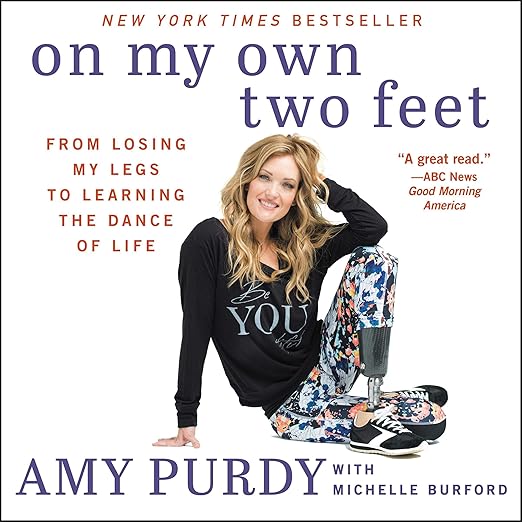
Quick Take
- Narration: Jorjeana Marie brings warmth and controlled emotion to Amy Purdy’s story, particularly effective in the near-death and hospital sequences where the material is at its most raw.
- Themes: Disability, reinvention, and athletic identity, near-death experience and spiritual transformation, the gap between public success and private struggle
- Mood: Unflinching and quietly triumphant, with genuine spiritual depth
- Verdict: A memoir that earns its emotional weight by refusing to skip the hard parts, and whose account of prosthetic snowboarding will make you reconsider what limits actually are.
I was halfway through my morning walk when Jorjeana Marie’s narration of On My Own Two Feet got to the part where Amy Purdy, nineteen years old, woke up in a hospital bed and began to understand what had happened to her. I had to stop walking. I stood at the side of the path for a few minutes, just listening. That kind of arrested attention is the mark of memoir working as it should: not performing emotion but creating the conditions for genuine feeling.
Purdy was nineteen when bacterial meningitis reduced her survival odds to less than two percent. She survived. She also lost both legs below the knee, her spleen, one kidney, and her hearing in one ear. The book does not skip past any of that. What distinguishes it from the broader category of inspirational memoir is precisely its willingness to stay in the difficult places: the despair, the doubt, the years of rebuilding self-image alongside physical function, the relationship with her own body that had to be invented from new materials. Reviewer Dusty Hogg, who found the book while searching for stories of resilience, appreciated that it is not a glossy magazine blurb about how perfect her life has been, noting that she bravely and humbly detailed her dark times and doubts.
The Near-Death Experience as Narrative Center
Purdy describes what she calls a near-death experience in striking terms: she saw three figures who told her she could come with them or stay, that no matter what happened, it would all make sense in the end. She chose to stay. This experience and a premonition she had a month before falling ill became the defining anchors of her subsequent life, the framework through which she interpreted her recovery, her career in adaptive sports, and her eventual appearance on Dancing with the Stars.
Some listeners will engage with this dimension of the memoir more than others. The spiritual framing is consistent throughout, not incidental, and it shapes Purdy’s interpretation of her circumstances in ways that are sometimes explicit and sometimes more subtle. Reviewer Irvol noted that throughout the book she seems to tell the reader she has faith in us and that we can achieve all our goals, describing it as a very personal and poignant story. That quality of invitation, the sense that Purdy is telling her story partly as an argument for what any reader might accomplish, is characteristic of the memoir’s voice.
The Snowboarding That Changed the Rules
The sports material is extraordinary. In 2014, Purdy became the only competitor, male or female, with two prosthetic legs to compete in adaptive snowboarding at the Paralympic level, claiming a bronze medal for the US team. The path from learning to walk again to competing at that level is not condensed into a training montage. Purdy describes the technical problem-solving required to make prosthetic legs function on a snowboard: the physics of pressure and balance that work differently on artificial feet, the iterative adjustments, the falls, the specific kind of stubbornness required to keep treating failure as information rather than verdict.
For listeners interested in adaptive sports or disability and physical performance, these sections are remarkable. They are also accessible to readers with no particular background in snowboarding because Purdy explains the relevant mechanics without assuming knowledge. What she conveys above all is that the work was neither inspirational abstraction nor superhuman achievement; it was methodical problem-solving by someone who refused to accept that her body’s new configuration was a fixed limitation.
Jorjeana Marie and the Voice of the Memoir
Marie’s narration serves the memoir well throughout, particularly in the sequences that carry the most emotional weight. She does not push the emotion or signal to the listener when to feel moved; she reads the text and trusts that the material itself will do the work. Reviewer Cool Girl, who watched Purdy on Dancing with the Stars before encountering the book, wrote that she was right there with her every step of the way. That quality of accompaniment is partly the memoir’s intimacy and partly Marie’s delivery, which maintains a consistent closeness to Purdy’s voice without impersonating her.
At nearly eight hours, the memoir is full without feeling padded. Purdy covers her childhood in Las Vegas, the months before and immediately after the illness, the reconstruction of her physical and emotional life, the professional arc through adaptive sports, and the television experience with enough detail that each stage feels inhabited rather than summarized.
Who Will Find This Memoir Valuable
Listeners who respond to disability memoir and Paralympic athletics will find this among the better examples of both. Listeners who are themselves navigating serious illness or loss of physical function may find it genuinely useful as a companion text. Reviewer Erin O’Grady bought multiple copies and handed them out, which suggests the kind of specific resonance that sends people looking for others to share a book with.
The memoir is less suited for listeners who find spiritual or metaphysical framing difficult to engage with; the near-death experience is load-bearing to Purdy’s interpretation of her own story, and it cannot be separated from the narrative without losing something essential. But for those willing to meet the book on its own terms, Purdy tells a story that is harder and stranger and more genuinely earned than the Dancing with the Stars origin story suggests.
Frequently Asked Questions
Does On My Own Two Feet focus more on the athletic achievement or the personal recovery story?
Both receive substantial attention, but the personal recovery narrative is the foundation. The snowboarding and Dancing with the Stars chapters are framed as chapters in a larger story about identity and reinvention rather than as the central subject. Listeners interested in either the sports or the memoir dimensions will find the balance satisfying.
How central is the spiritual dimension to the memoir’s structure?
Very central. The near-death experience and premonition are not incidental details; they function as the interpretive framework for everything that follows. Listeners who find spiritual or metaphysical framing uncomfortable or unconvincing should know this upfront, as the memoir builds on those experiences throughout.
Is Jorjeana Marie’s narration a close match for Amy Purdy’s voice and personality?
Marie brings warmth and authenticity to the material without attempting an impersonation. Several reviewers who watched Purdy on television before encountering the audiobook reported feeling that the narration preserved Purdy’s directness and emotional honesty. The casting works.
Does the book address the practical and technical dimensions of learning to use prosthetic limbs, or is it primarily emotional?
Purdy covers the technical problem-solving in real detail, particularly around adaptive snowboarding and how she and her team worked through the physics and mechanics of prosthetic-limb performance. These sections are among the most distinctive in the memoir and set it apart from straightforwardly inspirational accounts.