Quick Take
- Narration: Frankie Corzo gives Maite a voice that is appropriately guarded and intense, she captures the survival-mode vigilance of a character who has spent her whole life waiting to be found.
- Themes: corporate authoritarianism vs. alien sovereignty, the politics of half-blood identity, survival as the baseline condition of existence
- Mood: Urgent and claustrophobic early, opening into something genuinely epic as the setting shifts from a dystopian Earth to far stranger places
- Verdict: A propulsive first entry in a YA space opera series that earns its intensity through specific worldbuilding rather than relying on genre conventions.
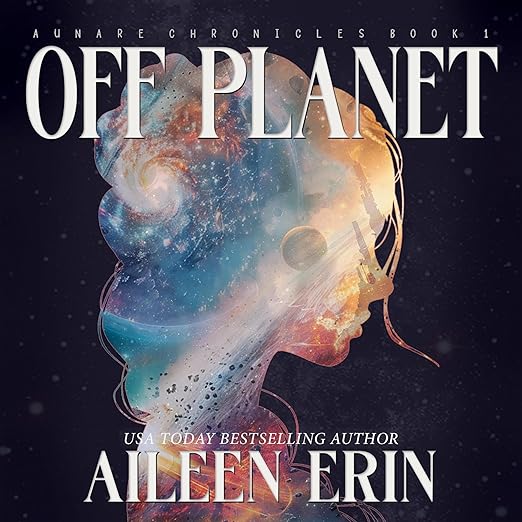
The first page of Aileen Erin’s Off Planet puts you immediately inside a body that does not feel safe, Maite Martinez waking up each morning with fear screaming through every cell, suppressing it, and getting out of bed anyway. That opening register, tense and close and specific, hooked me faster than I expected. I had picked it up for a transit review, good YA science fiction holds up well when you need something that will survive being interrupted repeatedly, and found instead that I did not want to be interrupted at all. I listened through the evening commute, through dinner, and considerably later than I had planned.
Maite is half human, half Aunare, daughter of the head of the Aunare military, living on Earth under a false identity while a corporate government called SpaceTech hunts her kind. The world Erin builds is detailed and specific in its dystopian mechanics: Earth’s economy collapsed, SpaceTech arrived as savior and stayed as overlord, and the alien Aunare represent the only power capable of challenging corporate control. Maite is positioned at the center of that conflict entirely against her will and for thirteen years has managed the situation by hiding absolutely everything about herself.
Our Take on Off Planet
The novel does something quietly ambitious with its premise. The half-blood identity politics are handled with more nuance than the typical genre approach. Maite does not want to be a symbol or a soldier. She has watched her mother pay for her father’s decision to stay off-planet rather than risk war to retrieve them, and she carries a specific, warranted anger about having been left in a bad situation by someone who made a political calculation instead of a parental one. That emotional specificity makes the larger conflict feel personal rather than abstract.
The worldbuilding expands in stages. Earth is rendered in the grimy, polluted detail of a planet run into the ground by a corporation optimizing for extraction rather than livability. When the setting shifts, and it does, dramatically, the contrast is stark and effective. Erin does not front-load the alien elements; she lets you sit in Maite’s constrained Earth existence long enough to understand exactly what she is escaping from before the story opens up into something considerably more epic.
Why Listen to Off Planet
Frankie Corzo’s narration is a significant asset for a book that lives or dies on the authenticity of its first-person voice. Maite is a character defined by suppression, she has to contain her abilities, her identity, her emotional responses, her genuine name. Corzo plays that containment convincingly. When things break open, when the survival-mode vigilance finally cracks under pressure, the shift in vocal register carries real weight because it has been earned against fourteen hours of careful control. The pacing of the audio version also benefits from Corzo’s instinct for which scenes to push and which to hold back, the volcano planet sequence, in particular, is considerably more visceral in audio than it might read on the page.
Reviewers describe the book as addictive in exactly the way the best YA space opera tends to be: the moment you put it down, you want to pick it back up. One reviewer admitted they read it in one sitting. That compulsiveness is a feature, not a flaw, and it speaks to the novel’s structural confidence, Erin understands how to end chapters on the kind of micro-tension that refuses to let you stop.
What to Watch For in Off Planet
One reviewer who came in expecting adult science fiction and found YA instead identified the self-doubt and second-guessing as a sticking point. This is a fair observation about the book’s genre identity. Maite’s internal monologue is extensive, and her emotional processing is thorough in the way that YA fiction tends to prioritize. If you read the opening pages and find the first-person intensity too close or too anxious, that register does not significantly modulate for a long stretch. The book rewards readers who meet Maite where she is rather than waiting for her to become less burdened.
The romance thread is present but handled with more restraint than some YA space opera. It never overtakes the survival narrative and the world-building momentum, which is the correct choice for this particular story. Readers who want the romantic subplot to be more developed may find it underwritten by comparison to the action.
Who Should Listen to Off Planet
Off Planet is well suited to YA readers who want their science fiction with genuine stakes, specific political worldbuilding, and a protagonist whose emotional complexity earns their investment. It works particularly well for listeners who enjoy the found-family-and-identity themes that the best YA space opera tends to explore, and who can meet the intensive first-person interiority of a character under chronic survival pressure. Adult readers who enjoy YA with crossover appeal will likely find it more satisfying than those who prefer lighter, more escapist genre fare.
Listeners who find extensive internal monologue frustrating, or who want their science fiction to center plot mechanics over character psychology, will find this a more demanding listen than the adventure-focused premise suggests. The book is emphatically a character study wearing a space opera’s clothes.
Frequently Asked Questions
Is Off Planet appropriate for younger teens, or does it skew toward older YA readers?
The content is intense, chronic fear, corporate violence, forced labor on a hostile planet, but not gratuitously dark. There is no explicit sexual content and the violence, while present, is not graphic. It skews toward older teens and adult YA readers, primarily because the emotional processing and political complexity are more accessible to readers with some life context for systemic oppression and survival under sustained threat.
How self-contained is Off Planet as a listening experience if I’m not ready to commit to a full series?
The novel reaches a satisfying conclusion within its own narrative arc while clearly establishing the series’ larger trajectory. Maite’s immediate situation resolves, though the broader conflict between SpaceTech and the Aunare remains open. It functions as a complete first chapter rather than a mid-sentence cliffhanger, so listening without committing to the rest of the series is viable.
How does the Aunare Chronicles compare to other YA alien-romance sci-fi series on Audible?
Erin’s series is more grounded in political and corporate dystopia than most alien-romance YA, which tends to center the interpersonal dynamic from the first page. The romantic element is present but secondary to the survival and identity politics for most of the first book. If you come in expecting the romance to drive the narrative the way it does in many genre peers, you will find this series has different priorities, and many readers consider that a point in its favor.
Does Frankie Corzo’s narration handle the action sequences as well as the quieter character moments?
Yes. Corzo shifts between the contained, suppressed tension of Maite’s daily life and the kinetic energy of the action sequences without losing either register. The most intense sequences, particularly the scenes in the forced labor environment, are narrated with a kind of controlled urgency that suits a character who cannot afford to panic even when the situation is terrifying.