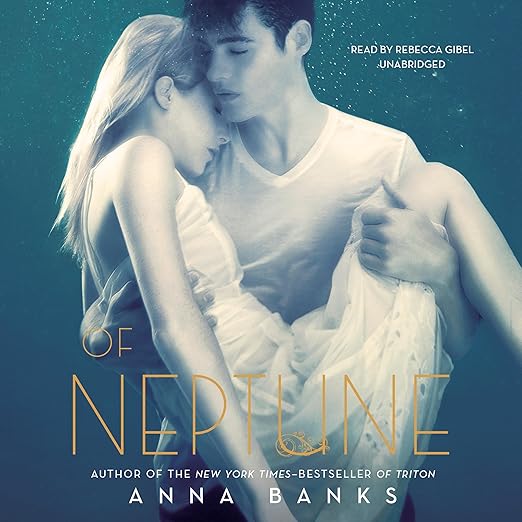
Neptune, the small town at the heart of Anna Banks' Of Neptune, turns out to be exactly the wrong place for Emma and Galen to find the peace they've been searching for across the Syrena Legacy trilogy. The audiobook, narrated by Rebecca Gibel and running 9 hours and 36 minutes, takes the premise that worked across Of Poseidon and Of Triton, a half-human, half-Syrena girl caught between ocean kingdoms, and adds a complication the series hadn't yet attempted: a community of land-dwelling freshwater Syrena who challenge everything Emma thought she understood about what her hybrid nature means and what it demands of her. The town itself becomes a test that Emma and Galen didn't agree to take and can't easily walk away from.
What We Made of It
Anna Banks built the Syrena Legacy series on a very specific kind of YA energy: romantic tension grounded in supernatural stakes, dialogue sharp enough to carry slower passages, and a heroine whose emotional responses feel proportionate to the genuinely unusual situations she finds herself in. Emma works as a character because Banks never lets her become passive or reactive in ways that feel like genre convention rather than character logic. In Of Neptune, that quality gets its hardest test yet. The Neptune community asks Emma and Galen not just to rest but to navigate a political problem they didn't create and don't fully understand, while a Half-Breed named Reed complicates the romantic certainty that defined the series' earlier dynamics with an appeal Emma has to actively resist rather than simply overlook.
Rebecca Gibel's narration serves the material in the ways that matter most for a first-person YA series: Emma's voice stays recognizable from the first chapter to the last, carrying the cumulative weight of two previous books without losing the character's fundamental texture. Gibel finds the difference between Emma's public composure and her internal monologue without forcing it, which is the specific skill required for narrating a protagonist who has learned to present a calmer surface than she actually feels. The consistency across the full trilogy is an asset that listeners who have followed the series in audio from the beginning will appreciate immediately.
Reviewer Jessica S., who acknowledged that her memory of Of Triton had faded before picking up this volume, found Banks' recapitulation adequate for catching up on the important details. That calibration, enough context for returning readers without over-explaining for those who remember the earlier books clearly, is harder to execute than it sounds, and Banks manages it in ways that Gibel's narration respects rather than overplays.
The freshwater Syrena community gives Banks room to interrogate the mythology she has built over the trilogy, asking what happens when the rigid racial and caste logic of the ocean kingdoms encounters a population that developed entirely different customs and relationships to land. This interrogation sits at the center of the book's thematic work: Emma's hybrid status, which the earlier books framed primarily as a personal identity problem, becomes a political and historical question in Of Neptune. Her existence matters not just to her but to a community whose future depends on whether land and ocean Syrena can coexist. That expansion of stakes gives the trilogy's conclusion a weight the first two books, for all their strengths, couldn't have generated on their own.
Reviewer Anna's observation that she ordered this immediately after finishing book two and found it delivered everything she wanted speaks to the series' consistent genre execution. The 9-hour runtime is appropriate for a YA trilogy conclusion. Banks doesn't overextend the story; the Neptune setting is contained and purposeful, and Gibel's pacing keeps the plot moving without skipping past the emotional beats the romance requires. The balance is careful and reflects a writer who understands the difference between a conclusion and a finale.
Things to Know Before Starting Of Neptune
Reed, the charming Half-Breed who can barely disguise his feelings for Emma, is the book's most interesting new addition and also its most narratively convenient element. The love triangle he creates is handled with more restraint than the trope usually receives in YA fiction, but listeners who are firmly in the Galen camp may find his presence more of an irritant than a meaningful complication. Banks resolves the dynamic decisively, but the setup requires a temporary suspension of certainty that some readers will find frustrating rather than engaging.
The freshwater Syrena political conflict is the most ambitious plotting Banks attempts in the trilogy, and it lands somewhat unevenly in audio form. The worldbuilding required to establish a parallel Syrena society with different customs, hierarchies, and relationships to land-dwelling life is significant. Gibel works hard to give those new characters distinct voices, and the result is functional rather than elegant in places, particularly in the middle section where the power struggle's mechanics require the most sustained explanation.
Best Suited For
Listeners who have followed Emma and Galen from Of Poseidon will find this a complete and emotionally satisfying conclusion to the Syrena Legacy. YA fantasy romance readers who want a trilogy that actually closes its arcs rather than leaving threads deliberately open will appreciate Banks' commitment to resolution. Approach with caution if you're new to the series; the worldbuilding assumes familiarity with Syrena society, Emma's hybrid biology, and the specific relationship history that makes Reed's complication meaningful. If you loved the first two books primarily for the ocean setting and Galen's perspective, note that Neptune shifts the environment significantly and gives Emma's first-person voice even more weight than the earlier volumes.
Common Questions
Do I need to listen to the first two Syrena Legacy audiobooks before Of Neptune?
Yes. Of Neptune is the trilogy's conclusion and assumes full familiarity with Emma's hybrid origin, her relationship with Galen, the politics of the Poseidon and Triton kingdoms, and the events of the first two books. There is some recapitulation, but it is oriented toward reminders for returning readers rather than introductions for newcomers.
Does Rebecca Gibel's narration match the tone of the earlier audiobooks in the series?
Gibel narrates the full Syrena Legacy trilogy, so returning listeners will find Emma's voice consistent with what they've heard before. She maintains the character's distinct internal voice while adjusting for the emotional and contextual changes that come with a series conclusion. Narration continuity across a three-book arc is a significant advantage for series romance.
How does the romance between Emma and Galen resolve in this audiobook?
The conclusion is satisfying for series fans without significant hedging or open-ended ambiguity. Banks resolves the Reed complication decisively and gives the central relationship a conclusive arc. Reviewers have consistently noted the ending as a positive rather than a disappointment, which is meaningful for a trilogy finale in this genre.
Is Of Neptune more action-focused or romance-focused compared to earlier books?
It balances both, with a lean toward political and romantic stakes rather than pure action sequences. The Neptune setting introduces a new community and conflict that requires diplomatic as much as physical navigation. The romance gets meaningful development, but the book is more interested in resolution and emotional consequence than in escalating supernatural battles.