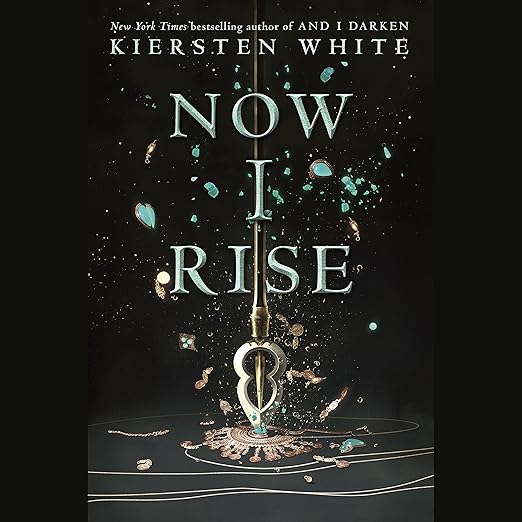
Quick Take
- Narration: Fiona Hardingham brings the necessary weight and ferocity to Lada while shifting convincingly to Radu’s quieter, more conflicted register.
- Themes: Ambition versus loyalty, identity under empire, gendered power and its costs
- Mood: Epic, politically dense, and emotionally bruising
- Verdict: A worthy second installment that deepens both siblings rather than simply advancing the plot, requires the first book but rewards the investment with greater complexity.
I came to the And I Darken series through someone who pressed the first book on me insisting it was the kind of YA that did not feel like YA, and they were right. Kiersten White writes historical fiction with a moral seriousness and structural ambition that most adult fiction does not reach. Now I Rise, the second novel in the series, picks up almost immediately after And I Darken ends, with Lada Dracul heading back toward Wallachia and her brother Radu heading toward Constantinople under orders from Mehmed that are more dangerous than any diplomatic mission.
The comparison to Game of Thrones that publishers have leaned on hard is both accurate and insufficient. Accurate because White refuses to protect her characters from consequence, and the political landscape they navigate is genuinely complex. Insufficient because the emotional core of the And I Darken series is not about the politics; it is about the Dracul siblings and what they are becoming in the process of pursuing their respective destinies. Fiona Hardingham’s narration understands this distinction and plays accordingly, keeping the intimate emotional stakes audible even when the Ottoman siege machinery is loudest.
Lada Without Allies and What That Forces Her to Become
Where the first book established Lada’s formidable character primarily through her interactions with Mehmed and Radu, Now I Rise strips away the relational framework and forces her to operate alone. She has no crown, no reliable allies, and increasingly questionable methods. White does something structurally brave here: she allows Lada to be genuinely threatening and genuinely wrong in ways that a lesser YA novel would qualify or explain away through convenient plot redemption.
The result is a character study of what happens when someone built entirely for survival continues using survival tactics in situations that call for something else. Lada’s brute force approach produces real consequences in this installment, and the narrative does not let her off the hook for them. Reviewers who describe the book as less intense but more complex than the first are identifying this accurately. The first book’s intensity was partly the thrill of watching Lada operate in a world that underestimated her. The second book asks what happens when that approach is not enough, and the answer is uncomfortable in exactly the right way.
Radu in Constantinople: The Spy Who Cannot Stop Caring
Radu’s arc in Now I Rise is where the novel does its most interesting emotional work. Sent by Mehmed to Constantinople as a double agent, Radu discovers that his capacity for empathy, long treated as weakness in comparison to his sister, is both his most effective tool and his greatest liability. He makes genuine connections behind enemy lines, and those connections create impossible loyalties that no amount of strategic clarity can resolve.
Reviewers who entered the first book primarily invested in Lada frequently describe emerging from Now I Rise with equal or greater investment in Radu. One listener captures this well, noting they were entirely Lada-focused in book one and found themselves equally devoted to Radu by the end of the second. That kind of reader realignment does not happen without careful parallel narrative construction across hundreds of pages. His refusal to help Lada at a critical moment is the novel’s central rupture, and it lands because both characters have been developed to the point where there is no clean answer about who is right.
Fiona Hardingham and the Ottoman Empire as Audio Experience
The historical and geographical scope of Now I Rise is significant. White moves between Wallachia, Constantinople, and multiple Ottoman contexts, and the level of political and cultural specificity she brings to 15th-century history requires a narrator who can make that specificity feel alive rather than textbook-like. Hardingham does this through tone rather than through heavy character differentiation alone. She understands that this is a world where what is not said carries as much weight as what is, and her reading of the political scenes has a measured deliberateness that makes the subtext land consistently.
The Teen Choice Book Award nomination associated with this series is worth noting for adult listeners approaching it as historical fiction. The YA label will push some adult readers away who would genuinely enjoy the material. The prose quality, moral complexity, and historical ambition place this firmly in the territory that the best literary fiction occupies. Booklist’s starred review description of the series as gorgeous, rich, and rewarding applies equally to this second installment.
The audio format, with Hardingham’s performance, is an excellent way to absorb the density of the Ottoman political landscape that White builds across 13 hours. The siege of Constantinople, which forms the novel’s climactic centerpiece, is rendered with the kind of historical weight that few YA authors attempt and fewer execute successfully. White and Hardingham together make it work. This is the rare sequel that earns its existence by being genuinely different from the book that preceded it rather than by simply extending it.
Where to Place Now I Rise in Your Reading Order
And I Darken is non-negotiable before this. Several reviewers specifically warn that jumping into Now I Rise without the first book produces immediate confusion about who these people are and why their choices matter. The series rewards investment with cumulative payoff, and that payoff is not available to listeners who try to shortcut the entry. Bright We Burn, the concluding volume, awaits after this, and the shape of what Now I Rise leaves unresolved will make the final book feel necessary rather than optional.
Frequently Asked Questions
Can I start with Now I Rise, or is And I Darken essential reading first?
And I Darken is essential. Multiple reviewers warn explicitly that Now I Rise requires the character and backstory context from the first book. The series is structured as a continuous narrative, not as standalone installments.
Is this accurately described as YA, or does it read as adult historical fiction?
It is technically published as YA but reads considerably older. Multiple adult readers describe it as qualitatively different from standard YA. The moral complexity, political detail, and willingness to let characters fail distinguishes it from the genre mainstream.
Does Now I Rise resolve the story, or does it end requiring book three?
The book ends with significant narrative threads unresolved. The And I Darken series has three installments, and Now I Rise is the middle chapter. Expect to need Bright We Burn to reach the conclusion.
How does Fiona Hardingham handle the vocal distinction between Lada and Radu, who are very different characters?
Hardingham uses tonal register rather than heavy characterization to distinguish the siblings. Lada’s sections carry a controlled intensity while Radu’s have a more reflective quality. The approach suits the alternating POV structure and avoids making the distinction feel theatrical.