In Brief
- Read by: Jeff Harding is consistently cited as the definitive Reacher narrator, and Nothing to Lose is no exception - The Sunday Times noted that 'you have to savour every minute' of his delivery.
- At its heart: small-town secrets and institutional corruption, Reacher's moral absolutism, the cost of unbothered curiosity
- Vibe: Spare and steadily pressurized, with the measured confidence of a protagonist who knows how this ends before it starts
- Short version: Not the strongest entry in the Reacher series by most listeners' rankings, but Harding's narration and Child's lean Colorado setting make it a consistently satisfying thirteen-hour listen.
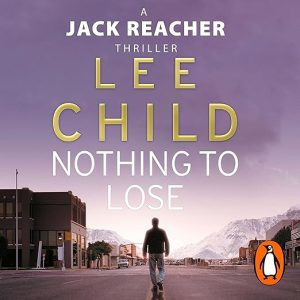
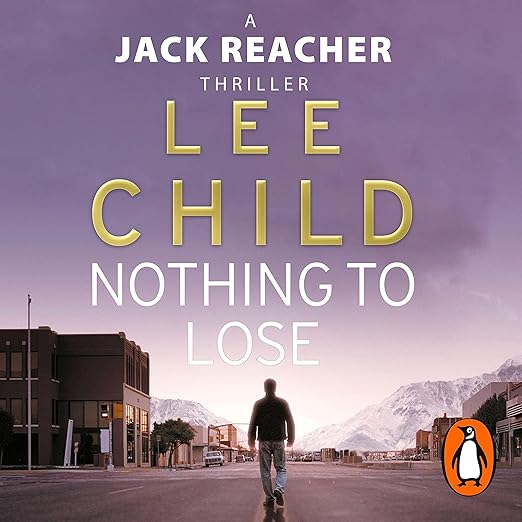
Nothing to Lose, the twelfth Jack Reacher audiobook narrated by Jeff Harding, begins with one of Child's most economical premises: a man wants a cup of coffee and ends up in the middle of something considerably larger than that. Between two Colorado towns named Hope and Despair - names that Child is clearly not deploying by accident - Reacher walks into a vagrancy charge, a forced expulsion back across an invisible line, and a set of local secrets that nobody wants examined by an outsider. The hook is simple, the stakes escalate quickly, and Harding's narration makes every beat of it land with exactly the controlled authority the series requires.
Is Nothing to Lose Worth Your Time?
Child's Reacher novels have a formula, and they work because the formula is well-constructed rather than lazy. The protagonist arrives somewhere with no plan and no baggage - "no job, no address, no baggage" as the synopsis states - and his curiosity collides with local forces that have reason to keep their secrets from outsiders. Nothing to Lose executes that architecture in a setting that gives it specific texture: rural Colorado, two towns with a loaded symbolic geography between them, and a community whose hostility to an outsider has the particular quality of a place that is actively guarding something shameful rather than simply being unwelcoming. The secrets Reacher uncovers here have more political weight than some entries in the series, and Child handles the escalation from trespassing to larger revelations with careful, measured pacing.
Reviewer Dave's observation that the novel "felt not as strong as the others" is worth acknowledging honestly - this isn't one of the series' peak entries in terms of plot architecture, and seasoned Reacher listeners will likely agree. The Colorado setting is distinctive, but the mechanics feel slightly more formulaic than entries like The Killing Floor or Killing Floor. That said, reviewer Dennis J. found it "very suspenseful with action and a little romance," which is an accurate description of what Child delivers even in his more workmanlike entries. A mid-tier Reacher novel is still a well-crafted thriller, and Harding's narration ensures that the floor of quality is high.
What Lee Child Gets Right
Harding is the reason to choose this audiobook over the print edition, full stop. The Sunday Times review quoted in the product description - "Jeff Harding's narration captures Reacher's character perfectly, you have to savour every minute" - is not publisher hyperbole. Harding has the specific quality that the Reacher novels require from a narrator: he sounds unhurried and absolutely certain. Reacher's internal logic runs on the premise that once he decides to involve himself in a situation, the outcome was always inevitable - and Harding's measured delivery communicates that certainty without tipping into the kind of arrogance that would make the character insufferable.
He also handles the physical violence in Child's action sequences with a precision that avoids both the bland flatness of under-performance and the melodrama of over-performance. The fight sequences in the Reacher novels are built with a specific economy - short sentences, specific body mechanics, no lingering - and Harding's pacing respects that economy rather than trying to inject drama that Child didn't put on the page. At thirteen hours and twenty-six minutes, the audiobook is long enough to develop genuine rhythm, and Harding's consistent, authoritative presence holds the experience together across the full runtime.
Where Lee Child Loses Some Ground
Child's series novels can be listened to in any order, but Nothing to Lose sits in the middle of a long run and has the characteristics of a mid-series entry. It assumes familiarity with Reacher's methods and personality without re-explaining them, and the emotional investment in the character is more satisfying the more of the series you carry with you. New listeners won't be confused - Child establishes everything a first-time reader needs - but they also won't get the full weight of what a twelve-book Reacher listener feels when Child places the character in a particular kind of situation and the outcome is already implicit in the setup.
The Colorado geography is worth paying attention to as a departure from the urban and suburban settings of many earlier entries. The open country between Hope and Despair gives the novel a different spatial quality - more exposed, more elemental - than the series normally operates in, and Child uses that openness purposefully in the novel's second half. The two-town structure, with its obvious allegorical loading, is either a satisfying literary gesture or an over-obvious one depending on your tolerance for that kind of layering; the series regulars I've spoken with tend to appreciate it as a break from the generic small-town thriller backdrop.
Who Should Pick Up Nothing to Lose
Committed Reacher listeners will want this entry for completeness, for Harding's narration, and for the Colorado setting that distinguishes it visually from the broader series landscape. Listeners new to the series who want a standalone entry point would be better served by some of the earlier, more architecturally ambitious novels - several of the first six entries are consistently cited as the series' strongest work. But "not as strong as the others" in a series this consistently crafted still represents a solidly entertaining thirteen hours, and Harding ensures the experience never becomes a chore even in the passages where Child's plotting is less surprising than usual.
The audiobook format specifically suits Child's prose style. The short chapters, the lean sentences, the physical specificity of the action sequences - all of these work well in Harding's measured audio delivery. If you've been reading the series in print and haven't tried the audiobooks, Nothing to Lose is a reasonable entry point for the audio format even if it's not the strongest entry for the story.