Quick Take
- Narration: Kyla Garcia brings Finn’s sarcasm and Alfie’s grief into sharp contrast, making the dual-protagonist structure work across nearly fifteen hours.
- Themes: Identity and disguise, grief and forbidden magic, found family amid catastrophe
- Mood: Fast-paced and immersive, with a Latinx cultural richness that lifts the familiar YA fantasy framework
- Verdict: A debut that earns its comparisons to Adeyemi and Bardugo by grounding its magic in specific cultural identity rather than generic world-building.
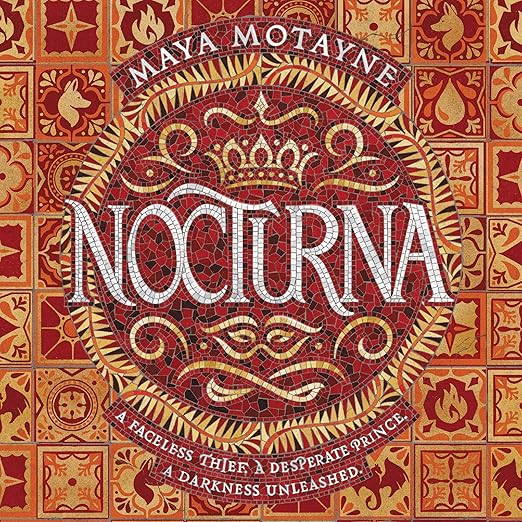
I picked up Nocturna on a colleague’s recommendation with some skepticism. The YA fantasy market has been crowded for years, and debut novels in the Leigh Bardugo comparison zone have a mixed track record of delivering on that particular promise. Maya Motayne’s first novel surprised me, and not just pleasantly. It surprised me by being more interested in its characters’ psychological specificity than in its magic system’s mechanics, which is a choice that separates the books worth remembering from the ones that blur together.
Published by HarperCollins and running almost fifteen hours, Nocturna is the first book in the Forgery of Magic trilogy. It features two protagonists whose paths collide with world-altering consequences: Finn Voy, a faceshifter and thief who has spent years looking like everyone but herself, and Prince Alfehr, who is so consumed by grief for his murdered brother that he is willing to dabble in forbidden magic to bring him back.
Our Take on Nocturna
The Latinx cultural grounding is the first thing that distinguishes Motayne’s world from the standard YA fantasy template. Castallan is a Spanish-inflected kingdom where magic words are drawn from the Spanish language, a choice the author has explained in interviews as rooted in the power of language as identity. Reviewers who attended Motayne’s signings noted that she talked about this meaningfully, and you can feel that consideration in the text. The magic system is not merely Spanish-flavored, it is built around the idea that naming, in a specific cultural language, carries particular weight.
Finn is the standout character. Several reviewers describe her as among their favorite literary characters, which is a significant claim, but the characterization earns some of that enthusiasm. A girl who has worn other people’s faces for so long she no longer remembers her own face is an elegant metaphor for identity loss, and Motayne does not let it remain metaphor. Finn’s psychological reality, including the specific terror of having erased herself, is present in the text as lived experience rather than thematic decoration.
Alfie functions as a useful counterpoint: where Finn moves through the world in disguise, Alfie is entirely visible as a prince and entirely invisible as a person. His grief for his brother is rendered with the kind of detail that makes YA fantasy feel like actual literature rather than entertainment with literary trappings. The choice to pursue forbidden magic is not presented as obviously stupid. It is presented as the choice of a grief-destroyed person who cannot see past his own pain, which is considerably more honest.
Why Listen to Nocturna in Audio
Kyla Garcia’s narration handles the dual-protagonist structure effectively. The tonal shift between Finn’s sardonic exterior and Alfie’s earnest grief is clear without being exaggerated. At nearly fifteen hours, the narration needs to sustain interest through a substantial middle section where the plot’s stakes accumulate rather than accelerate, and Garcia holds it together through character commitment rather than pacing tricks.
The Spanish language elements, the magic words drawn from a real linguistic tradition, benefit from audio delivery. Hearing the cadence of those words as magic rather than reading them on a page adds a layer of texture that the novel’s cultural argument needs.
What to Watch For in the Darker Elements
One reviewer mentions dark things in this book alongside the love, and that is accurate. The antagonist Ignacio, described by another reviewer as creepy in a way that works, represents genuine menace rather than cartoonish evil. The forbidden magic plot involves real consequences and real horror, which is appropriate but worth knowing for listeners who prefer lighter YA fantasy.
The book is also fairly long for a first novel in its genre, and there are sections in the middle where the pacing slows to accommodate world-building. One reader described the reading experience as taking longer than expected without being quite sure why. In audio, this translates to sections that reward patience more than they reward speed. The final third recovers momentum strongly.
Who Should Listen to Nocturna
This audiobook is ideal for YA fantasy readers who want cultural specificity alongside their magic systems, and for adult readers of literary fantasy who are willing to engage with a teenage protagonist. Fans of Tomi Adeyemi’s Children of Blood and Bone or Leigh Bardugo’s Six of Crows will find familiar pleasures in the morally complex characters and the world-building grounded in real cultural tradition.
Listeners who prefer lighter, faster YA fantasy without psychological weight should look elsewhere. And anyone coming for pure plot momentum will need to be patient with Motayne’s investment in her characters’ interiority, which is real but slow-building.
Frequently Asked Questions
Does Nocturna work as a standalone, or does it end on a cliffhanger requiring the next book?
The immediate catastrophe of the novel is resolved, but it is clearly the first book in a trilogy and ends with significant threads open for the sequel. It functions reasonably well on its own but is clearly designed as an opening volume.
How central is the Latinx cultural element, and is it integrated naturally or does it feel like a setting overlay?
It is integrated into the magic system itself, which is one of the novel’s strongest choices. The use of Spanish as the language of magic is explicitly tied to the novel’s themes of identity and naming, not simply applied as a cultural texture to a generic fantasy structure.
Is this book appropriate for younger teen readers, or does the dark content push it toward older YA?
The antagonist presents genuine menace and the forbidden magic has real horror elements. The book is marketed as YA and is appropriate for older teens, roughly 14 and up, but parents of younger readers should know it is not a light fantasy.
How does Kyla Garcia’s narration handle Finn’s sarcastic voice versus Alfie’s more solemn interiority?
Garcia differentiates the two protagonists clearly and consistently. Finn’s sardonic edge and Alfie’s grief-laden perspective are distinct enough that listeners always know whose chapter they are in, which matters considerably in a nearly fifteen-hour dual-POV narrative.