Quick Take
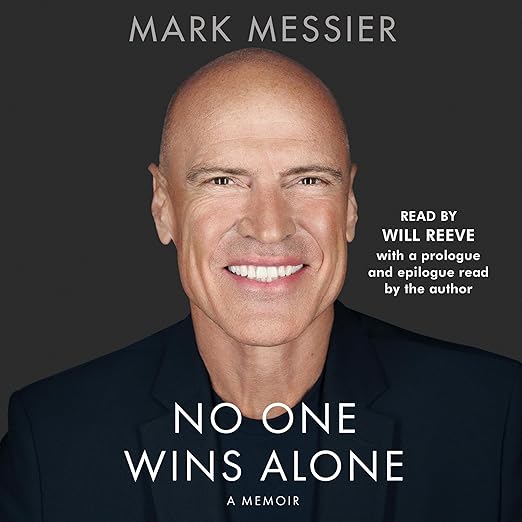
- Narration: Will Reeve reads with warmth and sincerity that matches Messier’s own register, no false excitement, just clear delivery of a memoir that earns its emotional moments.
- Themes: Collective leadership, the culture of winning dynasties, mentorship across generations
- Mood: Generous and reflective, with flashes of the intense competitive energy that defined Messier’s career
- Verdict: A sports memoir that holds its central argument, that winning is always collaborative, with more philosophical consistency than the genre usually manages.
I am not a hockey person by background. I grew up in France and came to North American sports as an adult, which means I arrived at No One Wins Alone knowing Mark Messier’s name but not much else about what made him legendary. That turned out to be a reasonable way to approach this book. Messier writes, and this is rarer than it should be in athlete memoirs, as if he is trying to explain something, not just commemorate it.
The title is the thesis. No One Wins Alone is not a clever marketing hook, it is the argument the book makes from its first chapter to its last, and it shapes every anecdote and reflection that Messier includes. He is specifically interested in the mechanics of team culture: what creates it, what destroys it, and what a leader can do to sustain it under conditions of extreme pressure. This is not a novel subject for sports memoirs, but Messier’s extended experience, six Stanley Cup championships, the Edmonton Oilers dynasty, and then the New York Rangers’ 1994 championship that ended a fifty-four-year drought, gives him a depth of evidence that most writers in this genre cannot match.
Our Take on No One Wins Alone
The chapters on the Oilers are the emotional center of the book. Messier’s relationships with Wayne Gretzky, Kevin Lowe, Paul Coffey, and Glenn Anderson during the dynasty years are rendered with specificity and affection. He doesn’t mythologize them, he shows you the friction, the different personalities, the way individual temperaments had to be managed for the collective to function. His portrait of Gretzky is particularly interesting: generous without being worshipful, honest about what their different styles of leadership meant for how each one fit into the team.
One reviewer noted that the chapter called “Everything Changes” produced genuine emotion, a surprising response to a sports memoir, but consistent with what several other readers describe. Messier is willing to go to unexpected places in this book, including an honest account of what high-level competition costs personally and the ways ambition and family life are not easily reconciled. A critical reviewer flagged the near-absence of his immediate family until the epilogue as a “profound omission” given the book’s stated commitment to collective success. That’s a fair point, and it’s the kind of structural gap that sharpens an otherwise strong reading experience.
Why Listen to No One Wins Alone
Will Reeve’s narration is well-matched to the material. He reads with a directness that suits Messier’s own register, this is not a book that traffics in false modesty or inflated superlatives, and Reeve doesn’t manufacture either. The ten-hour runtime covers Messier’s early years, the Oilers dynasty, the international travel that he undertook between seasons to reset his energy and perspective, and the Rangers championship, without feeling like a greatest-hits clip reel. The book has structure and argument rather than just incident.
The leadership insights, which several blurbers have emphasized, are genuine rather than retrofitted. Messier isn’t reaching for business-book language to make his experiences transferable. He is describing what he actually did and why, and the principles emerge from that description rather than being imposed on it afterward. David Grann’s blurb, calling it “an inspirational memoir that transcends sports”, is not hyperbole.
What to Watch For in No One Wins Alone
The family omission noted above is real and worth flagging. For a book that argues this consistently for the importance of collective effort and mutual dependency, the near-silence about Messier’s personal life creates an awkward gap. The epilogue addresses it briefly, but the absence through most of the memoir is noticeable.
Listeners expecting extended play-by-play analysis or statistical deep-dives into Messier’s career will find those elements present but not dominant. This is a memoir organized around ideas rather than chronology, and some reviewers have found the structural looseness frustrating. It is better understood as an argument illustrated by a hockey career than as a conventional sports biography.
Who Should Listen to No One Wins Alone
Strong recommendation for hockey fans, obviously, but also for anyone interested in leadership and team culture who wants concrete examples over management theory. Non-hockey listeners, and I include myself here, will find the sport’s specific rules and history sufficiently explained without the book condescending to those who already know it. This is genuinely a book about something that extends beyond the ice.
Frequently Asked Questions
Does No One Wins Alone require knowledge of hockey history and rules to be enjoyable?
No. Messier explains enough about the game’s structure and the significance of major events for readers unfamiliar with hockey to follow the narrative and argument. Several reviewers who are not hockey fans found the book fully engaging without prior knowledge of the sport.
How much of the audiobook is focused on the 1994 New York Rangers championship versus the Edmonton Oilers dynasty?
Both periods receive substantial attention, but the Oilers chapters form the emotional and philosophical core of the book. The Rangers championship is covered as a culminating event rather than the dominant subject, Messier uses it to demonstrate how the lessons learned in Edmonton applied in a different organizational culture.
Does Will Reeve’s narration add any particular quality to the listening experience?
Reeve reads with warmth and directness that prevents the book’s more reflective passages from becoming sentimental. He doesn’t push for emotional effect, which suits a memoir that earns its moving moments through specificity rather than rhetoric.
Is the family omission that one reviewer flagged significant enough to affect the book’s central argument?
Structurally, yes, for a book explicitly arguing that no one succeeds alone, the near-absence of Messier’s immediate family until the epilogue creates a gap that is hard to ignore. It doesn’t undermine the hockey and leadership content, but it leaves the book’s stated thesis somewhat incomplete at the personal level.