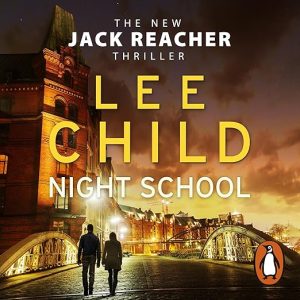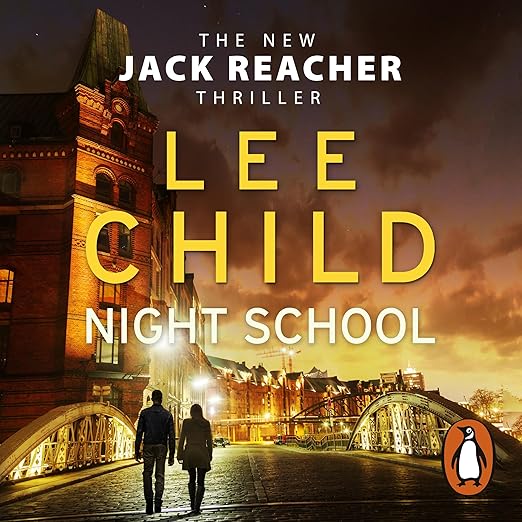
- Read by: Jeff Harding, widely praised as the definitive UK voice of Jack Reacher, brings his established controlled, unshowy delivery to this procedural, institutional entry.
- At its heart: Cold War-era espionage tension, interagency distrust, Reacher's active-duty military past
- Vibe: Tense and procedural, with prescient geopolitical undertones
- Short version: A genuinely strong, atypical Reacher entry that works well even as a first taste of the series, thanks to its earlier timeline and Harding's acclaimed narration.
A cluster of sharply dressed young men meets in a Hamburg apartment, and an intercepted voice mentions a hundred million dollars, and that's all the setup Lee Child needs to launch the twenty-first Jack Reacher audiobook into motion. Night School drops back to 1996, well before most of the series' established timeline, catching Reacher fresh off a secret mission and freshly decorated, only to reassign him to a strange three-person school alongside an FBI agent and a CIA analyst. Their entire assignment: find the American selling something to someone for a hundred million dollars, and stop it before whatever it is gets delivered.
First, the Big Picture
Setting the book in 1996 gives Child real material to work with: Reacher is still active-duty military police rather than the drifting ex-Army wanderer later books established, which changes his relationship to rank, procedure, and the FBI and CIA colleagues he's forced to cooperate with rather than simply outmaneuver. The plot's Saudi financing angle also reads with an unmistakable, deliberate hindsight charge given what the real late-1990s were quietly building toward, though Child wrote this in 2016 with full awareness of that dramatic irony rather than by accident. The synopsis is upfront that the series can be experienced in any order, and Night School's earlier timeline actually makes it a reasonable entry point for a new listener curious about young, active-duty Reacher before sampling the character's more famous drifter era.
Jeff Harding narrates, and he's earned a real reputation as the definitive UK voice of this character across the series; The Sunday Times has praised his Reacher performances specifically, writing that he captures Reacher's character perfectly and that listeners have to savour every minute. That reputation is built across many entries rather than this book specifically, but it's a genuinely strong signal for any Reacher title he narrates, and Night School's institutional, procedural tone, three agencies forced into uneasy cooperation, suits his controlled, unshowy delivery well.
Lee Child, the pen name of British author Jim Grant, had already built Reacher into one of thriller fiction's most reliable franchises by the time Night School arrived as the twenty-first entry in 2016, and the confidence shows in how willingly Child breaks from formula here, trusting listeners to follow Reacher into a genuinely different structural mode rather than repeating the isolated-town setup that made the series famous.
The Best Parts of Night School
Karin Slaughter's blurb calls it, in her own words, 'Best. Reacher. Ever,' adding that she says something like this every year but means it here specifically, and one listener reviewer backs up that enthusiasm, describing the plot as a rollercoaster of unexpected developments that kept them guessing at every turn. For a series now over twenty books deep, that kind of specific, renewed excitement from both a fellow thriller novelist and an ordinary listener is a meaningful signal that this particular entry doesn't feel like formula repetition.
Another reviewer frames it directly as 'Atypical Reacher,' and that's an accurate, useful way to set expectations: this is closer to a spy-thriller procedural than the standalone-town, one-man-against-local-corruption structure many Reacher books follow. Listeners who enjoy watching Reacher navigate institutional politics and interagency distrust, rather than simply outfighting a small town's worth of bad guys, will find this specific structural variation genuinely refreshing rather than a departure to be wary of.
The book sits comfortably alongside classic spy-procedural fiction, closer in structure to John le Carre's institutional suspicion or Tom Clancy's interagency plotting than to Reacher's usual lone-wolf action template, which gives Night School crossover appeal beyond the series' existing fanbase. Listeners who enjoy that genre generally, regardless of any prior Reacher exposure, will find the FBI-CIA-military-police triangle at the plot's center genuinely well handled.
A Few Reservations
One detail-oriented reviewer flags a small continuity wrinkle worth mentioning: despite playing an active-duty major addressing senior officers in 1996, this version of Reacher still talks the way the later, out-of-uniform Reacher does, skipping the formal 'Sir' a real major would typically use with superiors. It's a minor nitpick rather than a real flaw, but continuity-focused longtime fans of the series may notice it too.
With only 78 ratings attached to this specific listing, the review base here is thinner than the series' overall popularity would suggest, likely a reflection of how ratings get split or pooled across different editions and formats rather than any real reflection on quality. Listeners expecting the pure physical-confrontation intensity of Reacher's more famous entries should also adjust slightly: Night School leans harder into procedural tension and institutional distrust than hand-to-hand action, at least through its first stretches.
One more thing worth knowing: this specific listing's narrator, Jeff Harding, is the voice of the UK Random House editions of the Reacher series specifically, distinct from the narrators used on US editions of the same books. Listeners who've heard other Reacher titles narrated by a different voice shouldn't be alarmed by the switch here; it reflects the region-specific production rather than any inconsistency within a single edition.
The Right Listener for Night School
Longtime Reacher fans curious about his active-duty military years, alongside spy-thriller and procedural readers who enjoy interagency tension as much as physical confrontation, are the ideal audience, and Harding's established, critically praised performance makes this a safe pick for anyone already sold on the series' audio editions. New listeners looking for a chronologically earlier entry point than the character's famous wandering years might also reasonably start here.
Skip this one if you want Reacher at his most purely physical, working through problems with his fists from the opening chapter; Night School spends real time on institutional maneuvering before the action escalates. Listeners who get distracted by small continuity inconsistencies, like the military-address quirk noted above, may also want to go in forewarned, though it's a small enough detail that most listeners won't notice at all.
Do I need to hear the other twenty Jack Reacher audiobooks before this one?
No, Lee Child's own note confirms the series can be enjoyed in any order, and Night School's earlier 1996 timeline actually makes it a reasonable starting point.
Is this audiobook as action-heavy as other Jack Reacher entries?
It leans harder into procedural tension and interagency distrust than hand-to-hand combat, at least through its opening stretches, which one reviewer specifically calls atypical Reacher.
Why does this audiobook have fewer ratings than other Reacher titles despite the series' popularity?
With only 78 ratings on this specific listing, the number likely reflects how ratings get split across different editions and formats rather than any real reflection on the book's quality.
How long is the Night School audiobook?
It runs eleven hours and twelve minutes, a fairly typical length for a Reacher entry.