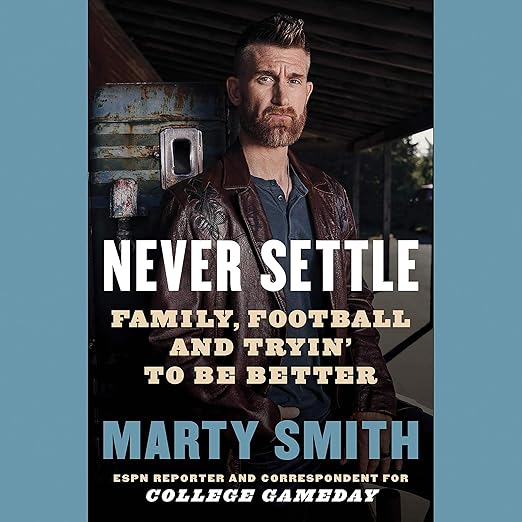
I put on Never Settle during a long Saturday morning drive, which felt right given that Marty Smith has spent years being the voice people turn on during exactly that kind of unhurried weekend ritual. By the time I hit the third chapter, I had already laughed out loud twice and was listening more closely than I expected to. That surprise, the one where you realize a book is better than you thought it would be, is the best thing that can happen to you as a listener, and it happens here with satisfying regularity.
Marty Smith is an ESPN correspondent and College GameDay regular, one of those reporters who somehow manages to interview Nick Saban at his lake house and get Tiger Woods to talk about things he doesn't usually talk about. The book's premise is simple: how did the kid from Pearisburg, Virginia who played high school ball and grew up on a farm end up with what he freely acknowledges is the greatest job in sports broadcasting? But the execution is considerably more layered than that premise suggests, and the layers are what make Never Settle worth the eight-plus hours it asks of you.
What We Made of It
What I found most unexpected about Never Settle is how much of it is not really about sports at all. The chapters about Smith's father, about growing up in rural Virginia, about the particular texture of small-town Southern life, these carry the book's emotional weight. Smith is clear-eyed about where he comes from without being either romanticizing or apologetic about it, which is harder to pull off than it sounds. The reviewers who loved this book consistently mentioned being moved by sections they didn't anticipate finding affecting, and I had the same experience. There is something about his account of his parents, their expectations and their sacrifices, that grounds everything that follows.
The sports stories themselves are genuinely good. The anecdote about getting Nick Saban to jump in a lake is as funny as it sounds in the synopsis. The material about Dale Earnhardt Jr.'s return to racing and his conversation with Smith about it carries real feeling, partly because Smith is clearly someone Earnhardt trusted enough to be vulnerable with, and that trust comes through on the page. The chapter involving Tiger Woods has a similar quality, a sense that we are hearing something real rather than something curated for public consumption. These moments feel earned because Smith has spent chapters establishing who he is before he tells us who he has met.
What Makes Never Settle Worth Hearing
The standard knock on celebrity memoir is that it reads like an extended press release. Reviewer Amberly articulated exactly this fear before admitting that Never Settle overcame it completely. The key is that Smith talks as readily about failure, self-doubt, and the things that almost derailed him as he does about the wins. He is not performing humility; he seems to have actually worked through some things before writing this book, and that gives the memoir a groundedness that is relatively rare in the sports broadcasting genre.
Smith also makes good use of the audio format specifically. Because he is narrating it himself, the pacing has the rhythm of spoken storytelling rather than written prose being read aloud. There are asides, small corrections, moments where the energy picks up because he is clearly enjoying the memory. Reviewer Dominic noted that this book avoids the trap of retelling stories that fans have already heard from Smith's podcast or TV segments, which matters: it gives the audiobook a sense of discovery rather than repetition. For listeners who are already part of Smith's audience, that distinction is crucial. For those new to him entirely, the book functions as an introduction that makes you want to find his other work.
What Might Not Land
Never Settle is not a meditation on the state of American sports media or a critique of the broadcasting industry's values and pressures. It does not try to be, and that restraint is appropriate. Smith is comfortable operating within a celebratory register, and the book is warmest and most alive when it stays there. Listeners looking for structural analysis or cultural criticism will not find it here. At just over eight hours, the pacing is generous without becoming slack, though a few chapters in the middle section feel like they are building toward a revelation that doesn't quite arrive at the weight the setup promises.
But the core of the book, the stories about what sports actually mean to the people who play them, coach them, broadcast them, and grow up watching them, has real conviction behind it. Smith's thesis is essentially that sports at their best are a way of transmitting values across generations, and he makes that case through accumulated specific detail rather than abstract argument. The chapter about his son is the clearest statement of that theme, and it lands the way the best chapters of any memoir land: quietly, without announcement, leaving you with something you did not have before you listened.
The Right Listener for Never Settle
Listen if you are a college football fan, a NASCAR follower, or simply someone who appreciates a sports memoir that gives you the sense of sitting with someone who has genuinely interesting stories and tells them well. Listen also if you want a reminder that American sports culture, at its best, is about something more than winning records and television contracts. Skip if you are looking for investigative depth or structural critique of the broadcasting industry. This is a book about love for the game, told by someone who clearly has it, and that love is more than enough.
Frequently Asked Questions
Do you need to be a NASCAR fan to enjoy Never Settle?
No. Several reviewers explicitly mentioned not being NASCAR fans and still finding the book compelling. Smith's NASCAR roots appear early in the book but the material quickly broadens to college football, personal history, and character sketches of athletes across sports.
How does Marty Smith's narration compare to a professional narrator reading the same material?
The self-narration is genuinely one of the book's strengths. Smith's Southern cadence and natural pacing make the behind-the-scenes stories feel like conversation rather than recitation. A professional narrator would likely deliver cleaner audio, but the personality would be considerably diminished.
Does the book cover Smith's coverage of athletes who have since become controversial figures?
The book focuses on the human moments in Smith's relationships with athletes and coaches rather than on their public reputations. It is written from a place of genuine admiration for the people he covers, which is both a strength and a limitation depending on what you are looking for.
Is Never Settle part of a series or does it stand alone as a complete memoir?
It stands alone as a complete memoir covering Smith's upbringing through his ESPN career. One enthusiastic reviewer humorously requested three sequels, suggesting there is plenty of material left, but the book resolves on its own terms and does not require continuation to feel complete.