Quick Take
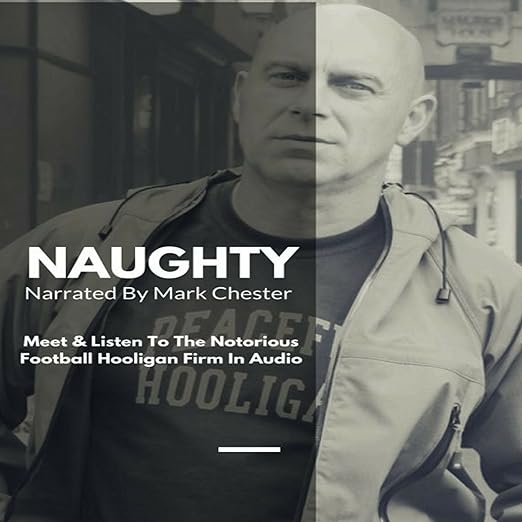
- Narration: Mark Chester reads his own memoir with the blunt, no-frills delivery of a man who has nothing left to prove and no reason to dress it up.
- Themes: Tribal loyalty, working-class identity, the seductive pull of organized violence
- Mood: Raw and propulsive, occasionally unsettling
- Verdict: A firsthand account that takes football hooliganism seriously as sociology without ever romanticizing the worst of it.
I picked this one up on a Tuesday evening when I was in the middle of a broader run through British football subculture writing, working my way from Nick Hornby’s polished sentimentality toward its more jagged edges. Naughty is about as far from Fever Pitch as you can travel while still talking about the same sport. Mark Chester was a founder member of the Naughty 40, the hooligan firm that grew out of Stoke City FC’s supporter base following a notorious 1985 trip to Portsmouth, and this audiobook is his unvarnished account of what that world looked like from the inside.
Chester is not a professional writer, and that actually works in the book’s favor. There is no literary scaffolding here, no attempt to frame his younger self as either a monster or a martyr. He simply recounts what happened: the coach trips from the Glebe pub, the hierarchy of men like Mark Bentley and the legendary Miffer, the clashes with Everton, West Ham, and Millwall that built the firm’s reputation. The result reads like testimony more than memoir, and at 14 hours it has the patience of a man who clearly wants you to understand the texture of the thing, not just the headline violence.
Our Take on Naughty: The Story of a Football Hooligan Gang
What makes Chester’s account genuinely interesting is the sociological dimension he stumbles into without quite intending to. His childhood, marked by expulsion from school and a short stint in the Staffordshire Regiment that ended in discharge for misconduct, traces a familiar arc: a young man who finds in the N40 the structure, belonging, and code of honor that conventional institutions failed to provide. The firm’s watchword, as he frames it, was loyalty, and for the men who grew up on Stoke’s terraces in the 1980s, that was not a trivial thing. The code was simple: whatever the odds, you made a stand. That ethic, Chester argues, created a cohesion rare among football gangs, and the audiobook takes care to distinguish the N40 from mindless chaos.
Reviewers familiar with Cass Pennant’s work will find this in the same tradition. Chester’s book covers similar ground but from a smaller, more intensely local perspective. This is Stoke City, not West Ham, and the N40 never claimed to be the most notorious firm in England. That modesty actually strengthens the account. Chester is not performing for a national audience. He is telling the story of his people as faithfully as he can.
Why Listen to This Over Reading It
Self-narration is always a gamble, and Chester is not a trained voice actor. His delivery is flat in places, and the pacing occasionally drags during the cataloguing of names and incidents that will mean more to someone who was there than to an outside listener. But the trade-off is authenticity. When he describes the moment he decided he was ready to commit to the hooligan life, the words carry the weight of someone who actually stood in that moment. No hired narrator could replicate that.
The audiobook also benefits from Chester’s willingness to reflect on what followed the golden years. Police operations, ground bans, and ID schemes broke up the original N40, but he argues that by the new millennium the gangs had returned, as ferocious as ever. That coda gives the book a melancholy undercurrent it might otherwise lack.
What to Watch For in the N40’s World
The introduction of the Under-Fives, the younger element that sought acceptance from the terrace legends, is one of the more compelling sections. It functions almost as a study in how subcultures reproduce themselves across generations, with the same dynamics of respect, initiation, and eventual conflict playing out in miniature. Chester describes this with obvious warmth, and it humanizes a story that could easily have stayed at the level of brawl reportage.
If you approach this audiobook as pure action writing, looking for a series of violent incidents strung together, you will probably find it repetitive by hour six. But if you come to it as cultural history from a participant observer, it rewards patience. Few accounts of British football hooliganism are this specific about the internal logic of a single firm.
Who Should Listen to Naughty: The Story of a Football Hooligan Gang
This one is well-suited for listeners already interested in British terrace culture, working-class history, or the sociology of male group identity. Fans of Cass Pennant’s books, or documentaries like The Football Factory, will find it genuinely illuminating. Listeners who come to it expecting a neutral or critical examination of hooliganism will be frustrated: Chester is an insider writing for insiders, and he never pretends otherwise. Those without an existing interest in Stoke City FC or 1980s English football may find the depth of local detail alienating rather than enriching.
Frequently Asked Questions
Does Mark Chester glorify the violence he participated in, or does he show any critical distance?
Chester presents the N40’s activities from a firmly insider perspective. He does not moralize excessively, but he also reflects on the consequences, including police operations and bans, and frames the firm’s loyalty code in terms that suggest he sees genuine value in what they built, even while acknowledging the damage. It is more memoir than manifesto, but critical distance is limited.
How does this compare to other British football hooligan books like those by Cass Pennant?
Several reviewers draw the comparison directly. Chester’s book covers similar ground but from a smaller, more localized Stoke City perspective rather than the larger West Ham milieu Pennant describes. The tone and approach are similar, with the insider voice and name-heavy roster of characters, but the scale is more intimate.
Is the self-narration a significant obstacle to enjoying the audiobook?
Chester’s narration is functional rather than polished. His flat delivery and northern accent are consistent, and the lack of performance actually suits the confessional nature of the material. Listeners accustomed to professional narrators may find it takes an hour to settle in, but the authenticity is real.
At 14 hours, does the audiobook sustain interest throughout, or does it run long?
The middle sections, which involve detailed accounts of specific clashes and the names of firm members, can feel dense if you are not already invested in the subculture. The opening and closing sections, which frame Chester’s personal history and reflections on the firm’s legacy, are the strongest parts. Patient listeners will find the full run worthwhile.