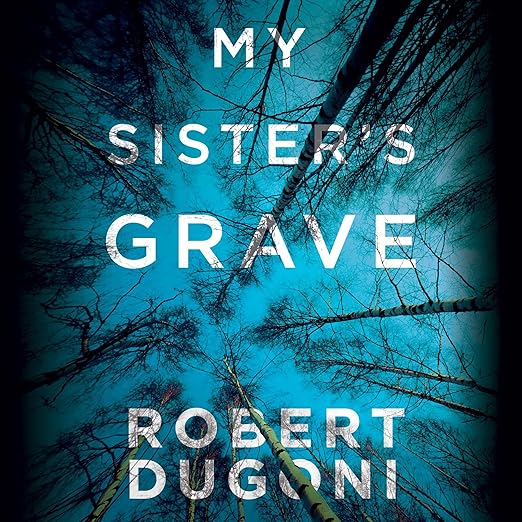
Quick Take
- Narration: Emily Sutton-Smith handles Tracy Crosswhite’s grief and determination with restraint and intelligence, no emotional overstatement, just steady forward motion.
- Themes: wrongful conviction, grief and obsession, Pacific Northwest procedural
- Mood: Tense and methodical, with an emotional current running beneath the investigation
- Verdict: A well-constructed series opener that earns its loyal following through character investment as much as plotting.
I started My Sister’s Grave on a long flight and finished it somewhere over the Atlantic, having abandoned two other audiobooks in the previous week for failing to hold me past the first hour. Robert Dugoni’s series opener held me from its second chapter, which is when Tracy Crosswhite’s history, her sister’s disappearance, the conviction that followed, the two decades of quiet rage that shaped her career choice, becomes clear enough to feel real. At just under eleven hours, it’s a substantial listen, and it uses most of that time well.
The setup is familiar in its bones: a detective investigates a cold case with personal stakes. What Dugoni does is give the formula enough specificity and emotional texture that the familiarity recedes. Tracy became a homicide detective specifically to get closer to the tools and knowledge that might eventually let her reopen Sarah’s case. The discovery of Sarah’s remains near their hometown in Washington’s northern Cascades, twenty years after her disappearance, is both the inciting event and the fulfillment of something Tracy has spent half her life building toward. That’s a different emotional architecture than a detective who catches a cold case by assignment, and Dugoni exploits that difference effectively throughout.
The Wrongful Conviction Tracy Can’t Let Go
Edmund House, the convicted rapist whose case Tracy has never been able to accept as the full truth, is serving time for Sarah’s murder. Tracy doesn’t believe he did it. This is not presented as a hunch or a sister’s denial: she has specific reasons, specific gaps in the evidence, specific moments from the trial that never resolved cleanly. Dugoni handles the legal procedural dimension of this with care. The trial flashbacks, the forensic details, the small inconsistencies that a grieving family might miss but a trained investigator circles back to, these are given enough space that you can follow Tracy’s reasoning rather than simply accept her conviction on faith.
Reviewer Lane described finishing 75% of the book in the last three nights of an eight-night read, after a slow start, which maps closely to my own experience. The first third establishes the backstory with more patience than some thriller readers will want. But Dugoni earns that patience: when the investigation accelerates in the book’s second half, the emotional stakes are fully loaded, and the plot’s twists land harder because you understand exactly what each revelation means for Tracy specifically. The setup is not wasted time, it’s structural preparation for the emotional impact of what follows.
Seattle PD, Cold Cases, and Emily Sutton-Smith
Tracy’s identity as a Seattle homicide detective gives the investigation procedural legitimacy while complicating her position: she is working a case in which she is a personal party, in a jurisdiction where she has no formal authority, reopening a verdict that the system considers closed. Dugoni uses this tension productively rather than ignoring it. The scenes where Tracy has to navigate departmental skepticism and active resistance from people who would prefer the old verdict to stand have a realism that grounds the thriller mechanics.
Emily Sutton-Smith narrates throughout with the controlled restraint that Tracy’s character demands. Tracy is not a demonstrative protagonist, her grief runs deep but she has learned, over twenty years, to function through it rather than display it. Sutton-Smith matches that quality exactly: the emotion is present and legible, but she doesn’t play it externally. Reviewer Irene A. described Dugoni as doing an excellent job captivating the audience by spreading twists throughout rather than concentrating them at the end, and Sutton-Smith’s steady delivery is part of what makes that pacing work aurally, she doesn’t telegraph the turns before they arrive, which allows Dugoni’s structure to function as intended.
The Emotional Architecture the Synopsis Undersells
The synopsis describes dark long-kept secrets and deadly danger, which is accurate but undersells the book’s emotional specificity. My Sister’s Grave is, at its core, a novel about what grief does to a life over twenty years, how it can become both an organizing principle and a prison. Tracy’s obsession with Sarah’s case is not presented as pathology but as a form of fidelity, and the question the book eventually forces her to confront is whether solving the case will release her from the weight she has been carrying, or whether that weight has become structural to who she is.
Reviewer Paul S, writing from the UK, described this as a brilliant police procedural and legal thriller in a detailed review covering both this book and its sequel. Reviewer Spell, writing with admirable economy, described being intrigued, enraged, heartbroken, and revenged, having to take a break midway to compose herself before jumping back in. That range of response is characteristic of the best crime fiction: the plot delivers procedural satisfaction while the character work delivers something harder to name. My Sister’s Grave does both with enough skill that it has generated nine subsequent books in the Tracy Crosswhite series, a body of work that only exists because the first entry was strong enough to earn continued investment.
Series Entry Point, Character Study, and Who Should Start Here
Come to My Sister’s Grave if you prefer character-invested crime fiction over pure plot mechanics. Come if you are drawn to Pacific Northwest settings, Dugoni’s Washington State geography is specific and atmospheric without becoming touristic. Come if you have patience for a first act that builds carefully before accelerating. If you prefer thrillers that open at full speed and maintain constant forward momentum, the book’s measured early pacing may frustrate you. But for readers who want a crime series with a protagonist worth following across multiple books, Tracy Crosswhite is a strong, coherent starting point, and this is the entry that earns everything that follows.
Frequently Asked Questions
Does My Sister’s Grave need to be read before the other Tracy Crosswhite books, or can you start anywhere in the series?
My Sister’s Grave is the correct starting point. It establishes Tracy’s history, her sister Sarah’s case, and the emotional foundation that the subsequent books build on. Jumping in at a later entry would mean missing the context that makes Tracy’s character meaningful.
How does Emily Sutton-Smith handle the dual timeline structure, the present investigation and the trial flashbacks?
Sutton-Smith manages the transitions between timelines cleanly. She doesn’t use dramatically different vocal registers for the past and present, which is the right choice: the flashbacks feel like memory rather than interruption, and her consistent voice keeps the emotional continuity intact across both strands.
Is the mystery genuinely surprising, or is the real killer telegraphed early?
Multiple reviewers noted they had no idea where the book was going, and reviewer Lane described frantically turning pages until the end. Dugoni distributes the clues and misdirections across the full length of the book rather than saving all the revelation for a final chapter, which keeps the mystery functional throughout.
Is My Sister’s Grave available as a free audiobook on Audible?
Yes, this free audiobook is available to Audible members through their subscription. Check the current Audible listing to confirm availability, as catalog access can change over time.