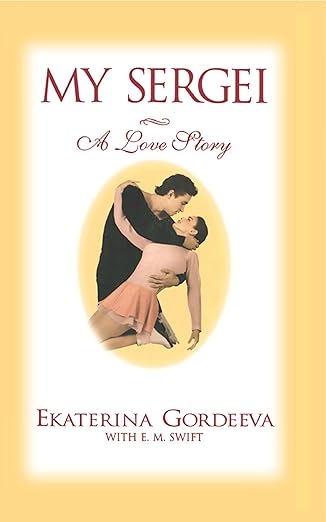
Ekaterina Gordeeva won Olympic gold in pairs figure skating twice alongside her partner and husband, Sergei Grinkov, before his sudden death from a heart attack ended both their marriage and one of skating's most celebrated partnerships. This audiobook compresses that entire arc, their first pairing as children, successive world championships, a storybook marriage, and Grinkov's death at age twenty-eight, into a single hour and thirty-three minutes, a runtime dramatically shorter than the full memoir this title is drawn from. Narrator Irina Lechova takes on the difficult job of carrying a genuine grief memoir at a pace that fits a short-form audio production, rather than the fuller, slower unfolding the print book allows its readers.
The synopsis here is unusually thin, barely a paragraph, but the reviews fill in what the marketing copy leaves out. Reviewer Nurse SportsFan, who revisited the book while watching skating during a recent Olympics broadcast, confirms Gordeeva wrote it shortly after Sergei passed away at age 28 of heart troubles, and calls it 'a fascinating look at how Russia used to be' beyond the personal love story. That combination, competitive-skating memoir and a window into late-Soviet and post-Soviet Russian life, gives the book more range than the title alone suggests to a casual browser.
Reviewer slc describes the couple as mismatched 'in terms of height, but not in their eventual capacity to develop a deep love and respect for one another,' a detail that captures something real about pairs skating specifically: the sport quite literally requires two bodies to move as one, and Gordeeva and Grinkov's ability to do that on ice mirrored, by every account here, how they operated as a couple off it. At 4.8 stars across 661 ratings, listener sentiment here is about as uniformly positive as a rating average tends to get.
Pairs figure skating as a discipline demands a specific, almost paradoxical trust between partners: throws, lifts, and side-by-side jumps require absolute physical synchronization, executed at speed, with real risk of injury if timing is off by a fraction of a second. Reviewers describing Gordeeva and Grinkov as visually mismatched in height but perfectly matched in partnership are pointing at something specific to the sport itself, where technical compatibility and emotional trust often matter more than how two skaters look standing next to each other off the ice.
Olympic athlete memoirs occupy a strange position in publishing: most are ghostwritten sports-career retrospectives published soon after retirement, competitive results and training anecdotes strung together for fans. My Sergei stands apart from that pattern precisely because grief, not athletic achievement, becomes the book's actual center of gravity, which several reviewers here credit for making it resonate with readers who have no particular interest in figure skating as a sport but respond to the love story and loss underneath it.
What Works
Reviewer Lily calls the love story 'very captivating and poignant,' adding she could not put the book down, strong language for a memoir whose ending every listener already knows going in. That is the real achievement of a grief memoir like this one: Grinkov's death is not a twist to be revealed, it opens the book's emotional frame from the start, and the listening experience becomes less about suspense and more about understanding exactly how deep the loss actually was for the people who lived it.
Because I found no prior track record for Irina Lechova to draw on, her performance here has to be judged on genre fit alone: a first-person Russian athlete's grief memoir calls for restraint over sentimentality, letting Gordeeva's own words carry the emotional weight rather than over-narrating it. Reviewer slc's description of the book as 'very tender, touching and profoundly deep' suggests the material itself does the heavy lifting regardless of narration style, which is common for source material this personal and specific to one couple's life.
Grief memoirs written close to the loss they describe, as this one apparently was, carry a different quality than ones written with decades of distance and reflection; the emotion is closer to the surface, less processed into tidy lessons, which several reviewers here seem to respond to directly. That rawness is often what separates a memoir that feels genuinely lived-in from one that reads as a polished retrospective account written safely after the wound has fully healed.
The book's brevity also means listeners finish in a single sitting, an unusual pacing advantage for a memoir this emotionally dense, letting the full arc of love and loss land without the interruption a longer, multi-session listen would introduce.
Before You Commit to My Sergei
Listeners should treat this specifically as a condensed or adapted audio production rather than assume it delivers the same depth as the original book; the emotional throughline survives the compression well, by reviewer accounts, but granular detail about specific competitions, training years, and the couple's early partnership necessarily falls away at this length. Anyone wanting the complete competitive record, not just the emotional core of the relationship, should treat this short edition as a starting point and seek out the full print edition for what the runtime cannot include.
The synopsis provided with this listing runs only a few sentences, noticeably thinner than the reviews themselves, which is worth knowing before purchase since the marketing copy undersells how much specific historical and personal detail listeners report finding inside. Go in expecting the reviews, not the brief synopsis, to be the more accurate preview of what this audiobook actually contains for a prospective buyer.
Short-form adapted audio editions of longer memoirs are not unusual in audiobook publishing generally, particularly for older backlist titles being reintroduced to a streaming-audio audience decades after original publication, and the ninety-three-minute runtime here fits that pattern rather than suggesting anything unusual about this specific production. Listeners should treat it the way they would any condensed adaptation: a genuine, faithful compression of the emotional core rather than a full substitute for the source material's complete detail.
Who It's For
This suits figure skating fans, especially anyone who remembers Gordeeva and Grinkov's actual competitive career or has watched footage of their programs, along with listeners drawn to grief memoirs that do not shy away from sitting inside loss rather than resolving it neatly. Reviewer Nurse SportsFan's habit of revisiting the book during Olympic broadcasts suggests this is a title with real relisten value for anyone with a standing interest in the sport's history.
Skip it if you want a comprehensive account of their full competitive career told at length; the short runtime here means significant compression of a much longer original story. Listeners who prefer their sports biographies focused primarily on technique and competition results, rather than romance and grief, should also know this leans heavily toward the emotional and personal side of Gordeeva and Grinkov's story rather than a blow-by-blow of their skating career together.
In Brief
- Performance: Irina Lechova has nothing in her prior work that I could confirm as directly comparable, so her restrained approach to Gordeeva's grief memoir is judged on genre fit alone.
- What it covers: Olympic pairs skating, sudden loss, Soviet and post-Soviet Russian life
- Feel: Tender and grief-laden, deeply personal rather than sports-focused
- Our call: A moving but heavily condensed listen best paired with the full print memoir for anyone wanting the complete competitive history.
Questions Listeners Ask
How long is the My Sergei audiobook?
It runs just one hour and thirty-three minutes, a significantly condensed audio production compared to the full-length print memoir this title is based on.
Is this audiobook mainly about figure skating technique or about the relationship?
It leans heavily toward the personal and emotional side of Gordeeva and Grinkov's story, their partnership, marriage, and his sudden death, rather than detailed competition analysis.
Does this audiobook work for listeners unfamiliar with figure skating history?
Yes, reviewers describe it as an accessible, tender love story and a window into Soviet-era Russian life that does not require deep prior knowledge of pairs skating to connect with.