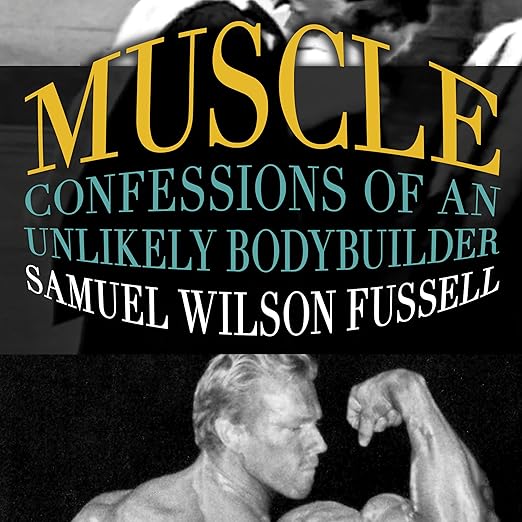
Quick Take
- Narration: L.J. Ganser handles Fussell’s self-deprecating, darkly comic voice well, the narration captures the absurdity of the subculture without losing the genuine pathos underneath it.
- Themes: Obsession and identity, the psychology of transformation, the cost of physical perfectionism
- Mood: Alternately funny and haunting, the memoir equivalent of watching someone walk deliberately into a trap they cannot see
- Verdict: One of the most psychologically honest books ever written about bodybuilding, and one of the more unusual literary memoirs about what it means to remake yourself entirely.
I came to Muscle through a recommendation that described it as a bodybuilding memoir written by an Oxford graduate who had never lifted a weight before age twenty-six, and I was immediately curious about the collision that premise implied. Samuel Wilson Fussell is the son of the literary critic Paul Fussell, grew up in a world of books and academic appointments, arrived in New York City after Oxford and felt, genuinely, physically, viscerally, afraid. The city seemed dangerous. His solution was to walk into a gym.
What followed is one of the stranger self-transformation stories in American memoir. Four years. Eighty pounds of muscle. Steroid injections. Protein powders. The bodybuilding circuit that culminated in Southern California’s Venice Beach, the place practitioners called the Mecca. And at the end of it, paradoxically, Fussell felt weaker, smaller, and more helpless than when he started. The pursuit of physical impregnability had turned him into something closer to an infant, dependent on his regimen, his drugs, his gym community, than the fortress he had imagined.
Our Take on Muscle
The book operates on two levels simultaneously. On the surface it is a darkly comic anthropological tour of hardcore bodybuilding subculture in the mid-1980s, the gym rats, the juicers, the coaches with baroque personal philosophies, the competition culture that demands you reduce yourself to near-helplessness in service of the ideal physique. Fussell has a novelist’s eye for the grotesque and the human in equal measure, and the characters he encounters in New York and later in Venice are rendered with affection as well as irony.
Underneath that, the book is an investigation of obsession itself. Fussell is trying to understand what happened to him, not just how he transformed his body, but why the transformation consumed everything else and still left him feeling vulnerable. His class background, his literary education, and his complete inexperience with physical culture when he began give him a useful distance from the subculture he enters. He can see it from both inside and outside simultaneously, and that dual vision is what elevates the memoir above its subject matter.
Why Listen to Muscle
L.J. Ganser’s narration is well-matched to the material. Fussell’s prose has a dry, literary quality, he is the son of a famous literary critic and it shows, and Ganser understands how to deliver irony without underlining it. The humor in the book is largely self-directed, and Ganser finds the right register: wry rather than slapstick, rueful rather than smug. When the material turns darker and more physically degrading, he does not flinch from the grimness, which the book requires.
One reviewer who had encountered the bodybuilding world firsthand noted that the characters Fussell depicts are recognizable, that the gym types, the coaches, the fellow obsessives all ring true. That quality of observed accuracy is one of the book’s most durable achievements. Fussell was there, he paid close attention, and the result is a portrait of a subculture that does not condescend to its subjects even while finding them fascinating.
What to Watch For in Muscle
The book was first published in 1991 and is set in the mid-1980s, which means the steroid culture it depicts reflects that era’s practices and attitudes. The bodybuilding world has changed in various ways since then, and some of what Fussell describes as typical may now be unusual, historical, or restricted. Readers who come to this expecting a contemporary portrait of the fitness industry will need to adjust their frame, this is a specific time and place, and it reads as such.
Some reviewers also noted a feeling that the book is slightly fictionalized or heightened, that certain scenes and characters feel too perfectly drawn to be pure memoir. Fussell himself acknowledged some compression and heightening. This is something to be aware of if you come to the book expecting strict documentary accuracy rather than memoir’s license to shape experience into narrative.
Who Should Listen to Muscle
This is a strong listen for: readers interested in obsession memoirs and psychological self-examination, anyone curious about hardcore bodybuilding culture from a literary outsider’s perspective, and listeners who appreciate memoir that uses a physical subject to investigate larger questions about identity, class, and the desire for self-transformation.
It is less suited to: readers who want practical fitness information (this is not that book), those who require strict documentary fidelity in memoir, and listeners who find extended immersion in a single subculture’s rituals and language more exhausting than fascinating. The book is deliberately narrow in its focus, and that narrowness is what gives it depth.
Frequently Asked Questions
Is Muscle strictly accurate memoir or does Fussell acknowledge any fictionalization?
Fussell acknowledged some degree of compression and heightening typical of literary memoir. Several reviewers noted that certain scenes and characters feel shaped for narrative effect. The book is drawn from his actual experience of four years in bodybuilding culture, but it is memoir rather than documentary journalism, and it carries the license that distinction implies.
Does the book cover steroid use frankly, and does it advocate for or against it?
Frankly, yes. Fussell documents his own steroid use as part of the experience without either sensationalizing it or defending it. He is interested in what it did to his body and his psychology, not in delivering a moral verdict. The portrayal is honest and somewhat disturbing, which is likely the intention.
How does L.J. Ganser handle the shifts between dark comedy and genuine pathos in the narration?
Ganser navigates these tonal shifts with the dry register the book requires, he does not play for laughs in the comic passages or sentimentality in the darker ones. Fussell’s prose is literary and somewhat detached even at its most revealing, and Ganser respects that quality rather than amplifying it emotionally.
The book is set in the 1980s bodybuilding world. How dated does it feel as a portrait of that subculture?
It reads clearly as a period piece, the specific drugs, training philosophies, competition circuits, and cultural geography of Venice Beach in the 1980s are all historically located. Readers familiar with contemporary fitness culture will recognize certain constants in the psychology of obsession, but the specific subculture Fussell describes belongs to its era.