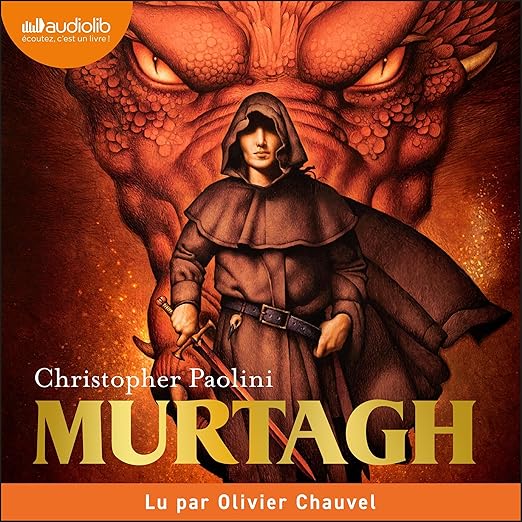
Note for English-language listeners: this edition of Murtagh, narrated by Olivier Chauvel, is the French-language audiobook published by Audiolib. The English-language edition exists separately. The review below addresses the novel itself and what this production offers. If you are looking for the English narration, please check the separate English edition listing.
It takes a particular kind of authorial confidence to write a companion novel twenty years after a debut, centered on the figure who spent most of the original series either antagonist or reluctant ally, and expect readers to follow. Christopher Paolini earns that confidence here. Murtagh works not despite the complexity of its protagonist's history but because of it - the twenty years since Eragon have given both author and audience time to understand what was interesting about Murtagh all along, which was never the villainy but always the constraint. He was a character who did terrible things because he had no choice, and who now has to live in a world that doesn't know that.
The novel picks up months after Galbatorix's fall. Murtagh and his dragon Thorn are pariahs: Alagaesia knows them as traitors and killers, ignorant of the role they played in Eragon's victory. They live in self-imposed exile, avoiding the world that would reject them. When rumors of strange events at the edges of the continent draw them into action, what unfolds is a quest that is equal parts external adventure and internal reckoning - Murtagh confronting the damage that Galbatorix's control left on his identity, his relationship with Thorn, and his capacity to trust anyone who isn't his dragon.
Murtagh and Thorn Finally Get Real Space
Paolini's characteristic tendency to render scenes at considerable length - a pattern that readers of the Inheritance Cycle will remember clearly - is present here, and one French reviewer specifically notes that this is more detail-dense on the adventure side than his more recent novel Idealis. Whether that's a strength or a limitation depends entirely on the reader. For those who want to live in Alagaesia rather than merely visit it, the pacing is appropriate. For those who prefer leaner epic fantasy, the extended sequences may test patience. What the novel does exceptionally well is honor the complexity of a figure who was always more interesting than his role in the original series allowed him to be. The Murtagh-Thorn bond, explored here with more space than any previous book offered, is the emotional center, and it's handled with genuine care.
Chauvel's Measured Delivery Fits the Introspection
Chauvel's narration suits the material's introspective register. This is a quieter epic fantasy than Eragon - more interested in Murtagh's interiority than in the spectacle of dragon combat, though that's present too - and Chauvel's measured delivery doesn't push for excitement the prose doesn't support. French-speaking listeners who grew up with the Inheritance Cycle translated into French will find this production a natural continuation of how they've always heard this world. The audio includes a companion PDF available via purchase confirmation, which contains additional materials from the print edition.
Written Only for Inheritance Cycle Veterans
The novel is written explicitly for readers who know the Inheritance Cycle. The emotional weight of Murtagh's situation - the guilt he carries, the specific nature of the damage Galbatorix did to him, the history of his relationship with Eragon - cannot be felt without that context. Newcomers would be starting at the wrong place entirely. The pacing in the middle section, as Murtagh and Thorn investigate the mysterious threat, runs slower than the opening and closing sequences, and some readers found the antagonist's threat less compelling than the internal character work. These are relative criticisms within what is overall a satisfying return to a world many readers have strong feelings about.
French Listeners Want This Edition Specifically
Readers who grew up with the Inheritance Cycle - who know Alagaesia, who always wondered what Murtagh's story looked like from the inside, who want to return to a world they've spent years with - will find this exactly what it promises. French-language listeners specifically will want this edition; English-language listeners should seek the separate English audiobook. Anyone who hasn't read the original four Inheritance Cycle novels should not begin here; the emotional stakes of Murtagh's situation are entirely dependent on accumulated knowledge. Epic fantasy readers who want dense world-building and a character study conducted through action rather than reflection will have more patience with the pacing than those who prefer tightly plotted adventure.
- Read by: Olivier Chauvel narrates the French-language edition with the measured authority that epic fantasy demands, handling the introspective weight of Murtagh's perspective with more restraint than many narrators bring to dragon-rider stories.
- At its heart: redemption under suspicion, the burden of inherited guilt, the difficulty of trust between beings of different natures
- Vibe: Thoughtful and atmospheric, darker and more reflective than the Eragon books - a hero's journey told in minor key
- Short version: A worthy return to Alagaesia for readers invested in the Inheritance Cycle, with a protagonist who proves more compelling when the spotlight finally falls on him directly.
This is listed as the French-language edition - is there an English audiobook of Murtagh available separately?
Yes. The English-language edition exists as a separate listing. This edition, narrated by Olivier Chauvel, is the French-language audiobook published by Audiolib. English-language listeners should search for the English edition specifically.
How much of the Inheritance Cycle do I need to have read before Murtagh makes sense?
All four original books ideally, though at minimum Eragon and Inheritance (Book 4). Murtagh's situation - his guilt, his exile, the specific nature of what Galbatorix did to him - is only meaningful with that full context. The novel doesn't recap the necessary backstory in enough detail for newcomers.