Quick Take
- Narration: Roger May delivers a clean, classroom-ready performance that suits the simplified language without stripping away Christie’s atmosphere.
- Themes: Collective guilt, the limits of justice, luxury as theater
- Mood: Contained and suspenseful, like a sealed room filling with snow
- Verdict: An intelligently adapted version that works as both a language-learning tool and a genuine introduction to Poirot’s world.
I came to this edition of Murder on the Orient Express sideways. A colleague teaching an advanced ESL course had recommended it to her students, and one of them mentioned it to me with the kind of enthusiasm you rarely hear from someone who was assigned a book rather than choosing one. That stuck with me. I finally listened on a Tuesday evening, finishing just before midnight with that familiar Christie feeling of the floor having shifted slightly beneath me. The ending still lands, even in abbreviated form, which tells you something important about how deeply the original puzzle is constructed.
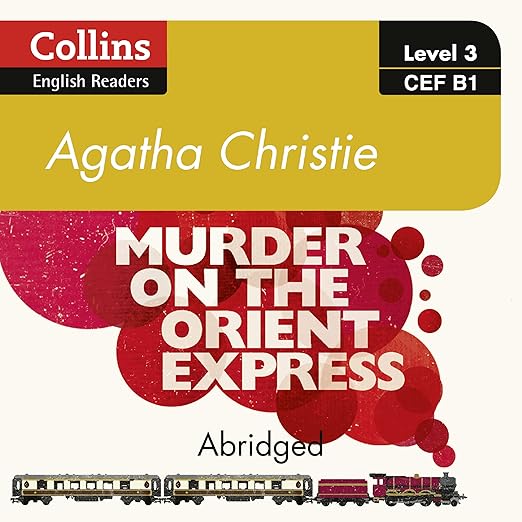
This Collins adaptation is not the full-length Agatha Christie novel, and it is worth being clear about that upfront. It is a carefully shortened version targeted at English language learners, with vocabulary and sentence structure calibrated for accessibility. What surprised me is how little of the original’s suspense the adaptation actually loses. The Simplon Orient Express is still snowbound. Poirot is still the most dangerous observer in any room. And the central puzzle, which remains one of the cleverest in Golden Age crime fiction, is completely intact. Christie built something here that is mechanically elegant enough to survive even a significant reduction in its surface detail.
What the Adaptation Preserves and What It Lets Go
Christie’s prose in the original is not particularly ornate. Her genius was always structural: the precise arrangement of clues, the timing of revelations, the way she positions the reader just close enough to the solution that the ending feels simultaneously surprising and inevitable. A language-learner adaptation turns out to be reasonably well-suited to preserving that kind of craft, because the architecture remains even when the vocabulary is simplified. The puzzle has its own internal logic that does not depend on elaborate sentence construction to function.
What is lost, inevitably, is some of the period texture. The original novel has a particular atmosphere of luxury that feels almost anthropological now, that sense of the early twentieth century train as a mobile class system, sealed off from the world outside. One reviewer noted enjoying the window it provides into what luxury travel looked like in that era, and the full novel does that work more richly. The adaptation gestures at it, which may actually be enough for a listener encountering Christie for the first time, before they have calibrated expectations around that specific texture. You receive enough context to understand that the train and its passengers represent a very particular social world, even if the full density of that world is reduced.
Poirot as a First Encounter
One reader pointed out, accurately, that this book functions as a solid standalone and a genuine introduction to Hercule Poirot without requiring prior knowledge of the series. That is worth emphasizing. Christie designed this novel to be read without context. Poirot’s methods, his famous little grey cells, his habit of organizing facts while everyone else is reacting emotionally, all of this is established clearly here. For a listener who has heard about Christie but never actually read her, this is a reasonable entry point rather than a compromise edition.
The central dramatic question, why would a group of seemingly unconnected passengers collectively conceal what they know about a murder, pulls harder the longer you listen. Christie structures it so that every interview Poirot conducts seems to open another door into confusion before the pattern finally resolves. Even knowing the solution before I started, I found myself paying close attention to the sequencing of revelations. That is a testament to the story’s fundamental construction. The multinational cast of characters, twelve passengers with twelve possible perspectives, is one of the novel’s most pleasurable elements, and the adaptation retains enough of their distinctiveness to let the puzzle function correctly.
Roger May’s Narration
Roger May reads with an even, measured quality that is appropriate for the language-learning context. The pacing is deliberate without being slow, and the diction is clear throughout. He does not attempt to differentiate the multinational cast with heavy accents, which is probably the right call for this edition, where intelligibility matters more than theatrical variety. Poirot’s voice is slightly warmer and more precise than the other characters, which is all the distinction the adapted text requires. It is not a performance that will define your understanding of Poirot forever, but it is a competent, trustworthy guide through the material.
Who Should Listen and Who Should Look Elsewhere
This edition makes most sense for English language learners working at an upper-intermediate level, for classroom use, or for someone who wants a quick and accessible pass through one of the most famous mystery plots in the English language. Reviewers who have used it in classroom contexts confirm it works exactly as intended. At least one confirmed it matches the version being used in their class. If you are a Christie fan looking for the full experience, or a mystery listener who wants the complete novel’s period atmosphere, you should find a different edition. This one is honest about what it is, and within those boundaries it delivers reliably. The story is still the story, and Christie’s ending still does what it has always done: it reframes everything you thought you understood about the hundred miles of track you already traveled. Available as a free audiobook on Audible, it is a worthwhile and accessible introduction to one of the defining and most enduring works of the mystery genre, and a genuine testament to how well the original is constructed.
Frequently Asked Questions
Is this the complete, unabridged version of Murder on the Orient Express?
No. This is a Collins adaptation specifically produced for English language learners, meaning it has been abridged and simplified. The vocabulary and sentence structure are targeted at upper-intermediate ESL learners. If you want the full original text, look for the unabridged Audible edition.
Does the abridgement affect the mystery’s ending or key plot points?
The central puzzle and the famous ending remain fully intact. What is trimmed is primarily atmospheric description and some of the period detail. The mystery’s architecture, which is what makes Christie’s solution so striking, is preserved.
Can someone who has never read Agatha Christie before start with this book?
Yes. One reviewer specifically noted that this functions as a solid standalone and a good introduction to Poirot without requiring any prior knowledge of the series. Christie designed the novel to be self-contained from the start.
How does Roger May handle the multinational cast of characters in his narration?
May opts for clarity over theatrical differentiation, keeping the diction clean and measured rather than layering heavy accents onto each character. This is appropriate for a language-learning edition where intelligibility is the priority, though listeners seeking more performed ensemble narration may find it understated.