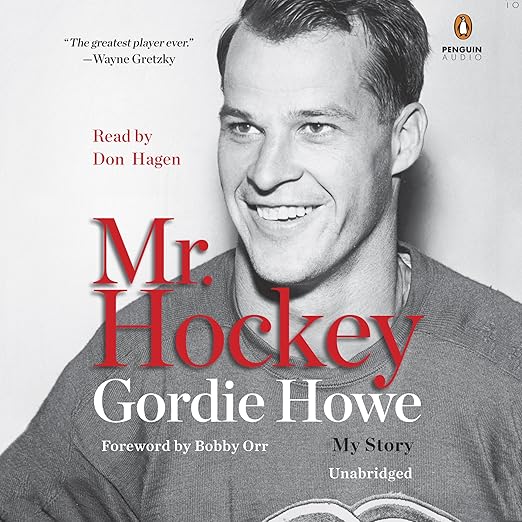
Quick Take
- Narration: Don Hagen brings a warmth and dignity to Howe’s first-person account that matches the man’s reputation, capturing both the ferocity the ice required and the decency that defined the life.
- Themes: Depression-era resilience, the integration of family into professional legacy, what greatness looks like over five decades
- Mood: Warm and reflective, with enough hockey specificity to satisfy fans and enough human story to reach readers who have never watched a game.
- Verdict: An autobiography that earns its subject’s legendary status not through boastfulness but through the accumulated weight of a life lived with remarkable consistency of character.
I grew up in a hockey household, which means I grew up knowing who Gordie Howe was the way you know certain things, through accumulated reference before you’ve read the primary sources. Four Stanley Cups. Five decades in the NHL. Playing professional hockey with both his sons. A foreword by Bobby Orr. The number 9 retired by the Detroit Red Wings. The “Gordie Howe hat trick,” which if you need it explained to you, you’ll want to listen to this book.
What I didn’t know was the texture of the life behind the statistics, and Mr. Hockey delivers that with a generosity and directness that feels characteristic of the man himself. Howe tells his story from the Depression-era Saskatchewan of his childhood through his Hall of Fame career and beyond, and the through line is not achievement but character: how a certain kind of person, formed by a certain kind of poverty and community, becomes the thing we eventually call a legend without the legend ever seeming to be the point.
Our Take on Mr. Hockey
The most consistent observation in the reviews is that this book is, at its core, a story about family. Howe’s marriage to Colleen, his relationship with his children, his sense of the Townsend family of the Detroit Red Wings organization as an extension of his own, these are the emotional centers of the autobiography, with the hockey serving as the arena where those values were tested and demonstrated. One reviewer draws a comparison to John Adams, which is a reach, but points at something real: great historical figures are interesting not just for their public achievements but for how their private lives illuminate what those achievements actually meant.
The Depression-era childhood sections are among the most vivid in the book. Howe writes about the Saskatchewan of his youth with a specificity that brings the era to life: the cold, the scarcity, the community’s instinct toward mutual support that he carries forward throughout his life. One reviewer who grew up watching Howe play at Detroit’s Olympia Stadium notes that reading the book revealed the person behind the athlete in ways that decades of watching the games hadn’t. This is the proper function of a sports autobiography: not to explain the statistics but to explain the person who produced them.
Why Listen to Mr. Hockey
Don Hagen’s narration is well-matched to this material. He delivers Howe’s voice with a kind of quiet authority that doesn’t oversell the legend while giving full weight to the moments that deserve it. The famous incident described by one reviewer, where Howe was targeted repeatedly all night before eventually making the other player pay for it in a fashion that was entirely legal and entirely conclusive, lands with the combination of humor and iron that the anecdote requires. Hagen understands that Howe’s reputation for both ferocity and decency requires a particular tonal balance, and he finds it.
At just under seven hours, this is a lean autobiography. Howe doesn’t overstay his welcome, which is a relief in a genre that often sprawls. The concision suits both the man’s character and the listener’s patience. You come away feeling that you’ve heard what needed to be said without the padding that pads out less confident memoirs.
What to Watch For in Mr. Hockey
One reviewer notes that Howe “rambles a bit in his recollections” and that the later playing days, particularly the time in the WHA playing alongside his sons Mark and Marty, receive less detailed treatment than the listener might want. This is fair. The book’s chronology feels slightly uneven in its attention, with the early career and the Red Wings years getting more space than the later chapters of the hockey story. Readers who want a deep account of the WHA period or the final return to the NHL will find the coverage briefer than they’d like.
The book was written with the collaboration of Scott Morrison, which is worth noting: the voice is consistently Howe’s in character and perspective, but the polished construction suggests a shaping hand. This is standard for athlete memoirs, and the result is more readable than a purely dictated autobiography typically is, but listeners should know they’re getting a crafted version of Howe’s story rather than pure unmediated recollection.
Who Should Listen to Mr. Hockey
Hockey fans who have not yet encountered this autobiography should consider it genuinely necessary. Multiple reviewers, including one who compared it favorably to both Derek Sanderson’s memoir and Bobby Orr’s account, describe this as the best of the three and well worth seeking out specifically. Non-sports readers who respond to biographies of people who built significant lives with integrity and who want the story of a Depression-era childhood and a decades-long marriage alongside the professional achievements will find more here than the sports packaging suggests. Those looking for a purely tactical account of hockey strategy or deep statistical analysis of Howe’s career should look elsewhere: this is the life, not the ledger.
Frequently Asked Questions
Do I need to be a hockey fan to appreciate Mr. Hockey?
No. Multiple reviewers describe the book as inspirational specifically because it transcends sports, with the Depression-era childhood, the marriage to Colleen, and the family relationships functioning as the emotional core. The hockey is the context, but the story is about a person.
How does Mr. Hockey compare to Bobby Orr’s autobiography and Derek Sanderson’s memoir as accounts of the same era?
One reviewer who read all three describes Sanderson’s book as hyperbolic but fun, Orr’s book as dull, and Mr. Hockey as a genuine delight. Howe’s balance of specific hockey memory, personal reflection, and the Depression-era context distinguishes it from both.
Does the book cover Gordie Howe’s time in the WHA and his return to the NHL at age 50 in sufficient depth?
Reviewers note that the later career, including the WHA years playing alongside his sons, receives less detailed treatment than the Red Wings years. The coverage is present but lighter than some fans would prefer. The WHA experience is described more in terms of its emotional significance, playing professionally with his sons, than in tactical or statistical detail.
Is Don Hagen’s narration appropriate for Howe’s first-person voice, given that Howe’s speaking style was known to be plainspoken and unpretentious?
Hagen matches the material well. His delivery has the combination of warmth and directness that suits Howe’s character, avoiding the theatrical quality that would feel wrong for a man whose public reputation was built on quiet competence rather than flamboyance.