Quick Take
- Narration: Lesley Manville is not just well-cast, she is the reason this audiobook works as well as it does. Her voice carries Susan Ryeland’s particular mix of intelligence and self-doubt with exactly the right register.
- Themes: Book-within-a-book mysteries, the editorial imagination, the weight of unresolved injustice
- Mood: Elegantly layered, with the texture of classic British crime and the architecture of a puzzle box
- Verdict: Horowitz builds on Magpie Murders without repeating it, delivering a mystery that rewards readers who love the genre’s formal pleasures as much as its narrative ones.
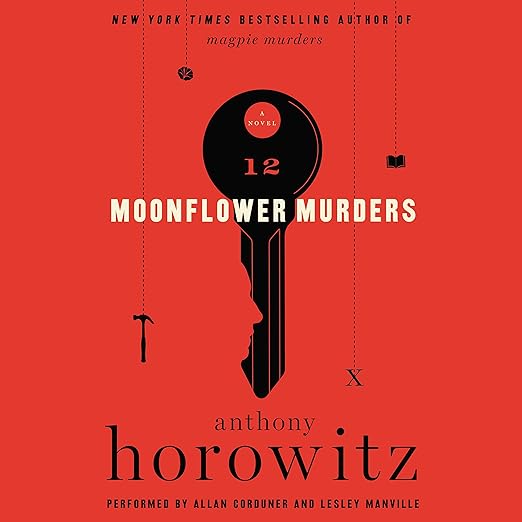
I spent a long weekend with Moonflower Murders, and there was a particular Tuesday evening when I genuinely could not determine where Susan Ryeland ended and Atticus Pund began, which is precisely the effect Anthony Horowitz is after. This is a book that takes the pleasures of the detective novel seriously enough to make its architecture part of the point.
The second installment in Horowitz’s Susan Ryeland series, narrated by Lesley Manville and published by Harper, runs eighteen hours and twenty-eight minutes. It picks up Susan in semi-retirement on a Greek island, co-running a hotel with her boyfriend Andreas, restless in the way that people who have spent their careers neck-deep in other people’s stories tend to become when the stories stop. She does not wait long for one to find her.
Our Take on Moonflower Murders
The premise layers with beautiful compression. A couple named the Trehearnes come to Susan’s island and tell her about a murder at Farlingaye Hall, a Suffolk inn, on the day of their daughter’s wedding eight years ago. A Romanian handyman was convicted. Their daughter Cecily read the third book in Alan Conway’s Atticus Pund series, a novel that Conway based on the very murder in question, and became convinced it proves the wrong man was jailed. Then Cecily goes missing.
Susan must return to England, read Conway’s novel, and figure out what he knew. This gives Horowitz license to embed a complete second mystery novel within the narrative, the Conway book, in full, and to ask readers to solve both simultaneously. One reviewer identified the Mary Westmacott reference embedded in the text almost immediately, and noticed the Hercule Poirot homage in the character of Atticus Pund. Horowitz is not hiding his influences; he is in conversation with them.
Why Listen to Moonflower Murders
Lesley Manville’s narration is the defining feature of this listening experience. She brings to Susan Ryeland what the character needs most: a voice that is clearly intelligent without being superior, slightly exhausted by her own editorial instincts, and capable of the kind of dry irony that English literary women of a certain professional class deploy so naturally it reads as warmth. When the embedded Conway novel takes over, Manville adjusts her register without making the shift feel like a disruption. It is a technically demanding performance over eighteen hours, and she delivers it consistently.
The book-within-a-book structure switches fully around the halfway point, where Horowitz gives you the entire Conway mystery before returning to Susan’s investigation. This is bolder than the Magpie Murders approach, which embedded the nested text earlier and more gradually. A reviewer noted this shift as distinctive and felt it worked. Others found the extended Atticus Pund section an interruption, it depends entirely on your patience with the formal experiment Horowitz is running.
What to Watch For in Moonflower Murders
One reviewer described the middle section as heavy on detail, a valid observation about the sustained exposition that comes with a dual mystery structure. Horowitz is playing fair with the reader, laying out evidence from both timelines in enough detail that the solution is technically accessible before the reveal. That thoroughness is a feature for readers who want to compete with the detective, and a drag for those who prefer to be swept along.
The resolution of the embedded mystery is somewhat tidy, as one reviewer noted. The logic holds, but the final explanation requires Susan to have assembled connections that, on reflection, feel slightly beyond what the evidence would have compelled. Horowitz is a craftsman and the resolution is satisfying in the moment; it just rewards less scrutiny than the elaborate setup might lead you to expect.
Who Should Listen to Moonflower Murders
This is for readers who loved Magpie Murders and wanted more of the same formal ambition rather than a more conventional follow-up, and for classic mystery fans who appreciate Agatha Christie’s tradition enough to enjoy a novel that is consciously in dialogue with it. Listeners new to the Susan Ryeland series should strongly consider starting with Magpie Murders, the character and the double-mystery format make more sense with that first book as context. Readers who prefer mysteries where the formal architecture serves the story invisibly rather than visibly will find Horowitz too self-aware. For the right reader, though, this is an exceptionally pleasurable eighteen hours.
Frequently Asked Questions
Do you need to read Magpie Murders before Moonflower Murders?
You can technically follow the plot without it, but the character of Susan Ryeland, the Atticus Pund novels, and the book’s formal pleasures make much more sense with the first installment as context. It is strongly recommended that you start there.
How does Lesley Manville handle the shift between Susan Ryeland’s sections and the embedded Conway mystery?
She adjusts her register clearly and purposefully when the embedded Atticus Pund mystery takes over, making the transition audible without making it feel jarring. It is a technically demanding performance and she handles it consistently across the full eighteen hours.
Is the book-within-a-book structure the same as in Magpie Murders?
Similar in concept but different in execution. In Moonflower Murders, the embedded Conway novel takes over completely around the halfway point, a bolder structural choice than the more gradual integration in the first book. Whether this works for you will depend on your patience with the formal experiment.
Is there enough plot momentum to carry eighteen hours, or does it drag in places?
The middle sections are dense with detail, as Horowitz lays out evidence from both timelines methodically. One reviewer flagged this as occasionally heavy going. The pace tightens decisively in the final third, and the dual resolution is satisfying even if some of the logical leaps require generosity from the reader.