Quick Take
- Narration: Juli Brooks reads with an approachable, encouraging energy that suits the teenage audience without being condescending, the tone is closer to knowledgeable older sibling than to classroom instructor.
- Themes: Personal finance fundamentals, credit literacy, building long-term financial habits
- Mood: Practical, encouraging, clear-eyed about real-world financial stakes
- Verdict: One of the most accessible introductions to personal finance for teenagers available in audio format, with practical scope that outpaces most school curricula on the subject.
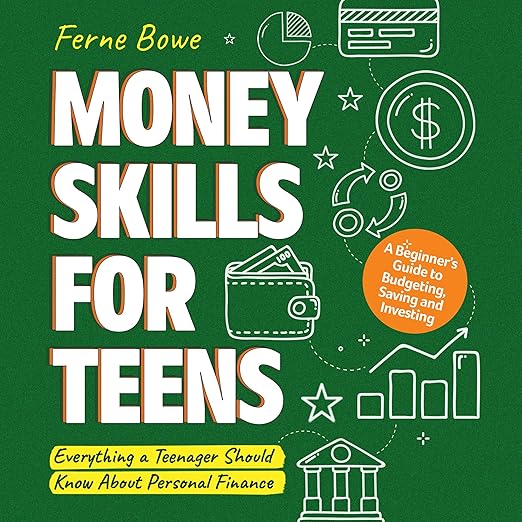
I have a clear memory of the moment I first understood what compound interest actually meant, not as a definition but as a mechanism with consequences for my own life. I was in my mid-twenties. That is not when you want to have that realization. I thought about this while listening to Ferne Bowe’s Money Skills for Teens, which covers compound interest, credit scores, payroll taxes, and investing basics within a format that a fourteen-year-old can actually get through and absorb. The appeal is obvious. The question is whether it delivers.
Bowe is the author of Life Skills for Young Adults and Life Skills for Tweens, books in the same series targeting financial and practical competence for young people. This entry focuses on money specifically, covering a range that the synopsis lists as forty-plus skills, from opening a first bank account to reading a bank statement, maintaining a credit score, avoiding fraud and scams, understanding spending personality types, and developing a long-term approach to investing. That is an ambitious scope for a three-hour audiobook, and the question of depth versus breadth is the central tension.
The Gap This Fills in Most Teenagers’ Education
Financial literacy is one of those subjects that most school systems handle inadequately, unevenly, or not at all. A teenager who finishes this audiobook will know more about how credit scores are calculated, how compound interest works against them on debt and for them on savings, and how to think about their first paycheck than most adults understood at the same age. One parent reviewer described getting a debit account for her daughter and finding this book gave the daughter the foundational context to use it intelligently. Another parent used it as homeschool curriculum with a specific money-and-career focus for the year.
That dual audience, teenagers listening themselves, and parents presenting it to teenagers, shapes how the audiobook is structured. Bowe writes in direct address to the teen, using real-life examples and what the synopsis calls “easy-to-understand language.” The result reads more like a conversation than a textbook, which matters enormously for retention in audio format. You cannot go back and underline a sentence in an audiobook. If the explanations are clear on first pass, they stick. Bowe’s explanations largely are.
What Juli Brooks Brings to the Format
Juli Brooks’s narration is probably the most important single factor in whether this audiobook reaches its intended audience. Financial content delivered in a dry, flat voice will lose teenage listeners within twenty minutes. Brooks reads with an energy that is engaged without being artificially cheerful, she sounds like someone who finds this material genuinely useful rather than someone performing enthusiasm about taxes. For a three-hour instructional audiobook aimed at an age group not always celebrated for its patience with nonfiction, that vocal quality is doing real work.
One reviewer who wished she had access to this content “many years ago” noted that the material is appropriate for grandchildren as well, suggesting the book has practical reach beyond its stated target audience. The coverage of spending personality types, identifying your relationship to money and the impulses that shape your purchases, is the kind of psychological framing that adults benefit from as much as teenagers.
Scope and Honest Limitations
Three hours is not long. Bowe covers significant ground, but each topic gets enough space for orientation rather than mastery. A teenager who finishes this will know what a credit score is, why it matters, and what the major factors are. They will not be a credit optimization expert. The same applies across topics: the investing section covers basic principles rather than specific instruments or strategies. This is a foundation, not a complete financial education.
That limitation is precisely stated in the book’s framing, it is a beginner’s guide, positioned to give teenagers a solid foundation rather than comprehensive expertise. Given that most teenagers enter adulthood with no financial foundation whatsoever, the scope is appropriate. The goal is to ensure that a sixteen-year-old understands why saving matters, what credit actually costs, and why they should care about a bank statement. On those terms, it succeeds.
Available as a free audiobook on Audible, Money Skills for Teens is practical enough to recommend as a gift without qualification, to teenagers, to parents looking for a starting point, and honestly to any adult who realizes in listening that some of this material is newer to them than it should be.
Frequently Asked Questions
Is Money Skills for Teens suitable for listening independently by teenagers, or is it designed to be used with parental involvement?
Both. The book addresses teenagers directly and is structured for independent listening. Several reviewers also used it as a parent-child or homeschool resource, listening together and using it as a conversation starter about specific financial topics.
Does the book address investing in any practical depth, or is the coverage too basic to be useful?
The investing coverage is introductory, it establishes principles like compound growth, the concept of risk tolerance, and long-term thinking, but does not cover specific instruments, platforms, or tax-advantaged accounts in detail. It is enough to create an orientation and motivate further learning.
How does Juli Brooks’s narration work for teenage listeners specifically, does it avoid the condescending or lecture-hall tone that some instructional audiobooks default to?
Yes. Multiple parent reviewers noted that the tone is clear and accessible without being either childish or dry. Brooks reads with the engagement of someone making a case for why this material matters, which suits the teenage audience better than a flat informational delivery would.
At three hours, is this long enough to be genuinely useful, or does the short runtime mean important topics get shortchanged?
The runtime is short but used efficiently. Each topic gets enough coverage for practical orientation rather than deep expertise, which is appropriate for a foundation-level guide. Think of it as a strong introduction that motivates the next level of learning rather than a complete financial curriculum.