Quick Take
- Narration: Victor Bevine brings quiet authority to Hiram’s white teenage perspective, keeping the narrative honest without over-dramatizing the horror at its center.
- Themes: Moral awakening, racial violence and complicity, generational conflict over justice
- Mood: Sober, historically anchored, and morally demanding for a YA audience
- Verdict: A rigorously honest fictional account of the Emmett Till murder that earns its place alongside the best historical YA fiction , Victor Bevine’s narration gives it the gravity the story requires.
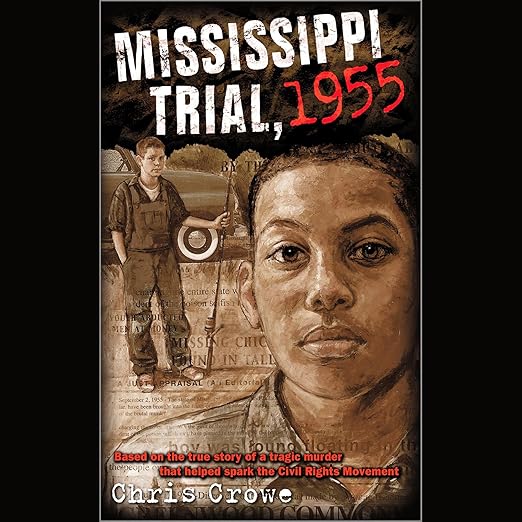
I first encountered Mississippi Trial, 1955 through a curriculum recommendation list, and I revisited it recently in audiobook form to understand what Victor Bevine’s narration adds to a novel I had only read in print. The answer is: quite a lot. The book’s power is partly textual , Chris Crowe’s writing is careful and honest in ways that matter , but Bevine’s voice gives Hiram Hillburn’s perspective a quality of moral uncertainty that the page alone is slightly less able to convey.
Hiram is a white teenager who arrives in Mississippi for a summer visit with his grandfather. He is also the point of view through which Chris Crowe asks young readers to watch one of the most infamous crimes of the twentieth century unfold. Emmett Till, a fourteen-year-old Black teenager from Chicago visiting the South for the summer, is murdered by white men after allegedly whistling at a white woman. His killers are acquitted. The novel does not spare its young readers the weight of that outcome, and that refusal to cushion is part of what gives it its force.
Our Take on Mississippi Trial, 1955
The choice to tell this story through a white protagonist is a deliberate and consequential one. Crowe is asking his readers to inhabit the perspective of someone who is not a target of the racism he witnesses, which is more uncomfortable and more honest than a perspective that would allow the reader to identify with the victim. Hiram is complicit in the social systems he is surrounded by in ways he does not initially recognize, and his moral awakening is painful precisely because it involves confronting what his grandfather represents as well as what the killers do.
The novel won the 2003 International Reading Association Award for Young Adult Novel, and the recognition is deserved. Crowe handles the tension between historical fidelity and narrative accessibility , the challenge of making a documented atrocity legible to a young audience without sanitizing it , with real skill. One teacher reviewer noted she might actually prefer it to To Kill a Mockingbird for certain readers, which is significant praise given that book’s canonical status in the classroom.
Why Listen to Mississippi Trial, 1955
Victor Bevine’s narration is measured and grave in the way the material demands. He does not use Hiram’s youth as an excuse for emotional lightness , the voice carries the weight of what Hiram is being forced to understand, which is that the world his grandfather represents is monstrous and that he has been living inside it without seeing it clearly. The performance is restrained in a way that amplifies rather than diminishes the horror at the story’s center.
At just over six hours, the audiobook is a manageable classroom or family listen. The historical detail is specific and accurate enough to function as a genuine introduction to the Emmett Till case and its context within the Civil Rights Movement. Several reviewers noted that the novel situates Till’s murder within a broader history , Rosa Parks, Montgomery, the March on Washington , in ways that give young readers the scaffolding to understand why this particular crime had the historical significance it did.
What to Watch For in Mississippi Trial, 1955
The use of historical fiction to approach real events always carries some risk of distortion, and Crowe is aware of this. One reviewer described the approach as playing with fire but noted that Crowe pulls it off in a credible fashion, particularly in the generational dynamics between Hiram, his father, and his grandfather. The relationships feel observed rather than schematic.
The book also frames its moral questions through Hiram’s perspective in a way that necessarily centers white experience in a story about Black suffering. That is a genuine limitation as well as a deliberate choice, and some readers will find it more problematic than others. Crowe does not romanticize Hiram’s awakening or suggest that his eventual clarity constitutes a resolution of anything larger than his own moral confusion.
Who Should Listen to Mississippi Trial, 1955
Essential for middle school and high school classrooms engaging with the Civil Rights Movement, and equally powerful for adult readers who want a compact, emotionally honest fictional approach to the Emmett Till case. The combination of historical fidelity and narrative accessibility makes it effective where more documentary approaches might overwhelm younger readers.
Adult listeners who prefer primary sources, documentary accounts, or unmediated historical engagement may find the YA framing limiting. But for its intended audience, the novel does exactly what historical fiction is supposed to do , it makes the past feel urgent and its consequences feel personal.
Frequently Asked Questions
Is Mississippi Trial, 1955 appropriate for younger teen readers given the subject matter?
It is written for middle school and high school audiences and is regularly used in classrooms. The subject matter is serious and the violence is not sanitized, but Crowe handles the content with care appropriate to a YA audience. Most teachers use it with students around 12 and up.
How accurate is the historical detail in the novel , is this a reliable introduction to the Emmett Till case?
Crowe has studied the Emmett Till case extensively, and the historical framework is accurate even as the protagonist Hiram is fictional. One reviewer who used the book in a classroom described it as an effective way to introduce the case to students who struggled with more complex historical texts.
Why did Chris Crowe choose to tell this story through a white protagonist rather than through Emmett Till’s perspective?
Crowe has discussed this in interviews , the white perspective allows readers who share that background to understand what it means to be complicit in or adjacent to racist systems without being their direct target. It is a more uncomfortable positioning for many readers and arguably a more honest one.
Does Victor Bevine’s narration work for this kind of historically grounded YA fiction?
Yes. His delivery is measured and appropriately grave without being performatively solemn. The restrained quality of his narration serves the material , it does not over-dramatize events that are already horrifying on their own terms.