Quick Take
- Narration: Bronson Pinchot is a natural fit for Rick Reilly’s wisecracking, working-class Boston voice – he brings the banter and the sentimentality in equal measure without overselling either.
- Themes: class resentment and aspiration, friendship under pressure, father-son estrangement
- Mood: Funny and unexpectedly tender, like a good sports bar story that ends with someone crying
- Verdict: Even non-golfers will find something to love here – Reilly uses the golf course as a canvas for a story that is really about fathers, class, and what we owe the people we grew up with.
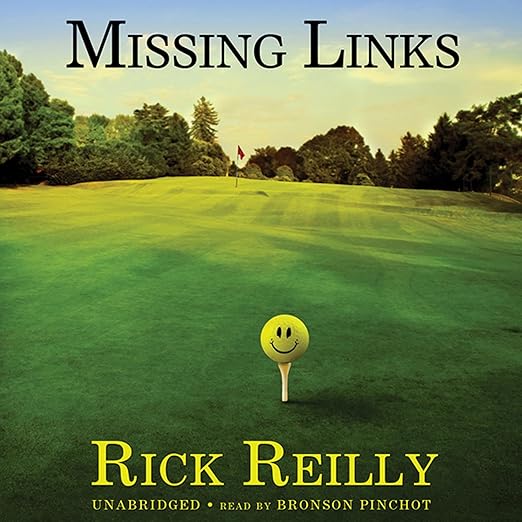
I played exactly one round of golf in my life, badly, on a course far less distinguished than Ponkaquogue Municipal Golf Links and Deli, which is at least honest about what it is. I went into Missing Links expecting to feel like an outsider, and instead I found myself listening past my stop on the Metro and finishing the rest on foot. Bronson Pinchot’s delivery of Rick Reilly’s Boston wiseguy narrator has a lot to do with that.
This is a book that announces itself as a spoof of country-club golf culture, and it delivers on that promise. But the spoof is the surface. Underneath it is a genuinely felt story about four working-class friends who have found something worth defending in the worst golf course in America, and what happens when one of them sees over the fence.
Our Take on Missing Links
The setup is irresistible. Ponkaquogue Municipal Golf Links and Deli, universally known as Ponky, sits next door to the Mayflower Club, a golfing Eden of the sort that its neighbors have been trained to resent on sight. The bet that animates the plot – who will be first to sneak in a round at the Mayflower – is a perfectly constructed premise because it contains two stories in one: the comic caper story and the class-aspiration story, and Reilly keeps them running together without letting either one dominate until the end.
The narrator’s relationship with his overbearing father is the emotional spine of the book, and Reilly handles it with more care than you might expect from a sportswriter working in his first novel. Several reviewers make the point that this is a book about love and loss, fathers and sons, struggle and triumph, as much as it is about golf, and that framing is accurate. The golf is the idiom; the relationships are the subject.
Why Listen to Missing Links
Bronson Pinchot was a smart choice for this material. He has a natural ear for comic timing and a gift for working-class Boston cadences that gives the protagonist’s voice real texture. The ensemble of Ponky regulars he voices is distinctive enough that you can track each character by ear without difficulty, which is not a given in ensemble audiobooks. One reviewer who described herself as someone who does not particularly love fiction noted that she found herself unable to put the book down, which suggests Reilly’s plotting does the work even when the form is unfamiliar.
At eight hours, this is a well-paced listen. The chapters are tight and the momentum builds steadily from the initial bet through the complications and eventually to a third act that earns its emotional weight. Reilly’s ESPN and Sports Illustrated background gives him a genuine gift for economy – he knows when to cut and when to let a scene breathe, and it shows.
What to Watch For in Missing Links
Readers expecting nothing but satirical comedy may be caught off guard by how earnest the book becomes in its final third. The father-son strand, which runs quietly through the first half as a background complication, moves to the foreground in a way that some listeners may find unexpected given the tone set by the Ponky sections. This is not a criticism – most reviewers consider it the book’s strongest quality – but it is worth knowing going in that Missing Links earns its sentiment rather than announcing it upfront.
The book is also very specifically of its period. The country-club class tensions of the 1990s, the particular register of Boston working-class culture it captures, the Sports Illustrated sensibility of its prose – these date it in ways that are charming rather than limiting, but listeners expecting a contemporary voice may notice the period feel.
Who Should Listen to Missing Links
Golf fans will get an extra layer of pleasure from the course details and the industry references, but this is genuinely accessible to anyone who has ever felt excluded from a place that looked like it might be worth belonging to. Listeners who enjoy early Carl Hiaasen or the funnier novels of Chris Moore – books that operate as comedies while concealing something more tender underneath – will find this satisfying. Those who require literary complexity or unconventional structure should look elsewhere. This is a page-turner in the oldest, best sense.
Frequently Asked Questions
Do I need to play golf or follow the sport to enjoy Missing Links?
No. Multiple reviewers specifically note that they came with minimal golf knowledge and found the book entirely accessible. Reilly explains enough to make the course details land, and the real subjects of the book – class, friendship, family – need no specialist knowledge.
How does Bronson Pinchot handle the Boston working-class ensemble of characters?
Very well. He has real range for the comic characters and finds distinct voices for the Ponky regulars without resorting to caricature. His timing for Reilly’s rapid-fire dialogue is particularly strong. Listeners familiar with Pinchot’s other narration work will recognize his gift for ensemble comedy.
Is this the first book in a series, and does the ending work as a standalone?
Missing Links is listed as book one in a series, but the audiobook functions as a complete, self-contained story. The main narrative arcs – the bet, the father-son relationship, the Ponky community – all reach resolution. You do not need to commit to a series to get a satisfying experience here.
How does the humor hold up for listeners who have read a lot of sports comedy fiction?
Reilly’s wit is specific enough to feel earned rather than generic. The jokes come from character and situation rather than setup-punchline mechanics, and the Ponky regulars are drawn with enough individuality that the comedy builds across the book. Longtime Reilly readers from his magazine work will find the transition to longer form smooth.